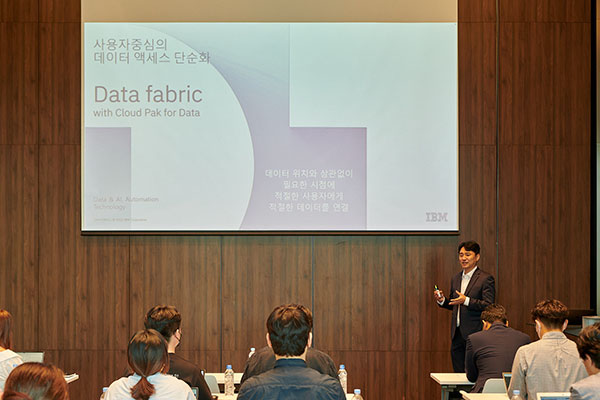
▲Choi Seok-jae, Head of Data & AI Technology Sales at IBM Korea, making a presentation
New data management plan introduced at the 15-day meeting
'Data Fabric' Virtualization and Cataloging Complexity Relief
Provides benefits of self-service, enhanced security, and task automation
Data has become the key to business competitiveness. Companies are creating new value through data-based insights, but efficient management and utilization of such large-scale data is not easy.
In the midst of this, experts have suggested that 'data fabric' can be used to manage a large amount of scattered data and provide desired data at the right time.
IBM held a media conference on the 15th and introduced data management methods through AI-based 'Data Fabric' that can be utilized in various IT environments and examples of adoption by domestic companies.
Kim Chang-hoe, head of sales for IBM Korea's Data & AI business division, said, "Making good use of data has become the key to corporate competitiveness."
In his presentation, Choi Seok-jae, head of IBM Korea Data & AI technology sales, claimed that data fabric can efficiently manage massive amounts of data through virtualization and cataloging.
Data analysis is a chronic problem that takes up more than 80% of the time and effort of development. Additionally, according to IBM research, high data complexity, along with a lack of experts and development tools and price issues, are challenges in adopting AI.
CEO Choi suggested 'data fabric' as a new approach to solve this problem. 'Data fabric' was also mentioned as one of the top strategic technology trends for 2022 selected by Gartner.
'Data fabric' is a concept that connects the right data to the right user at the right time, regardless of the data location, i.e., it is a technology that gets the desired data as quickly as possible.
The core concepts of data fabric are virtualization and cataloging. Through 'virtualization', users can access and view data in their personal environment without having to access scattered real-time data one by one. At this time, through 'catalog', data location and properties can be identified and only the necessary data can be retrieved.
Data fabric enables the following: △ Expanded self-service and collaboration on data △ Automate governance data protection and security through metadata △ Automated data engineering tasks and enhanced data integration.
CEO Choi cited domestic examples applied to Samsung Electronics, Hyundai Marine & Fire Insurance, and Subone. Samsung Electronics standardized internal corporate data as data assets and established a data-based decision-making system.
Finally, CEO Choi said, "Data fabric can be used for various purposes, such as finding assets for analysis and management indicators, and in Korea, it is expanding to the industrial and telecommunications industries, centering on the financial sector."
Meanwhile, data fabric has a difference from existing data meshes in that it includes layers that can be understood at a glance from a management perspective.
“In addition to hybrid cloud data leadership, management leadership is also important, and IBM’s solutions are expected to provide a good environment primarily for enterprise companies where IBM has a high level of understanding,” said Kim.