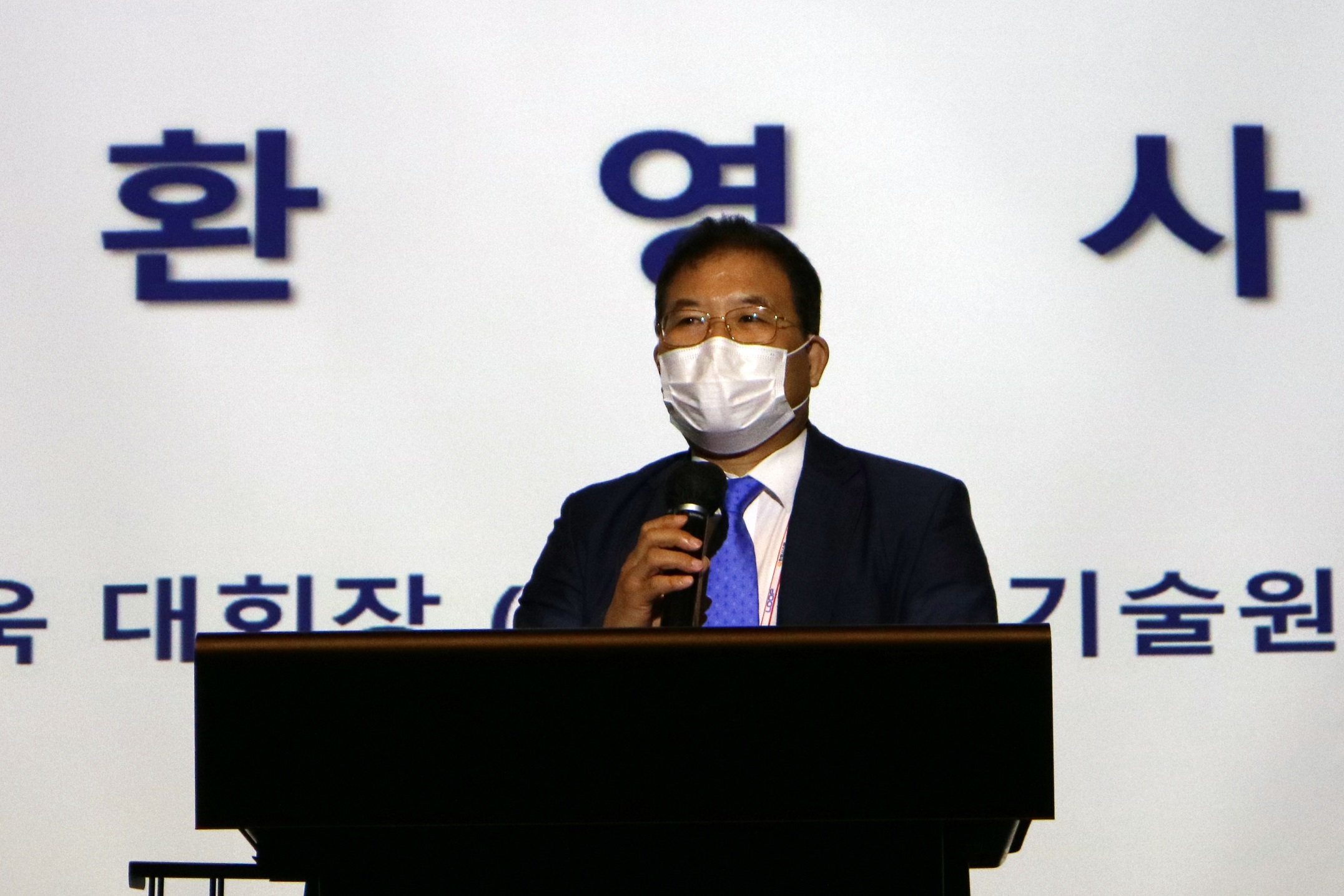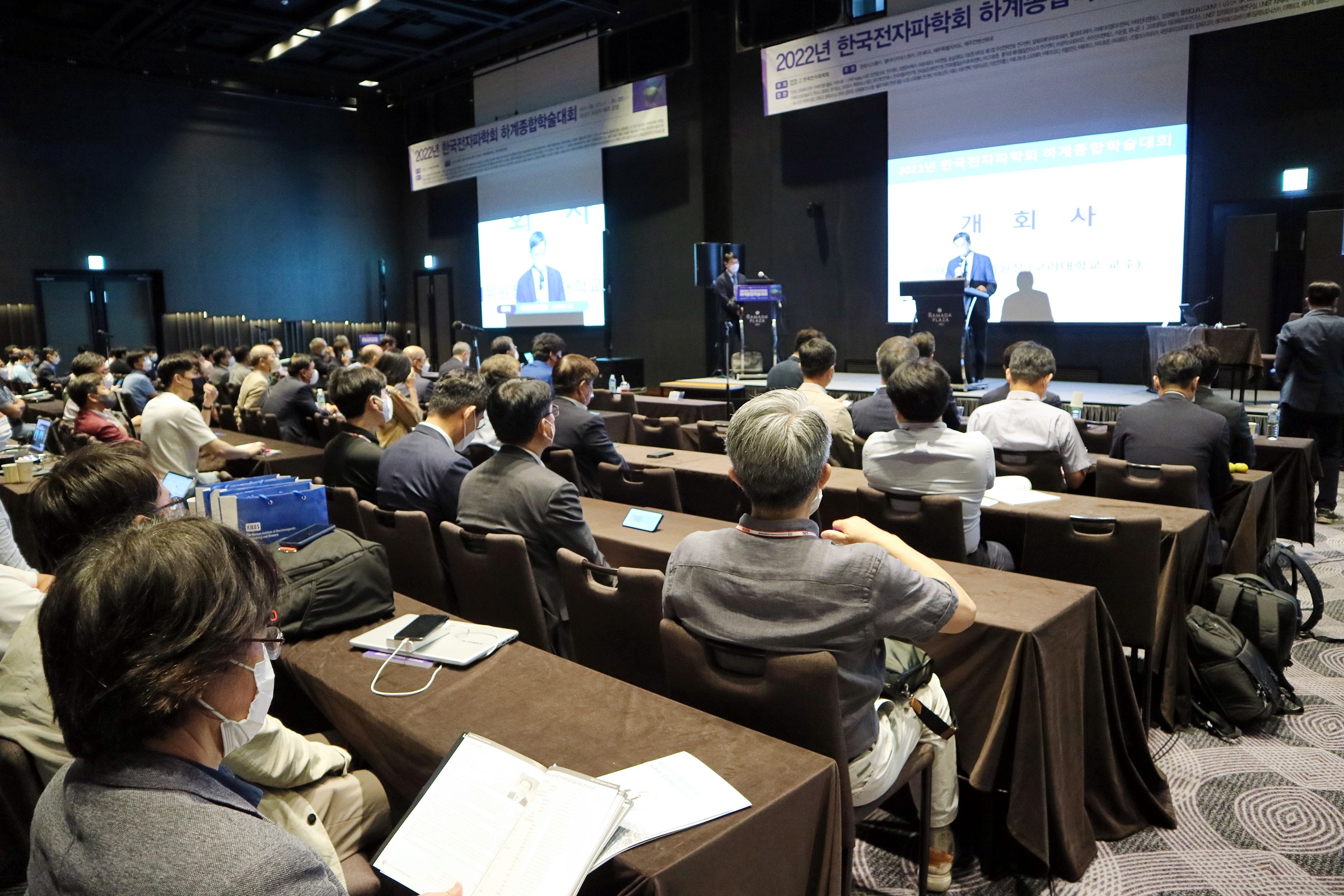
▲2022 Korea Electromagnetic Engineering Society Summer Academic Conference Opening Ceremony
A venue for academic presentations packed with over 830 papers and over 100 sessions
6G Space Communication Era Radio Satellite Importance↑, New Planning Projects in Radio Field Are Necessary
Hanwha Systems and LIG “Recruiting Talent”, Wayvis and Sensorview “Reveal RF Solutions”
The field of electromagnetic waves is expanding to various application and convergence fields such as communications and satellites, electric vehicles, autonomous driving, space and aviation, national defense, medicine, and AI, and is an academic discipline that serves as the foundation for next-generation core source technologies. The Korean Institute of Electromagnetic Engineering and Science, which leads related agendas, recently held a summer comprehensive academic conference and successfully established a venue for academic exchange encompassing industry, academia, and research.
On the 17th, the Korean Institute of Electromagnetic Engineering and Science Summer Conference, which celebrated its 10th anniversary this year, was held at the Ramada Plaza Hotel in Jeju Island. This event, held both online and offline, was attended by approximately 1,800 people from academia, industry, and research, and provided a time to share valuable academic achievements.
△EMI·EMC △Space·Satellite·Aviation △5G·6G·Radiocommunications △Defense △Autonomous driving·Electric vehicles, etc. Over 830 papers were submitted, and 83 group sessions were prepared for each paper to share diverse academic presentations. In addition, two special sessions, six poster sessions, and 10 workshops were held, and the grand academic conference, which included five keynote speeches and 13 keynote speeches by renowned domestic speakers, concluded on the 20th.
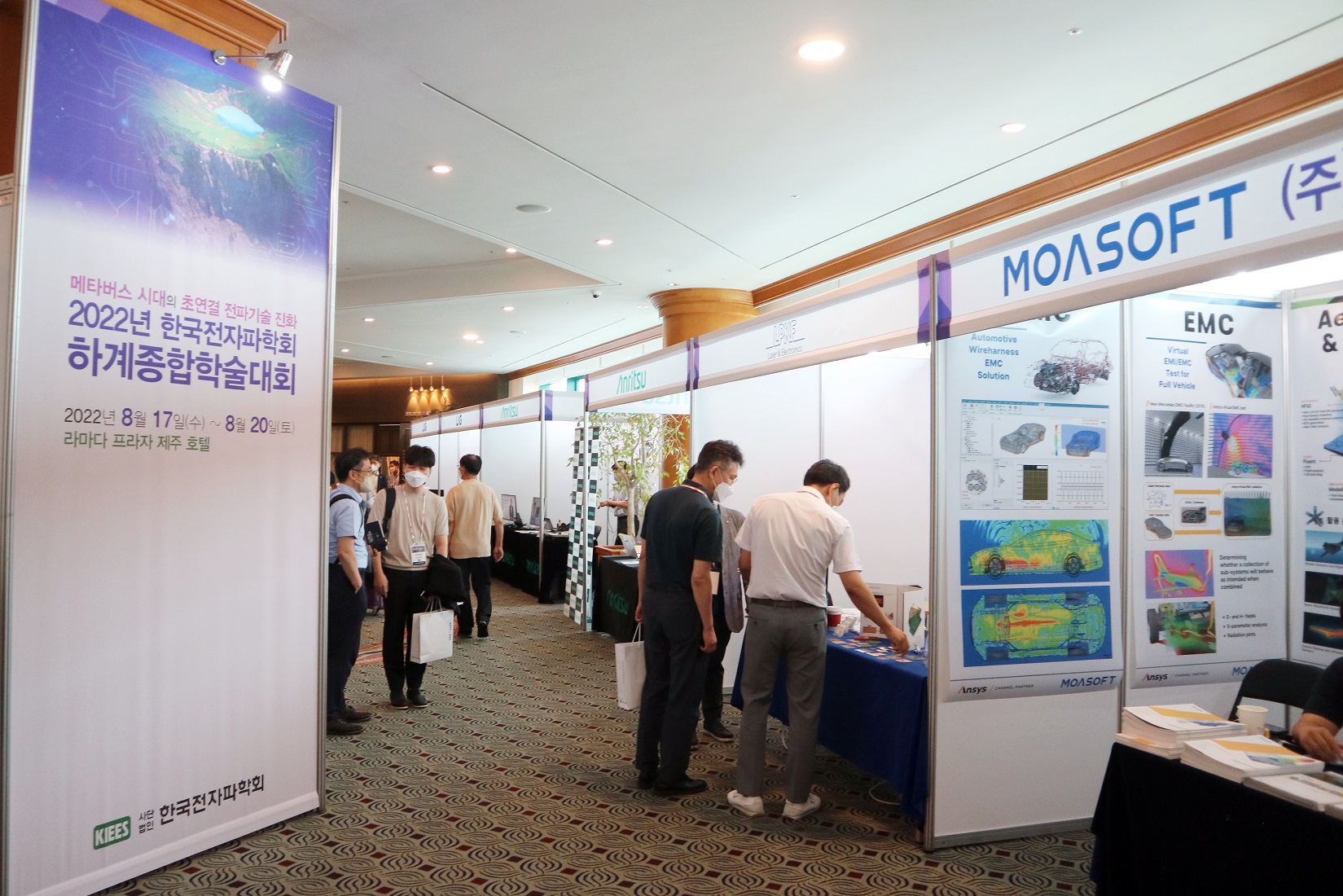
This event, in which around 70 companies participated, was held in conjunction with an industrial exhibition with 40 booths. Various companies, including Hanwha Systems, LIG Nex1, Loop, Anritsu Corporation, Sensor View, KMW, and Wayvis, participated and presented their own technical solutions.

▲Park Seong-wook, President of the Korean Institute of Electromagnetic Engineering and Science (Professor at Korea Advanced Institute of Science and Technology)
In his welcoming speech, Park Sung-wook, the president of the Korean Institute of Electromagnetic Engineering and Science, expressed his feelings, saying, “The Korean Institute of Electromagnetic Engineering and Science, founded in 1989, is celebrating its 33rd anniversary this year, and its cumulative membership has surpassed 12,000.” Chairman Park Sung-wook said, “I hope that this academic conference, consisting of various sessions, will become an educational opportunity to share a lot of knowledge and experience with the youth of our country.”
Minister of Science and ICT Lee Jong-ho said in a video message, “As non-face-to-face wireless services are spreading throughout the socio-economy, the importance of radio resources is being highlighted.” He added, “In order for our country to stay ahead in the communications technology competition with major powers, we will not spare investment in advanced research and development of next-generation original technologies, and we will push to expand the establishment of a radio playground region where future new industry products can be freely experimented with.”
■ Keynote speech, the importance of radio satellites in the 6G space communications era↑ 
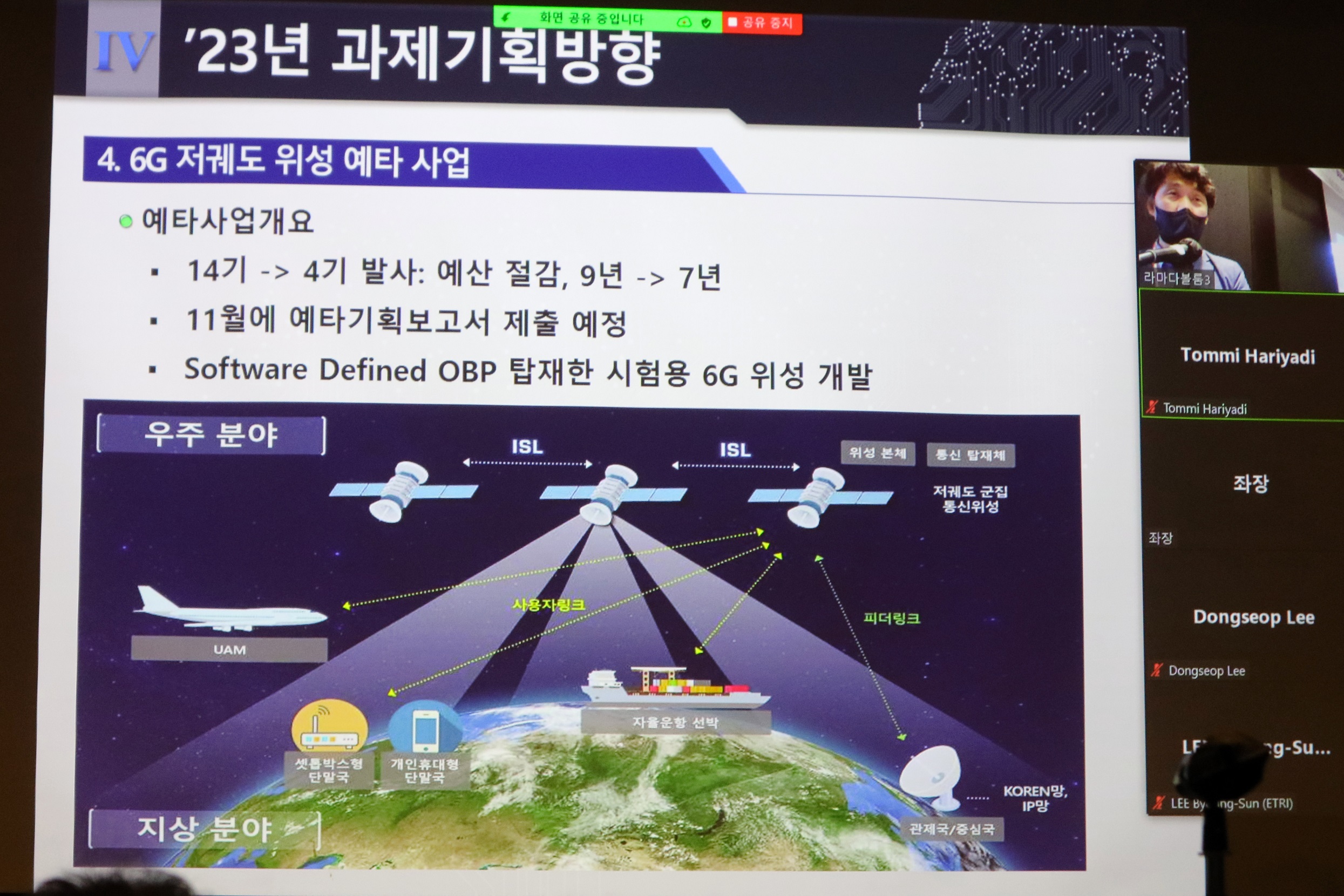
▲PM Woojin Byun of the Information and Communications Technology Planning and Evaluation Institute is giving a keynote speech. The 6G low-orbit satellite feasibility study project is scheduled for 2023.
The three-day keynote speech prepared by the Electromagnetic Engineering Society included keywords such as defense space, radio satellites, 6G, and low-orbit satellites, and included attempts to expand the communications field into space.
On the first day, Lee Beom-seok, director of the Space Technology Center at the Agency for Defense Development, opened the keynote speech. He gave a lecture on the direction of development of defense space technology and said, “Overseas communication satellites are geostationary satellites, so they have high latency and limited capacity, making it difficult to immediately link them with weapon systems.”
With private sector-led low-orbit satellites such as SpaceX’s Starlink, Amazon’s Kuiper, and OneWeb’s OneWeb leading the way in the market, Center Director Lee Beom-seok suggested, “Domestic companies and organizations should consider two aspects at the same time: utilizing these global services and developing related technologies domestically to expand the base.”
In the science and technology sector, R&D investment has been growing by an average of 10% per year, and in particular, the radio satellite sector has seen an average investment growth of 28% per year. Byun Woo-jin, PM of the National IT Industry Promotion Agency, emphasized, “While R&D investment in the radio satellite sector is increasing in the radio sensing and radio medical sectors, the broadcasting satellite sector had the lowest demand survey, and with 42 billion won worth of projects to be completed in the future, it is necessary to discover new related items.”
Since the terminated projects are not necessarily allocated to the radio sector, new planning projects are needed for 2024. Accordingly, PM Byun suggested the following candidate technologies: △Electromagnetic wave human body effects △Securing core technologies for precision positioning based on integrated broadcasting networks, satellite networks, and mobile communication networks △Various services integrating communications and sensing. In particular, it is known that there is currently no precision positioning technology being developed domestically.
The biggest project scheduled for 2023 is the 6G low-orbit satellite feasibility study. It is expected that four low-orbit constellation communication satellites will be launched to develop a test 6G satellite, which will be used for services such as UAM, autonomous ships, and smartphones.
■ Industrial Exhibition View: Hanwha Systems and LIG “Recruiting Talent”, Sensor View and Wayvis “Revealing RF Solutions” 
▲Korea Electromagnetic Engineering Society Summer Academic Conference Industry Exhibition
On this day, 33 companies participated in the industrial exhibition with approximately 40 booths, showcasing solutions in defense/space, RF, EMI/EMC, measurement/inspection, and testing/certification.
Hanwha Systems and LIG Nex1, which are also sponsors of the Electromagnetic Society conference, have been working hard to attract promising talent. Both companies have set up booths for talent recruitment consultations and provided employment consultations to related master's and doctoral candidates, and have created a space for discussions about company introductions and job descriptions.
The exhibition featured a variety of companies with RF solutions showing off their portfolios. Among these, Sensorview, a company that develops and manufactures high-performance antennas and ultra-low-loss cables based on millimeter wave bands such as 5G, is seeking to expand its business in the antenna and RF cable sectors by providing solutions such as △5G infrastructure solutions △5G wireless devices △RF·5G T&M.
“SensorView’s vision is to maximize the RF performance desired by our customers,” said Yoon Seong-hwan, managing director of SensorView. “We will become a company that provides solutions beyond 5G to 6G.”
At another booth, Waybis, a small IDM capable of developing and manufacturing GaN RF semiconductors, was showing off its next-generation RF component portfolio.
Lee Sang-min, head of the Waybis Foundry Business Division Research Center, explained, “Waybis possesses a 0.3 to 0.4 μm (micrometer) foundry, and 0.4 μm devices can be applied in the 4G and 5G low frequency range called S-band and are currently used in military weapon systems such as radar.” He added, “0.3 μm devices can cover the frequency range of 4 to 8 GHz (gigahertz) in the C-band.”
Waybis, which boasts of being the only company in Korea with GaN RF device design and foundry solutions, said it currently has a production capacity of up to 3,000 wafers and plans to open a foundry for 0.2㎛ and 0.1㎛ device production within the next two years.