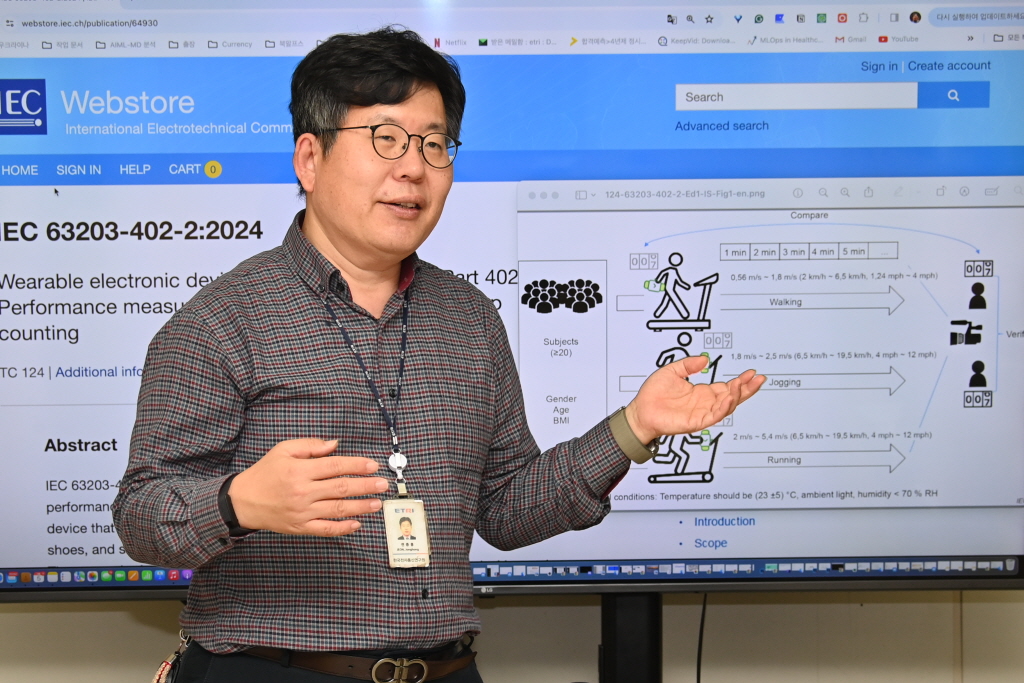
▲ETRI Research Director Jeon Jong-hong explains the step count measurement accuracy test method of the newly established international standard
Establishment of two essential performance test standards for wearable devices for health management
Establishment of a new group for standardization of next-generation wearable applications such as sleep assessment
A domestic research team has established a core international standard for testing the accuracy of step counts and heart rate, which are essential functions for health management in wearable devices, thereby creating an international common standard for evaluating measurement accuracy in wearable devices.
The Electronics and Telecommunications Research Institute (ETRI) announced on the 7th that two international standards regarding ‘performance testing of wearable devices for health management’ were finally established last month.
The establishment of quality criteria and improvement in measurement accuracy through this newly established international standard is expected to be of great help in promoting national health as well as revitalizing related equipment and service industries.
The international standards established this time are the 'Test method for accuracy of step count measurement' and 'Test method for accuracy of heart rate measurement' of the International Electrotechnical Commission (IEC).
Contains methods and procedures for testing the measurement accuracy of wearable devices that provide step counting and heart rate measurement functions.
The research team produces more than 500 million smart bands, watches, rings, etc. for health management purposes annually.The reason for establishing this international standard was that although wearable devices are being sold, there is no standardized test method for the accuracy of measuring basic exercise volumes such as the number of steps and heart rate, making objective comparative evaluation of performance and accuracy impossible.
ETRI announced that it has started developing standards for testing the accuracy of step counting and heart rate measurement together with major domestic companies, and that it has achieved results in establishing the standard after six years of research starting in 2019 and proposing an international standard.
As international standards for this technology are established, ETRI will be able to set and demand performance criteria for wearable devices for healthcare, and manufacturers will be able to officially present performance verification results tested according to international standard test methods.
It is expected that this will lead to the expansion of the global wearable industry and the related testing, evaluation, and certification market becoming more active.
ETRI has proposed the formation of a new working group (ahG7) to discover and standardize new international standardization issues, such as sleep monitoring and sleep disease diagnosis applications, wearable applications combining artificial intelligence technology, and wearable EEG applications. ETRI's Senior Researcher Jong-Hong Jeon is currently serving as the chairperson.
ETRI Standards Research Division Director Lee Seung-yoon said, “It is very significant that our country has established two core standards for performance testing of core healthcare functions applicable to all wearable devices.”
Professor Jae-Young Park of Kwangwoon University also said, “The largest application area for wearable devices is healthcare, so we will further strengthen international standard development and cooperation to lead the international standards for healthcare wearables centered on Wearable Electrical Devices and Technologies (TC 124).”
Based on these achievements, ETRI is establishing international standards in new healthcare fields such as wearable device sleep monitoring and diagnostic applications through domestic industry-academia-research-hospital cooperation.He explained that he plans to continue cooperating with the families.
ETRI said that this standard establishment is the result of the National Standards Technology Improvement Project of the National Institute of Standards and Technology and the standard development support of the inter-ministerial full-cycle medical device development project.
He also said that the results of this standard development were achieved through collaboration between ETRI Research Director Jeon Jong-hong and KAIST Professor Lee Jeong-cheol.