반도체 AI 인더스트리 4.0 SDV 스마트 IoT 컴퓨터 통신 특수 가스 소재 및 장비 e4ds plus

Materials Research Team Creates Electronic Devices Using Hybrid Bio-Nanostructures

기사입력2024.06.10 10:12


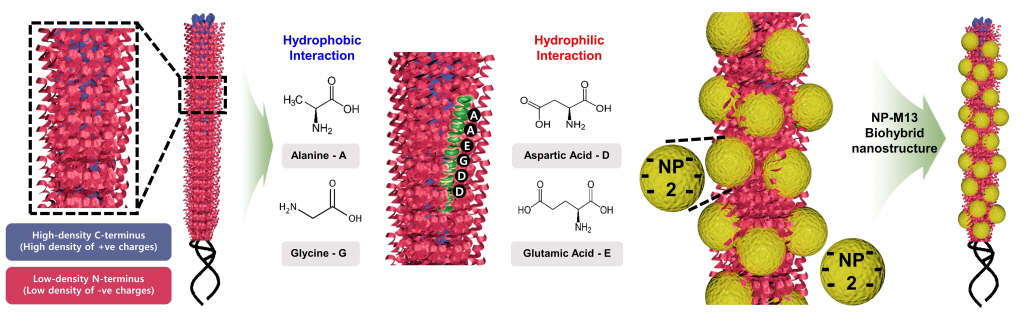
▲Hybrid bio nanostructure synthesis process

Development of high-performance hybrid bio nanostructures with Pusan National University and Kongju National University

The Korea Institute of Materials Science (KIMS, President Choi Chul-jin) has embarked on the development of hybrid bio-nanostructures, and expectations are high that this will lead to the full-scale production of electronic devices needed across industries, such as solar cells, organic light-emitting diodes, and sensors.

The Korea Materials Research Institute announced on the 10th that the research team of Dr. Jae-ho Kim and Dr. Myeong-gwan Song from the Energy and Environmental Materials Research Center, in collaboration with Professor Jin-woo Oh of Pusan National University and Professor Jin-woo Choi of Kongju National University, successfully developed a hybrid bio-nanostructure and used it to produce a fiber-type solar cell and fiber-type organic light-emitting diode with high performance and stability at temperatures ranging from -80℃ to room temperature of 150℃.

The research team confirmed that the photovoltaic efficiency of the fiber-type solar cell increased by 40%, and the luminous efficiency of the fiber-type organic light-emitting diode increased by 48%.

The 'spin coating' method, one of the common coating methods for existing metal nanoparticles, has the advantage of allowing anyone to quickly and easily create a thin film, but has the disadvantage of not being able to coat metal nanoparticles uniformly and orderly.

To improve this, the research team synthesized 'M13 bacteriophage', a biomaterial with the property of arranging metal nanoparticles in a uniform and orderly manner.

M13 bacteriophage has an active group that binds to metal cations, and binds all metal cations in a constant manner. Arrange.

Therefore, the hybrid bio-nanostructure synthesized with M13 bacteriophage has high stability in air and moisture, and can be used to produce high-performance fiber-type solar cells and fiber-type organic light-emitting diodes.

It was also confirmed that it exhibited excellent characteristics in extreme environments (-80℃ and room temperature 150℃) and washing characteristics.

M13 bacteriophage can be used in various electronic device fields such as piezoelectric elements, solar cells, sensors, and organic light-emitting diodes.

The unique feature of this technology is that the arrangement and alignment of metal nanoparticles can be easily established using hybrid bio-nanostructures.

In addition, since it can maximize the surface plasmonic effect, it can be applied to various electronic devices.

If this technology is utilized to advance domestic production and mass production, it is expected that a groundbreaking economic effect will be expected in electronic component companies.

“By utilizing hybrid bio-nanostructures, we can increase both performance and stability in the field of electronic devices,” said Song Myung-kwan, a senior researcher at the Materials Research Institute who led the research. “We expect that it will be applied to various fields such as energy production and storage materials as well as sensor materials in the future.”

This research was conducted with the support of the Ministry of Science and ICT, through the Korea Institute of Materials Science’s basic project (development of a fiber-type energy production and storage platform) and the National Research Foundation’s mid-career researcher support project. In addition, the research results were published in Small Structures on May 7. Currently, the research team is continuously conducting follow-up research to develop various bio-nanostructures and utilize them for organic electronic devices and in vitro diagnostic sensors.