인피니언 HV GaN
반도체 AI 인더스트리 4.0 SDV 스마트 IoT 컴퓨터 통신 특수 가스 소재 및 장비 e4ds plus

Mature IoT platform technologies lead digital transformation of daily life and work

기사입력2021.03.22 17:43

IoT Platform, Rapid Growth Beyond Early Research Stage
Domestic IoT platform-related patents increase 6-fold
Demand increases further in the post-corona era


The increased connectivity between things is changing society and industry. The era of only making one good product is coming to an end. High performance is important, but so is hyper-connectivity.
▲ With the development of the Internet, various products are connected, and in the past,
It became possible to collect data that could not be collected before.

Major domestic and international manufacturing companies, regardless of the field, are emphasizing that their products are connected to the Internet and implement various functions. Recently, there has been an increase in the number of products that borrow external computing power to solve functions that could not be implemented due to space and power limitations.

The natural language processing of AI speakers in the home is done in a data center somewhere. The driving environment data of autonomous vehicles on the road is collected by sensors installed all over the road, CCTVs, and even satellites in space. A manager at the Seoul headquarters can also control factory facilities in remote areas through the cloud.

All of these things are possible because these products are connected to the Internet. There is an increasing number of companies that are trying to diversify their business models by enhancing the functions of their products and creating various services through Internet connection. IT companies were the first to take the lead, and manufacturing companies are also actively developing the technology.

At the heart of it all is an IoT platform.

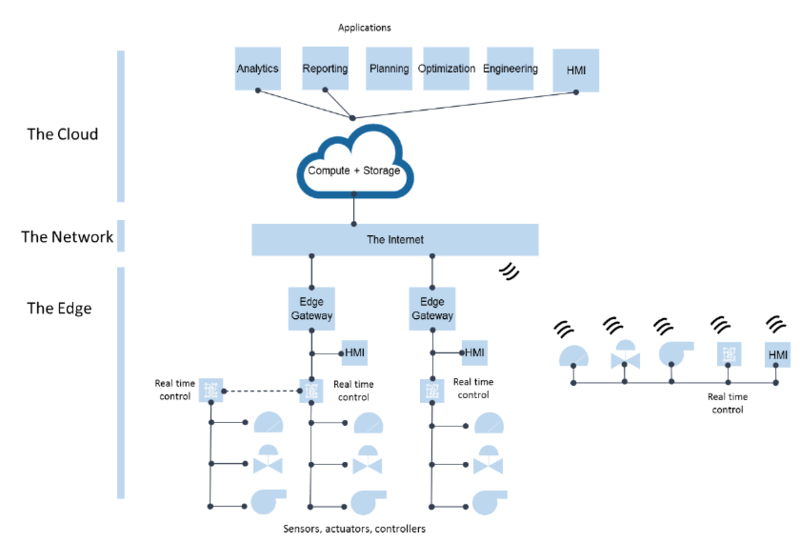
IoT platform is a technology that supports the development and operation of various services by connecting various sensors and terminals. Representative IoT platforms include ‘Apple HomeKit’ and ‘Google Home’, which are mainly used in AI speakers in some households.
▲ IoT platform connects various IoT devices and clouds
[Image = Paul McLaughlin & Rohan McAdam]

IoT platforms are rapidly growing past the initial research stage. This is because it is easy to secure large-scale industrial data and the market preemption effect is large, so once you take the lead, you can have a big impact on the related industry. Our country is also joining this trend.

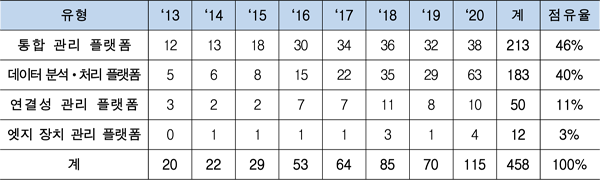
According to Park Seong-ho, a secretary at the Internet of Things Examination Division of the Korean Intellectual Property Office, the number of domestic applications related to IoT platforms increased nearly sixfold from 20 in 2013 to 115 in 2020.

◇ IoT platform developed with integrated management and data analysis functions as the main focus

IoT platforms can be broadly divided into four types.
▲ Status of patents related to IoT platforms by type [Table = Patent Office]

The first type is the 'IoT integrated management platform' that manages the entire system through hardware or software integration to provide IoT services. This includes oneM2M, OCF, and the integrated management platforms of the three domestic mobile carriers.

The second type is a 'data analysis and processing platform', which manages data based on AI technology on computer servers or in the cloud. Representative examples include Amazon Web Services (AWS), Google Cloud, and Microsoft Azure.

The third type is the 'connectivity management platform', examples of which include Cisco and the M2M platforms of the three mobile carriers. The fourth type is 'edge device management platforms', including AWS IoT, Google Cloud IoT, MS Azure IoT Edge, and EdgeX.

Of the 458 domestic IoT platform-related patents, △213 (46%) were related to IoT integrated management platforms, △183 (40%) were related to data analysis and processing platforms, and the majority were platforms that supported service provision and development. In addition, △50 (11%) were related to connectivity management platforms, and △12 (3%) were related to edge device management platforms.

◇ IoT platform enters full-scale commercialization phase
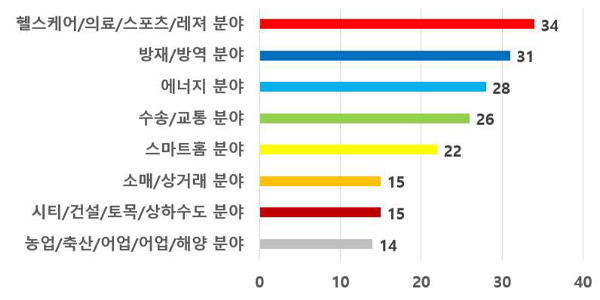
▲ Status of patents related to IoT platforms by industry [Table = Patent Office]

In terms of services utilizing the IoT platform, the order was healthcare (34 cases, 7%), disaster prevention/quarantine (31 cases, 7%), energy (28 cases, 6%), transportation/traffic (26 cases, 6%), and smart home (22 cases, 5%), showing that it is being applied to various services in various fields without being limited to a specific field.

By applicant, there were 286 companies (63%), which was more than the combined number of university-industry cooperation groups (64 cases, 14%), research institutes (47 cases, 10%), and individuals (61 cases, 13%). Secretary Park explained, “This means that IoT platform technology has entered the full-scale commercialization phase.”

In terms of M2M communication methods, the following were recorded: Wi-Fi 38 cases (23%), Bluetooth 35 cases (21%), LoRaWAN 22 cases (13%), DirectX 19 cases (11%), Ethernet 18 cases (11%), and LTE/5G mobile communication 14 cases (8%). While Wi-Fi still accounts for a high proportion, communication methods that consume less battery, such as DirectX, Bluetooth, and LoRaWAN, were also widely used.
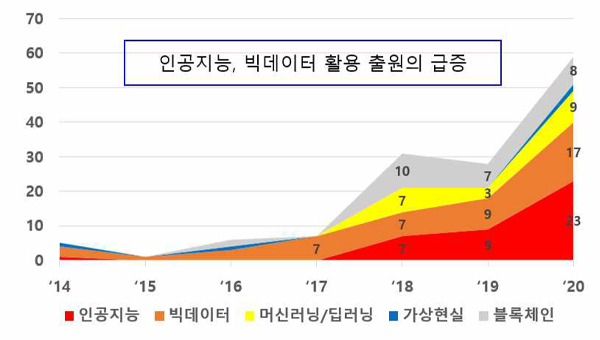
▲ Trend of increase in IoT platform patents related to new technologies [Table = Patent Office]

The combination of AI, big data, ML (machine learning) and DL (deep learning), VR (virtual reality), and blockchain technology is also on the rise. In particular, 23 patents related to AI-combined IoT platforms were applied for in 2020 alone. Before 2020, there were only 17 combined. The number of applications for big data (17 cases), ML/DL (9 cases), VR (2 cases), and blockchain (8 cases) also increased significantly compared to 2019.

◇ IoT capabilities, a critical measure of corporate competitiveness, require improved wireless design

The use of IoT technology is becoming a standard for corporate competitiveness. In particular, it is receiving attention as a key technology for realizing digital transformation (DX).

IoT platforms simplify access to the volumes of data generated by products, enabling enterprises to gain valuable insights from their data.

Companies can use the various data collected through IoT products to improve organizational operations and transform their business models from product-based to service-based.

Kim Kyung-min, senior researcher at IDC Korea, said, “The role of IoT technology has become more prominent in the recent response to COVID-19,” and “Demand for IoT adoption will also increase in preparation for systems and services for the post-COVID-19 era.”
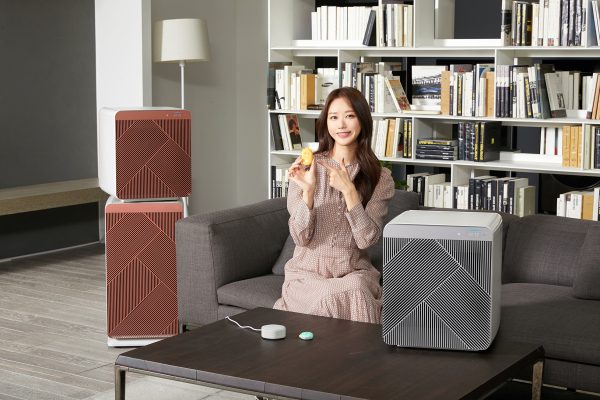
▲ Samsung Electronics and Kakao Enterprise in the smart home sector
Building a strategic partnership [Photo = Samsung Electronics]

In order to secure the IoT market, there are movements to form partnerships and cooperate in developing solutions among players. On the 4th, Samsung Electronics and Kakao Enterprise signed an MOU to strengthen their AI-based smart home business.

For manufacturing companies, getting high-performance products to market quickly is a key competitive advantage. Equally important is the ability to seamlessly connect to third-party products and the Internet. Accordingly, wireless design that supports various protocols is also expected to become important.
이수민 기자
기사 전체보기