

Webinars
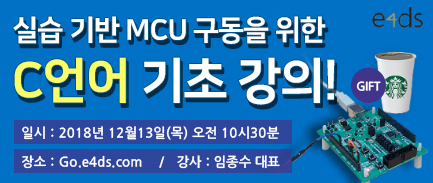
C Language Fundamentals Lecture for Practical MCU Operation!
What is well-written embedded software?
Is it performing a mission as quickly as possible through short and efficient coding?
If you have a different opinion, please leave a comment, and E4ds will give a Vita 500 to 50 people!
This lecture is specially designed for those encountering C language and processors for the first time, and includes various content on C language characteristics and requirements for processor operation.
Lecture Example: Explaining the entire process of applying power to a processor and the operation of code written in C language
First, we will examine what tools are necessary to write code in C language and operate it on a processor, and what roles these tools play.
Second, we will look at how to download the C code you developed on your PC to a processor that exists on the board.
Third, we will write C code to blink an LED using the GPIO (General Purpose Input Output) port that all processors fundamentally have. We will also add Timer functionality to the written code so that the LED can blink at precise time intervals.
Finally, we will observe the waveform and measure it using a program called CodeCheck by directly connecting a wire to the LED terminal to verify whether the LED blinks at the specified time intervals in the written C code.
This lecture is structured to allow you to naturally learn C language while performing various experiments step by step to facilitate understanding of C language and processors.
Furthermore, the course is organized to help you understand the concept of pointers necessary for writing code in C language and the corresponding addressing, and we will also examine the memory map by which the processor manages addresses.
Is it performing a mission as quickly as possible through short and efficient coding?
If you have a different opinion, please leave a comment, and E4ds will give a Vita 500 to 50 people!
This lecture is specially designed for those encountering C language and processors for the first time, and includes various content on C language characteristics and requirements for processor operation.
Lecture Example: Explaining the entire process of applying power to a processor and the operation of code written in C language
First, we will examine what tools are necessary to write code in C language and operate it on a processor, and what roles these tools play.
Second, we will look at how to download the C code you developed on your PC to a processor that exists on the board.
Third, we will write C code to blink an LED using the GPIO (General Purpose Input Output) port that all processors fundamentally have. We will also add Timer functionality to the written code so that the LED can blink at precise time intervals.
Finally, we will observe the waveform and measure it using a program called CodeCheck by directly connecting a wire to the LED terminal to verify whether the LED blinks at the specified time intervals in the written C code.
This lecture is structured to allow you to naturally learn C language while performing various experiments step by step to facilitate understanding of C language and processors.
Furthermore, the course is organized to help you understand the concept of pointers necessary for writing code in C language and the corresponding addressing, and we will also examine the memory map by which the processor manages addresses.

Comments
- 64 Comments
- 테*트 (2019-01-08 오후 6:03:46)
- 어 다시보기 되네요. ^^ 감사합니다.
- 박*준 (2018-12-26 오후 5:14:28)
- 지나간 세미나를 다시 보려고합니다. 어떻게 하면 다시 볼 수 있나요 ?
- 허*현 (2018-12-15 오전 1:23:15)
- 다시보기가 없다니...아쉽네요..
- 강*완 (2018-12-13 오후 1:22:33)
- 유리그릇때신 스테인레스 그릇같은 코딩을 어찌 증명하죠.Robust정도 지표는 어찌 증명하죠?
- 이*찬 (2018-12-13 오후 1:16:34)
- 다시 보려면 어떻게 하나요?
- 박*준 (2018-12-13 오전 11:16:19)
- 구입은 어떻게 하나요...?
- 김*연 (2018-12-13 오전 11:12:03)
- 실시간 스트리밍이 종료된 영상은 다시보기 할수 있나요?
- 김*수 (2018-12-13 오전 11:07:08)
- 벌써 끝났네요? 다시보기는 어떻게 합니까?
- 김*수 (2018-12-13 오전 11:06:37)
- 벌써 끝났네요? 다시보기는 어떻게 합니까?
- 길*수 (2018-12-13 오전 11:05:37)
- 화면이 안나와요