

# Necessity of Analog Circuit Design and LTSpice Analog circuit design is a fundamental discipline in electronics engineering that requires both theoretical knowledge and practical experience. The importance of analog circuits extends across various applications, from consumer electronics to industrial systems and high-precision measurement instruments. LTSpice is a powerful simulation tool developed by Analog Devices that enables engineers to design, analyze, and verify analog circuits before physical implementation. This software provides comprehensive circuit simulation capabilities, allowing designers to evaluate circuit performance, validate design specifications, and optimize parameters efficiently. The necessity of analog circuit design stems from the widespread use of analog signals in real-world applications. Many sensors, amplifiers, and signal conditioning circuits operate in the analog domain, making it essential for engineers to understand analog principles and design methodologies. LTSpice facilitates this learning process and accelerates the design cycle by providing accurate simulation results and enabling rapid prototyping of analog circuits.
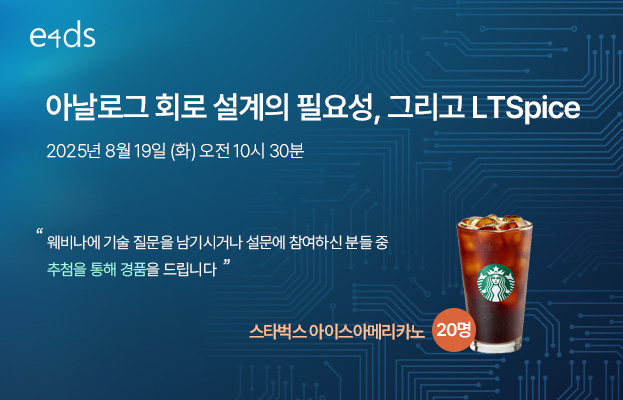
💡 In the Digital Age, Why Still 'Analog'?
In today's world dominated by digital technology,
the beginning and end of circuits remain fundamentally analog.
From minute sensor signals to high-speed communications, audio processing, medical devices, and power control —
analog circuits form the foundation of electronic systems and are the critical element that determines performance.
This lecture focuses on the theoretical necessity and practical application of analog circuit design,
and circuit simulation demonstrations using LTSpice,
introducing essential knowledge that design engineers must know through hands-on practice.
<Lecture Key Content>
1. Necessity and Presence of Analog Circuit Design
-
"All circuits start in analog and end in analog"
-
The decisive role analog plays in areas that digital circuits easily overlook
-
The weight of analog design that determines overall circuit performance
2. Analog Circuit Application Cases Encountered in Practice
-
Transmit and receive circuits for radar and wired/wireless communication equipment
-
Power control in electric vehicles and eco-friendly energy systems
-
Implementation examples of core circuits in audio amplification, sensor interfaces, and medical devices
3. Analog Circuit Components and Classification
-
From passive components such as resistors, capacitors, and inductors
to practical components including Op-Amp, filters, ADC, mixers, oscillators, regulators and more
-
Structure and usage context of analog/mixed-signal integrated circuits (IC)
4. LTSpice: The Essential Tool for Circuit Simulation
-
LTSpice's basic structure and functionality provided free of charge
-
Learning simulation-based circuit design and analysis through demo practice
-
Rather than iterative design, practical design strategy for rapid verification and optimization with LTSpice
<Target Audience>
-
Electronics and electrical engineering majors who have completed circuit theory and electronic circuits courses
-
Practicing engineers who wish to design and verify actual circuits using LTSpice
-
Hardware developers and R&D practitioners who want to grasp the fundamentals of analog circuits
If you already understand the foundational theory but are uncertain how to apply it in practice, this lecture can serve as an opportunity to find answers in actual design schematics.

Adjunct Professor, Department of Electronic Engineering, Shinhan University (2017-2021)
Adjunct Professor, Graduate School, Kyung Hee University (2011-2013)
Adjunct Professor, Department of Electronic Engineering, Gachon University (2002-2009)
Hello,
This is a one-hour lecture for circuit design practitioners that covers both the essentials of analog circuit design and hands-on LTSpice practice!
• Necessity of analog circuit design
• Applications of analog circuits
• Types of analog circuits
• Analog integrated circuits
- 9 Comments
- 이*훈 (2025-08-19 오후 5:39:15)
- 안녕하세요? 다시 보기 지원은 안될까요?
- 이*성 (2025-08-19 오후 3:49:33)
- 수고하셨습니다
- 신*우 (2025-08-19 오전 10:16:11)
- 유익한 강의 기대합니다
- 정*동 (2025-08-19 오전 10:12:23)
- 좋은 강의 기대됩니다.
- 천*희 (2025-08-19 오전 10:07:18)
- 감사합니다.
- 주*원 (2025-08-19 오전 10:05:31)
- 유익한 강의 기대합니다
- 정*만 (2025-08-18 오전 9:09:37)
- 좋은 세미나 기대됩니다.
- 김*진 (2025-08-18 오전 8:31:47)
- 좋은 강의 기대하겠습니다~
- 최*휴 (2025-08-07 오전 11:15:24)
- 좋은강의 부탁 드립니다.