


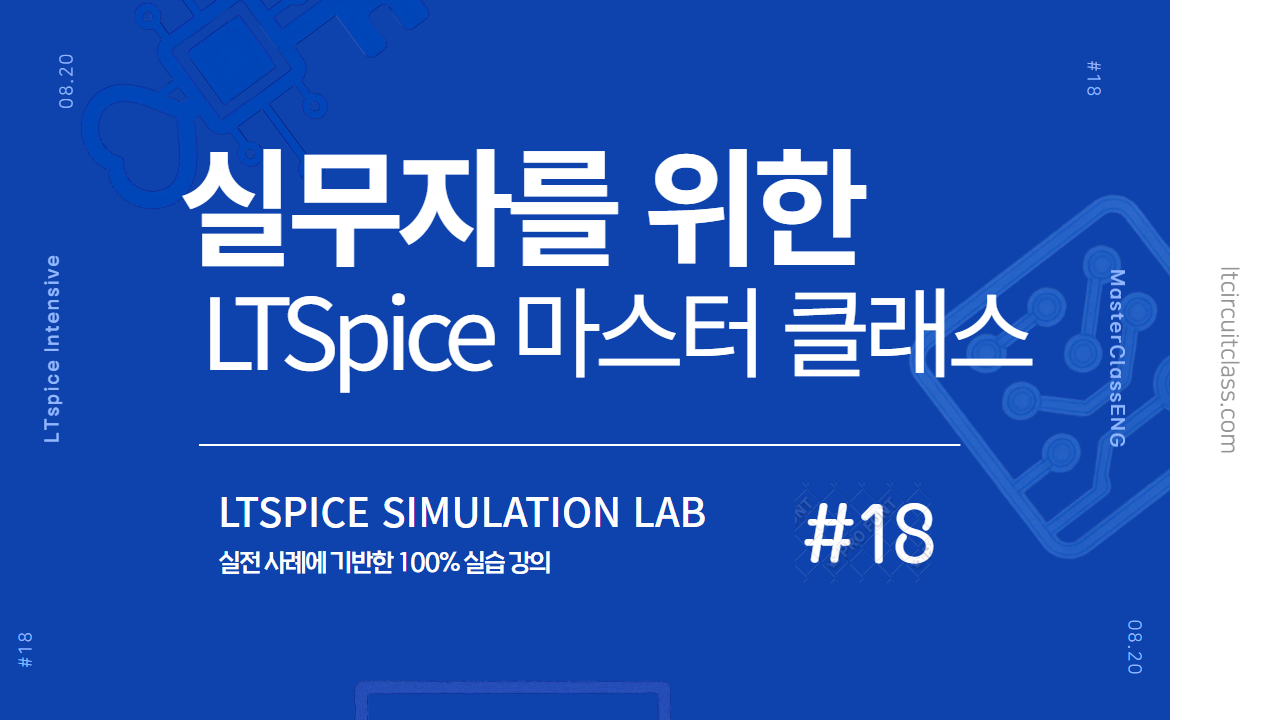
LTspice Intensive Master Class for Practitioners (Special Lecture by Professor Lim Seung-chan)
Venue: e4ds Conference Center
Address: 서울 금천구 디지털로 178 (가산동) 가산퍼블릭 A동 1823호
* Clicking the webinar registration button at the top will redirect you to the payment page.
* Please note that payment closes one week before the training date
* Please note that the training schedule may change if the number of participants is low.
* Schedule changes will be notified via email one week in advance.
🚩 Course Overview
Do you want to leverage LTspice not just as a tool, but as a genuine circuit analysis instrument?
A practical, hands-on LTspice master class led directly by Professor Lim Seung-chan, who has led defense electronics equipment development for 35 years and holds over 20 patents!
This is simulation training for professionals built on accumulated real-world industry project experience in avionics, communications equipment, power circuits, and sensor interfaces—going beyond simple usage to master circuit design and verification completely.
🎓 Instructor Profile
Professor Lim Seung-chan
-
B.S. in Electronics Engineering (Hanyang University), M.S. in Electron Optics (KAIST)
-
Former CTO, Research Institute Director, and CEO of Korea Telecom
-
Led localization of defense industry electronics equipment for 35 years
-
Adjunct Professor at Shinhan University, Kyung Hee University, and Gachon University (teaching electronic circuits, radar, and electromagnetics)
-
Holds over 20 MILES and electronic circuit-related patents
This is not merely a tool training course. We transfer deep simulation expertise that can be immediately applied to practical circuit design.
📚 Course Curriculum (7 sessions, approximately 6.5 hours)
Session 1: LTspice Overview and First Hands-On (50 minutes)
-
Introduction and comparison of circuit simulator types
-
Explanation of LTspice advantages and features
-
Software installation and demo circuit execution practice
-
Overview of major component groups and property editing methods
-
Voltage/current sources, RLC, diodes, BJT, MOSFET, JFET, etc.
-
Application of Analog Devices macromodels
-
Basic explanation of digital components
-
Session 2: Schematic Editing and Waveform Analysis Practice (50 minutes)
-
Schematic editing practice based on RLC circuits
-
Component placement, wiring, node labeling, annotations, and keyboard shortcuts
-
-
Interpretation of simulation results using waveform viewer
-
Zooming in/out, node voltage measurement, ripple and frequency measurement
-
Average value, RMS, power analysis, and other hands-on practice
-
Session 3: LT8306 Datasheet-Based Circuit Practice (50 minutes)
-
LT8306 datasheet review and operating principle understanding
-
Entry and execution of LT8306-based Flyback converter circuit
-
Implementation of 60V No-Opto Isolated circuit and waveform verification
-
Session 4: Circuit Analysis Methods and BJT Amplifier Design (50 minutes)
-
Explanation of six simulation analysis techniques
-
Transient, AC, DC Sweep, Noise, Transfer Function, DC Bias
-
-
BJT-based small-signal amplifier design
-
DC bias point setting and model-based circuit configuration
-
Hands-on comparison of calculation results vs. simulation
-
Session 5: Operational Amplifier and Active Filter Circuit Practice (50 minutes)
-
Operational amplifier-based amplifier simulation
-
Inverting and non-inverting op-amp configuration practice
-
-
Various active filter circuit practice
-
LPF, HPF, APF, and Notch filter design and comparative analysis
-
Experience the performance differences in 2nd and 3rd order filter circuits
-
Session 6: Application Circuit Simulation I (50 minutes)
-
ADC (Analog-to-Digital Converter) circuit simulation
-
Linear regulator circuit simulation
Session 7: Application Circuit Simulation II and Advanced Functions (50 minutes)
-
Switching regulator circuit simulation
-
Linear vs. switching regulator comparative analysis
-
Other advanced functions
-
BOM (Bill of Materials) generation
-
SMPS efficiency calculation
-
Transformer modeling and simulation
-
💡 Why You Should Take This Course
-
In-service engineers who want to turn LTspice from a "tool" into a "design verification weapon"
-
Hardware designers who want to verify circuit performance in advance during the product development stage
-
Those who want to optimize application-specific circuits such as ADCs, power circuits, and filters through simulation
-
Developers who frequently use Analog Devices components
🔧 Training Tools and Provided Materials
-
Latest version of LTspice (pre-installation guide provided)
-
Example circuit files, macromodels, and practice manuals provided
📅 Training Schedule and Location
-
Time: 9:00 AM ~ 6:00 PM (total 8 hours)
-
Location: [e4ds Electrical & Electronics Training Center, Gasandong]
-
Capacity: 20 people (first-come, first-served)
🎟 Registration Information
-
Tuition: [250,000]
-
Required Materials: Personal laptop, LTspice pre-installation (installation guide provided)
Venue: e4ds Conference Center
Address: 서울 금천구 디지털로 178 (가산동) 가산퍼블릭 A동 1823호
지하철 : 가산 디지털 단지역 6번출구 도보 9분 버스 : 5537, 6004, 5615, 5616, 5618, 5619, 5626, 5630, 5712, 5714, 21광명, 75부천, 652, 653, 5012, 금천03, 금천07