2026 Physical AI Conference
반도체 AI 보안 인더스트리 4.0 SDV 스마트 IoT 컴퓨터 통신 특수 가스 소재 및 장비 유통 e4ds plus

Power semiconductors are in short supply, automotive supplies are in short supply, and home appliance prices are down

기사입력2023.01.10 17:40

PMIC demand remains strong as vehicle electrification trend continues
PMIC Capa ↑4.7%, Lead Time Issues Still Remain

The semiconductor industry is also experiencing mixed fortunes across sectors amid a recession that has led to a sharp decline in demand for consumer products. In the consumer semiconductor sector, the average selling price (ASP) is under downward pressure due to a decrease in demand for finished products, while automotive semiconductors are showing signs of a deepening supply shortage as they continue to enjoy the electrification special trend from last year.

According to market research firm TrendForce, PMIC prices in consumer electronics, communication devices, and industrial equipment, where demand is decreasing, are expected to drop by 5-10%. In the automotive sector, suppliers are reportedly focusing on increasing production capacity due to the supply and demand shortage and longer lead times.

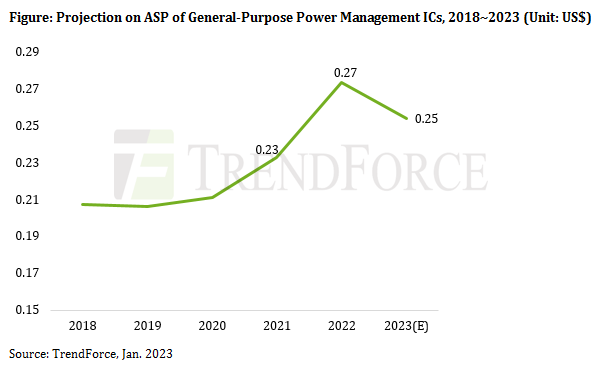
▲2018-2023 General PMIC Average Selling Price Trend and Forecast (Graphic-TrendForce)

Since the third quarter of last year, PMIC prices in consumer electronics such as laptops/PCs, tablets, TVs, and smartphones have begun to fall, and in the fourth quarter of this year, prices for AC-DC converters, DC-DC converters, buck converters, regulators, and PWMs fell 5-10% compared to the third quarter.

The continued slowdown in consumer electronics spending is expected to contribute to an additional 5-10% decline in related PMIC order prices during the first half of 2023. According to Counterpoint Research, the smartphone replacement cycle in 2022 was announced to be the highest ever at 43 months, and it is expected to remain at over 40 months in 2023. Market analysts forecast that the recovery in demand for IT devices will gradually begin in the second half of this year.

On the other hand, it is expected that automotive semiconductors will not experience significant price fluctuations due to the continued paradigm shift toward electric vehicles and a stable demand base. This is interpreted as being due to the long-term partnership between automotive semiconductor manufacturers and finished vehicle manufacturers.

As automakers such as Hyundai, Tesla, and Toyota pursue production expansion policies, supply and demand imbalances in automotive semiconductors are expected to grow further. According to Nikkei Asia, global auto sales are expected to continue to squeeze the supply of analog semiconductors such as power semiconductors and PMICs throughout 2023 due to increased demand for automotive semiconductors.

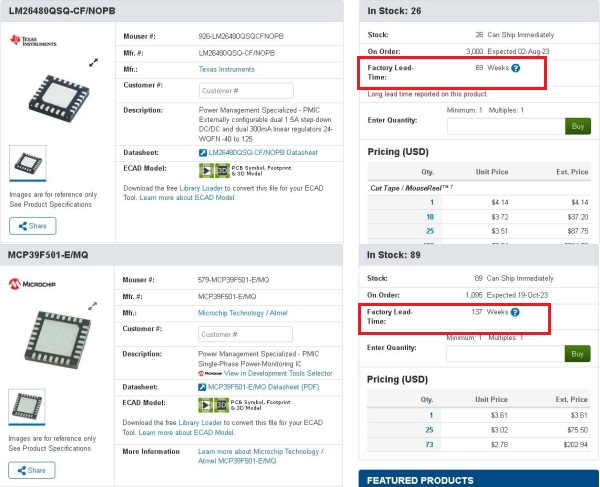
TrendForce diagnosed that the lead time of PMICs belonging to automotive applications is more than 32 weeks, and when searching for automotive PMIC products on electronic components distributor Mouser, we were able to confirm that, excluding some products with short lead times, the lead time ranges from 32 weeks to as long as over 100 weeks.

▲PMIC lead time information (captured from Mouser homepage)

Major IDMs that manufacture PMICs, such as Texas Instruments (TI), STMicroelectronics (ST), ON Semiconductor, and NXP, are focusing on expanding production and investment, but it is difficult to meet demand in the short term.

TI began initial production of its 12-inch wafer fab, RFAB2, in Richardson, Texas, in September. It is 30 percent larger than the existing RFAB1 and will produce more than 100 million units of its analog and embedded portfolio per day. Recently, in December, TI's second 12-inch fab, LFAB in Lehi, Utah, began first production.

Infineon started operation of its Cegled, Hungary, plant in October to support the manufacturing of semiconductors for electric vehicles, while ST announced plans on the same day to build a silicon carbide plant in Italy, which is scheduled to begin operations in 2023. In July, ST announced that it would begin building a 12-inch semiconductor manufacturing facility in Krolles, France, together with GlobalFoundries (GF), with the goal of completion in 2026.

Some have warned that while long-term investment in response to increased demand is essential, such rapid expansion of production capacity could make supply and demand balance more difficult if it exceeds the pace of demand recovery.

Meanwhile, according to market research and consulting firm Future Market Insights, the global PMIC market is expected to reach approximately USD 28.1 billion (KRW 35 trillion) in 2022 and grow at an annual average of 6.6% to reach KRW 41.2 billion (KRW 51 trillion) within five years.