Techday
Physical AI HBM Smart Factory SDV AIoT Power Semicon 특수 가스 정정·반론보도 모음 e4ds plus

JEDEC Forum Shares Next-Generation Memory Challenges

Google 우선 소스 기사입력2023.05.17 08:16


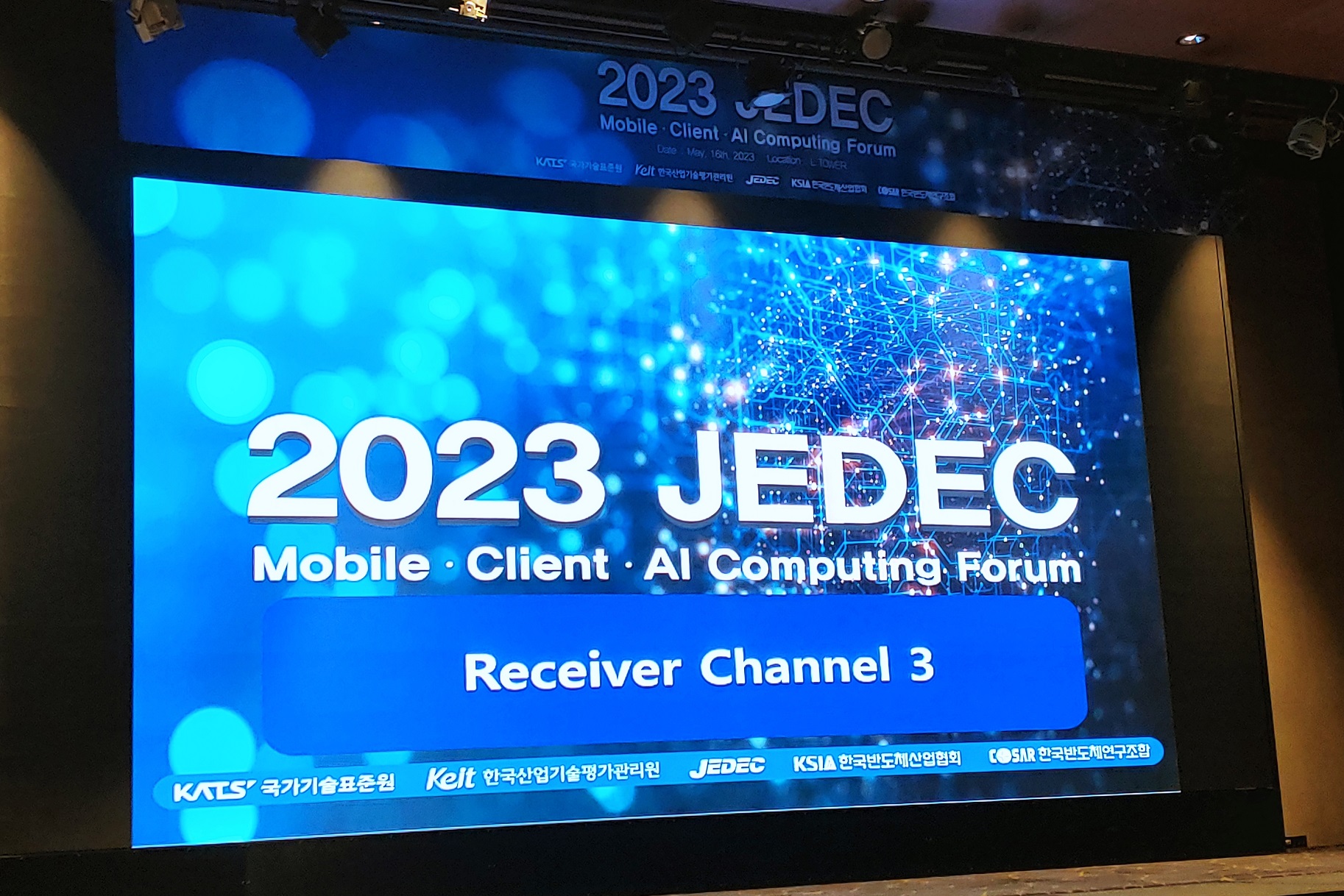
▲2023 JEDEC Forum
Data explosion, AI boom, and expansion of server market expected to benefit memory companies
LPDDR5, expanding demand sources in all directions... Satisfying demand-specific requirements is a must

On the 16th, the Korea Semiconductor Industry Association (KSIA) held a JEDEC forum with the Joint Electromagnetic Engineering Council (JEDEC) at Yangjae El Tower.

Domestic memory manufacturers Samsung Electronics and SK Hynix participated, and several global semiconductor companies including Intel, AMD, Micron, STMicroelectronics, Infineon, and Synopsys participated to share insights on semiconductor standard specifications trends, challenges, and prospects.

This 2023 JEDEC Forum will present on the utilization of next-generation memory in the following fields: mobile, AI computing, server, cloud, and edge. Presentations were made by experts from global companies such as Samsung Electronics, SK Hynix, Intel, AMD, IBM, and Google on the theme of utilizing next-generation DRAM such as DDR5 in data servers.

In his congratulatory remarks, JEDEC Board Chairman Mian Quadus said, “JEDEC has a long history of working on standards across the electronics industry, and its approximately 350 member companies are semiconductor companies that account for a significant portion of global sales.” He continued, “JEDEC has established most of the major standards for semiconductor memory, and is currently working on DDR6 and LPDDR6.”

Current global economyAlthough the memory industry is going through a rough patch due to inventory buildup and sluggish demand caused by the coronavirus, the industry is optimistic about the future outlook. Samsung Electronics Manager Taek-Woon Kim presented the memory market trends and cited IDC data, predicting that data will reach 450 billion gigabytes (GB) by 2028.

Data growth of more than doubled from the current point in time is expected to benefit the most from the memory sector, with servers accounting for 49%. In addition, Manager Kim Taek-woon said, “GPU AI accelerators that support the generative AI field will grow rapidly, and the exponential experience of FLOPS over the past four years proves this,” adding that HBM is the only solution for bandwidth suitable for next-generation AI accelerators.

Also worth noting is the application-wide adoption of LPDDR. SK Hynix engineer Choi Jun-yong emphasized, “LPDDR was originally used mainly in mobile devices, but is now starting to be applied to all applications,” and “LPDDR is a product that focuses on power efficiency, and has achieved a 40% power reduction scale down over the generations.”

As LPDDR5 faces the issue of exponential increase in cost compared to power savings, the key issue is expected to be how to overcome the trade-off between power savings and cost in next-generation LPDDR6 products.

SK Hynix proposed the idea of “providing a cost-additional solution option by isolating it next to the die rather than integrating it into the existing die.”

In addition, as demand for LPDDR increases in various applications such as automotive, client, server, and consumer, it has become difficult to meet different requirements such as cost, power, density, bandwidth, speed, and durability. Accordingly, it is expected that solutions will be needed to satisfy the requirements of each sector.

Meanwhile, JEDEC is an international private standards organization established in 1958 for the purpose of developing standards for semiconductor devices, and holds a forum with the Korea Semiconductor Industry Association every year on issues related to standards essential to the electronics industry.