


AhnLab Announces Q1 2019 Ransomware Trends: "GandCrab Rampant, Attack Methods Diversifying"
 Published2019.04.11 09:39
| Gandcrab, WannaCry, and Venus Locker make up the majority
| Ransomware Attack Methods Become More Diverse, User Caution Needed
On the 10th, AhnLab announced ransomware trends for the first quarter of 2019.
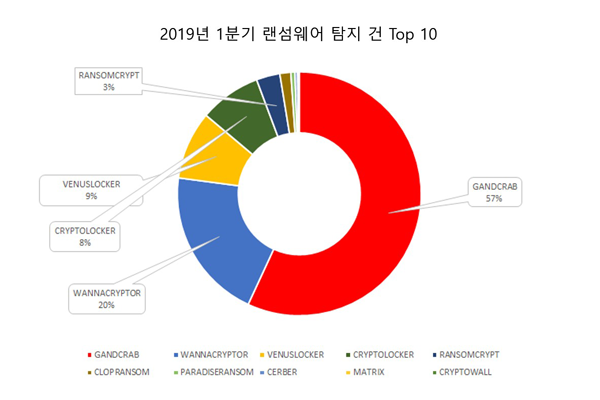
During the first quarter of this year, the number of new ransomware samples collected increased by 48% compared to the same period last year, and the number of ransomware detections was highest for 'GandCrab' ransomware (57%).
AhnLab collected a total of approximately 340,000 new ransomware samples, including variants of existing ransomware, in the first quarter of 2019. This represents an increase of about 48% compared to the approximately 230,000 samples collected during the same period of the previous year, but a 21% decrease compared to the fourth quarter of 2018.
Among the new ransomware samples, GandCrab (66%) and WannaCryptor (27%) accounted for 93% of the total. GandCrab increased by 400% from 22,000 cases in the fourth quarter of 2018 to 111,000 cases this quarter, and WannaCrypt increased by 117% from 20,000 cases in the previous quarter to 45,000 cases this quarter.
The number of ransomware detections in the first quarter of this year increased by 84% compared to the fourth quarter of 2018. GandCrab accounted for 57% of the total detections, making it the most detected ransomware in the first quarter of this year. This was followed by WannaCry (20%), VenusLocker (9%), and CryptoLocker (8%). In particular, GandCrab-based ransomware saw a 77% increase in detections compared to the previous quarter, emerging as the most active ransomware in Korea.
GandCrab is a ransomware-as-a-service (RaaS) that is produced by a specific group through buyer orders and distributes the extorted profits. It has been continuously distributed through repeated version updates since it was first discovered in January 2018.
During the first quarter of this year, ransomware distribution methods became more diverse depending on the target. Cases were discovered in which ransomware was distributed disguised as document files such as resumes, purchase invoices, and warning letters targeting relevant personnel, and cases were also found in which ransomware was distributed targeting users with insufficient security updates by analyzing their PC environments and exploiting various vulnerabilities. In particular, cases of distribution have been discovered where attackers hijacked corporate server administrator accounts and infected subsystems within the organization with ransomware, potentially causing catastrophic damage to the company.
To prevent ransomware damage, you must follow security guidelines such as refraining from opening attachments from emails with unknown sources, maintaining the latest versions of the OS and programs and applying security patches, downloading genuine software and content, avoiding suspicious websites, and keeping antivirus software up to date and performing periodic scans.
An official from AhnLab stated, “The continuous increase in ransomware distribution means that attackers are generating revenue from it,” adding, “As the likelihood of continued ransomware spread is high due to the diversification of new ransomware creation and distribution methods, individual users and organizations need to exercise special caution.”
관련뉴스

Cyberattacks in 2018: Ransomware Declines, Cryptojacking Increases
Ransomware used in cyber attacks declined significantly over the past year, while the number of cryptojacking attacks nearly doubled that of ransomware attacks. According to a report released by IBM X-Force Security Research on the 27th, cryptocurrency-related cryptojacking cyber attacks showed the largest increase over the past year. In the fourth quarter of 2018, attempts to install ransomware on devices decreased by 45% compared to the first quarter, while the growth rate of cryptojacking attacks reached 450%, an increase of more than four times during the same period. This indicates that as cryptocurrency prices surged last year, hackers illegally mined cryptocurrency using victims' computers and generated profits through this activity.
2019.02.28by 이수민 기자

As data value increases, data risk increases… Domestic companies have more data than the global average, but security measures are inadequate
Dell EMC has released the '2018 Global Data Protection Index Report,' which surveyed and analyzed the data protection status and strategy maturity of enterprises worldwide. According to the report, while enterprises' awareness of data value and the importance of data security has generally increased, the risk of data loss has actually grown. In the case of domestic enterprises, they possess more data than the global average, and the proportion of those who have experienced data security incidents is relatively high, with insufficient preparedness measures in place.
2019.03.25by 이수민 기자

"You took the bait" Kuntek launches domestically 'DeceptionGrid', a security solution based on cyber deception technology
쿤텍이 트랩엑스의 사이버 기만기술 기반 보안 솔루션 디셉션그리드를 국내에 출시했다. 공격자를 속이는 기만기술인 디셉션 기술은 사이버상의 공격자가 서버 또는 시스템을 공격할 때 유인하는 함정으로 만들어졌던 허니팟이 변화한 형태다. 디셉션그리드는 자격 증명, 데이터베이스 연결, 네트워크 공유 등 수십만 개의 공격자 기만 요소를 제공한다. 즉, 공격의 대상이 될 수 있는 모든 것을 모방 및 위장하여 공격자를 속일 수 있는 완벽한 가짜 인터페이스를 만드는 것이다. 공격자가 트랩을 만지는 경우 거의 100% 공격을 인지하며, 경고의 정확성도 99%로서 오탐에 대한 피로가 거의 없는 것이 특징이다.
2019.04.02by 이수민 기자
.png)
Databricks Unveils Open AI Security Monitoring 'Lakewatch'
Databricks entered the security market on March 24 by unveiling LakeWatch, an open-source agentic SIEM. The core functionality of this product is to integrate and analyze security, IT, and business data in a single environment to support AI-based threat detection and investigation. The company explained that it reduces the limitations of existing security operations centers, which have had to forgo some data due to high cost structures, and enables large-scale data analysis and automation based on open formats and ecosystems. LakeWatch is currently offered as a private preview, with Adobe and Dropbox mentioned as early customers. Databricks also announced an expanded partnership with Anthropic as well as the acquisition of Antimatter and SiftD.ai.
2026.03.26by 배종인 기자
Kaspersky Unveils Revamped 'NEXT' Combining SOC Integrated Management and AI Analytics
As enterprises increase demand for integrated management and automation in the construction and operation of Security Operations Centers (SOC), Kaspersky has disclosed updates to its B2B security product suite 'Kaspersky Next'. This update expands EPP, EDR, XDR, and SIEM integration through a single console based on OSMP, incorporates AI capabilities such as DLL hijacking detection and suspicious account takeover behavior identification, and includes integration with generative AI assistant tool KIRA. The company stated that in large-scale deployment environments, EDR Expert can reduce resource requirements by up to 30%, and XDR Expert by up to 60%.
2026.03.25by 배종인 기자











