



Preventing ESS Fire Accidents with Micro-Arc Detection System
 Published2021.01.07 14:26
Solving copper-aluminum joint problems using electromagnetic force
Simultaneous production of pyramid embossed structure trays
An ESS is a combination of numerous batteries and connectors. Therefore, if a micro-arc—a small spark—occurs in one battery, it can easily spread to other batteries, leading to a large-scale fire.
To prevent this, the occurrence of micro-arcs must be reduced first, and second, a system must be established to detect micro-arcs early and prevent them from leading to fire.
The Korea Institute of Industrial Technology (KITECH) announced on the 6th that it has succeeded in developing an 'ESS micro arc detection system' in collaboration with Daekyung Electric, an Energy Storage System (ESS) manufacturer.
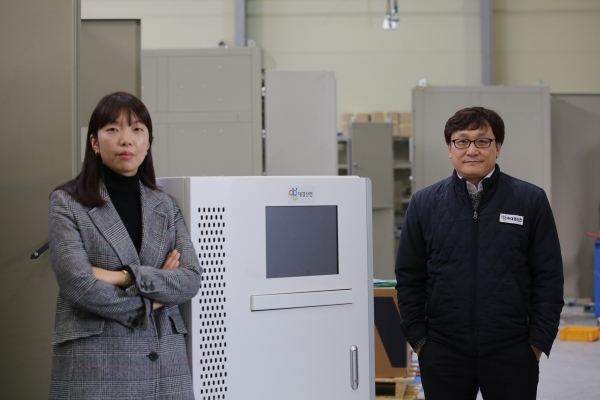
Daekyung Electric, focusing on the cause of micro-arc generation, diagnosed that as the connection part of the battery connector becomes loose, energy transfer efficiency decreases, and eventually micro-arc occurs due to overload.
To improve this, Daekyung Electric decided to add a buffer between the battery and the connector. In addition, an idea was devised to increase the capture rate of micro-arc signals by manufacturing the inside of the top of the battery tray in a pyramid embossing shape, thereby increasing the rate of reach to the sensor through the reflection of light from the micro-arcs.
However, the key issue was how to solve the bonding problem between copper, the battery connector material, and aluminum, the cushioning material, and the tearing problem of the tip of the pyramid embossing during general press forming.
Dr. Shim Ji-yeon of the Carbon Materials Application Research Group at KITECH solved the problems based on electromagnetic force-based high-speed bonding and forming technology.
The problem of joining dissimilar materials, copper and aluminum, was solved by utilizing the principle that when different materials collide at high speeds of over 200 m/s using electromagnetic force, they instantly change into a fluid-like state and become strongly bonded.
Similarly, when aluminum is formed at high speed using electromagnetic force, localized heating improves formability, which made it possible to produce a tray with a pointed pyramid embossing structure.
The pyramid embossing structure allows more than 80% of micro-arc signals to be captured by just a single sensor through light reflection, regardless of which battery micro-arcs occur. It also resulted in cost savings as a large number of sensors were not required.
This research was conducted through KITECH's 'Collaborative Technology Development Project with Leading Research Institutions Supporting SMEs.' The developed product is scheduled to be launched in the first half of this year following validation testing.
Comments
Related news

Schneider Unveils Integrated Power-Process Control System Management Solution
Schneider Electric has unveiled EcoStruxure Power and Process (ESPP), developed in collaboration with AVEVA. This platform integrates engineering design, operations, and maintenance for energy-intensive industries such as oil refining and chemicals, while optimizing decision-making across the enterprise. Notably, large refineries can achieve a 10% improvement in process energy consumption and reduce CO2 emissions by 567,000 tons annually, resulting in savings of $210 million per year.
2020.11.03by 김동우 기자
Saenggiwon Develops High-Power All-Solid-State Battery Material with Reduced Fire Risk
Commercial lithium-ion batteries use flammable liquid electrolytes, which pose an explosion risk when overheated or damaged. In contrast, solid-state batteries based on solid electrolytes offer superior thermal resistance and durability, with no concerns about fire and explosion accidents. Accordingly, the institute developed an integrated composite cathode material that can maximize the energy density of oxide-based solid-state batteries while simultaneously enhancing safety and output performance.
2020.11.27by 이수민 기자
.jpg)
Hyundai Motor and LS Motors to Develop 95kW Hydrogen Fuel Cell Power Generation System
Hyundai Motor and LS Electric have formed a partnership to expand the supply of eco-friendly energy and achieve an early realization of a hydrogen society. Hyundai Motor and LS Electric have signed a Memorandum of Understanding covering mutual cooperation in the development and supply of hydrogen fuel cell power generation systems.
2020.12.08by 명세환 기자

Intel Unveils Next-Generation 'Core Ultra Series 3' and vPro Platform for Enterprise PCs
Intel has officially unveiled the "Intel Core Ultra Series 3" for next-generation enterprise PCs and the latest vPro platform, addressing a wide range of demands from enterprise notebooks to high-performance workstations.
2026.03.26by 배종인 기자

ROHM Launches ESD Protection Diode Compatible with High-Speed Interfaces of 10Gbps or Higher
Semiconductor specialist ROHM has developed the 'RESDxVx series' of ESD (electrostatic discharge) protection diodes capable of responding to next-generation high-speed data communication environments exceeding 10Gbps, simultaneously enhancing both signal quality maintenance required in high-speed interfaces and IC protection performance.
2026.03.26by 배종인 기자











