


UNIST Develops Next-Generation Semiconductor Material Synthesis Technology to Replace Silicon
 Published2021.03.08 12:20
Development of a technology to synthesize transition metal chalcogenides
Improve quality by using solid and liquid raw materials together
To accelerate the commercialization of next-generation semiconductor materials to replace silicon (Si), a team of Korean researchers has developed a technology for growing two-dimensional semiconductor materials at the atomic level in thin, wide, and uniform layers. They have also demonstrated this feasibility by fabricating actual semiconductor devices.
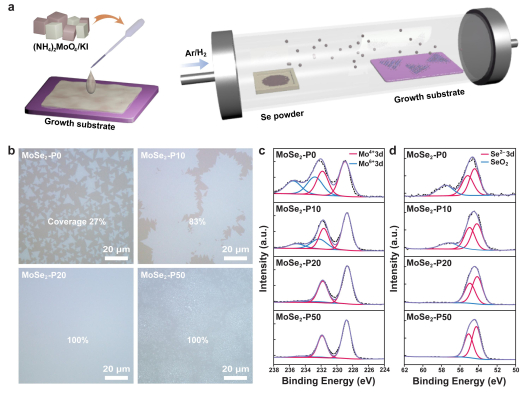
On the 8th, a research team led by Professor Hye-Sung Park of Ulsan National Institute of Science and Technology (UNIST) and Professor Joo-Hoon Kang of Sungkyunkwan University developed a technology to synthesize transition metal chalcogenide compounds with excellent atomic arrangement regularity by using both liquid and solid raw materials, unlike the existing method that only used solid raw materials.
[Image = UNIST]
Transition metal chalcogenides are attracting attention as next-generation semiconductor materials, but large-area synthesis is challenging. Chemical vapor deposition (CVD), which synthesizes using solid precursors that vaporize at high temperatures, has uneven vapor concentrations, making it difficult to obtain multiple films of identical quality. Furthermore, the size of the films that can be synthesized is limited. Therefore, methods utilizing liquid precursors are gaining attention.
However, when using liquid raw materials, there is a problem that the quality of the synthesized material, such as the regularity of the atomic arrangement, i.e. crystallinity, is reduced. Accordingly, the research team coated a liquid transition metal raw material onto a substrate and allowed it to react with the vapor-state chalcogen element.
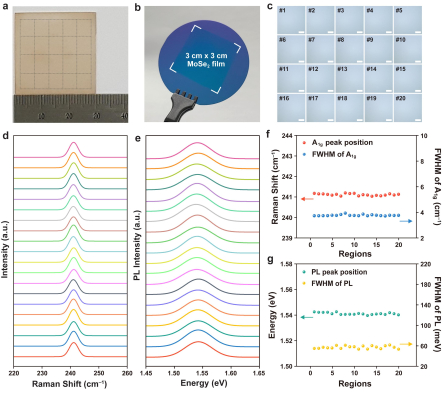
Officials explained that the metal halide, a reaction accelerator in the liquid raw material, facilitated the chalcogenization reaction, making it easy to obtain a compound with excellent crystallinity. Furthermore, the use of the accelerator allowed the compound to grow only horizontally, rather than vertically, making it possible to synthesize a transition metal chalcogenide composed of only a single, thin layer.
The developed synthetic method can be used regardless of the type of transition metal chalcogenide. The research team synthesized various single-layer transition metal chalcogenides by varying the combination of transition metals such as molybdenum (Mo) and tungsten (W) and chalcogen elements such as sulfur (S) and selenium (Se).
[Image = UNIST]
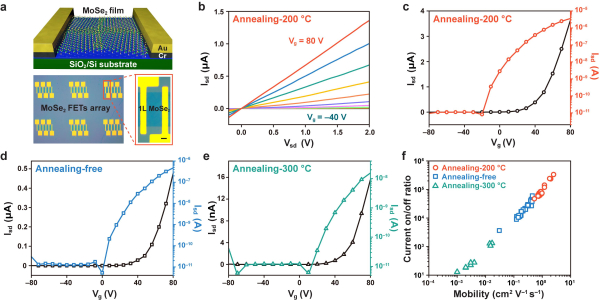
In particular, the research team also demonstrated that semiconductor devices can be manufactured using synthesized semiconductor thin films. A field-effect transistor was fabricated using a molybdenum diselenide (MoSe2) thin film, and the excellent electron mobility of the thin film was confirmed.
Meanwhile, this study was published under the title 'High-Crystalline Monolayer Transition Metal Dichalcogenides Films for Wafer-Scale Electronics' in the February 23rd issue of 'ACS Nano', an academic journal in the field of nanomaterials.
Comments
Related news
AI semiconductor development, minimizing data movement intervals and memory-centric operations are key
An era has arrived in which how quickly a company processes AI computation is linked to its competitiveness, and demand for semiconductors optimized for AI processing is increasing. For AI semiconductors, parallel processing methods are more suitable than serial processing, and memory-centric design is more appropriate than processor-centric design. For AI semiconductor companies to grow, securing world-class technological capabilities is essential, and communication with downstream industries that use AI semiconductors is equally important.
2020.12.14by 이수민 기자

Fostering the System Semiconductor Industry, Demand-Linked Fabless is the Key
System semiconductors are specialized in computation and control, unlike memory semiconductors which are specialized in storage. Additionally, while the memory semiconductor ecosystem is centered on IDMs that handle both design and production simultaneously, the system semiconductor ecosystem has well-established division of labor between fabless companies that handle design and foundries that handle production. To grow the system semiconductor industry further than it currently is, it is necessary to foster and support fabless companies that are capable of customer-centric semiconductor design specialized in specific tasks, rather than foundries which have high barriers to entry.
2021.01.19by 이수민 기자

"Accelerating AI with Memory" Samsung Electronics Develops HBM-PIM
Samsung Electronics has developed 'HBM-PIM,' which combines memory semiconductor and AI processor for the first time in the industry. PIM (Processing-in-Memory) is a technology that adds processor functions necessary for computational tasks within memory. Samsung Electronics developed this product by integrating an AI engine into HBM2 Aquabolt, a second-generation High Bandwidth Memory semiconductor that has been in mass production since January 2018.
2021.02.18by 강정규 기자

Intel Unveils Next-Generation 'Core Ultra Series 3' and vPro Platform for Enterprise PCs
Intel has officially unveiled the "Intel Core Ultra Series 3" for next-generation enterprise PCs and the latest vPro platform, addressing a wide range of demands from enterprise notebooks to high-performance workstations.
2026.03.26by 배종인 기자
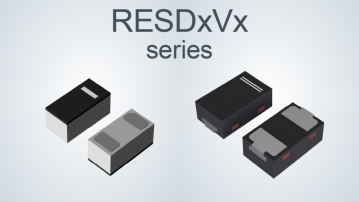
ROHM Launches ESD Protection Diode Compatible with High-Speed Interfaces of 10Gbps or Higher
Semiconductor specialist ROHM has developed the 'RESDxVx series' of ESD (electrostatic discharge) protection diodes capable of responding to next-generation high-speed data communication environments exceeding 10Gbps, simultaneously enhancing both signal quality maintenance required in high-speed interfaces and IC protection performance.
2026.03.26by 배종인 기자











