


Inorganic-based semiconductors to rise "also cheaper"
 Published2021.05.17 12:01
Demonstrated through the development of a monitoring device for Parkinson's disease patients
Manufacturable via inexpensive solution process, easy to commercialize
A research team led by Professors Jae-Sung Son, Moon-Ki Choi, and Joo-Young Kim of the Department of Materials Science and Engineering at Ulsan National University of Science and Technology (UNIST) succeeded in synthesizing silver sulfide (Ag2S) inorganic semiconductor thin films using an inexpensive solution process.

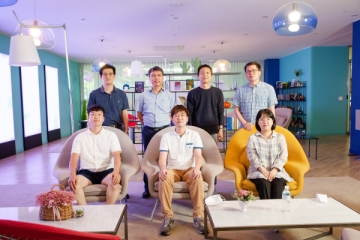
Professor Kim Ju-young, Researcher Yang Woo-jeong, Researcher Cho So-young,
Researcher Hwang Kyung-seok [Photo=UNIST]
The performance of inorganic semiconductor thin films was also demonstrated by applying resistive random-access memory (RRAM) fabricated from the synthesized thin films to a monitoring device for Parkinson's disease patients. When the developed device is attached to a patient's body, it can detect movement abnormalities such as muscle spasms.
The silver sulfide inorganic semiconductor thin film developed by Professor Son's team exhibits semiconductor properties while also being highly flexible. Existing inorganic semiconductor materials are composed of ionic bonds and are easily broken, but the silver sulfide thin film developed this time has an elongation strain of 15%.
"Inorganic semiconductor materials have superior thermal and chemical stability compared to organic compound semiconductor materials, so they can be used in flexible electronic devices capable of stable operation even in high-temperature and high-humidity environments," explained Seung-Ki Cho, a postdoctoral researcher at Yonsei University's KIURI Research Group.
In particular, unlike existing methods, the newly developed inorganic semiconductor thin film can be manufactured using an inexpensive low-temperature solution process, making it advantageous for commercialization. The method involves rotating a solution containing inorganic semiconductor particles and a solvent over a substrate to apply a uniform coating. The solvent is then removed by evaporation.
"Existing production methods that apply high temperature and high pressure to raw materials are expensive to produce thin films, and other material layers that make up the memory device cannot withstand high temperature and high pressure, making it difficult to apply them directly to device fabrication," explained Cho So-young, a master's student in the Department of Materials Science and Engineering at UNIST.
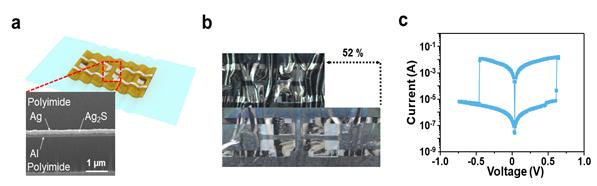
In addition, the research team used this to develop the world's first 'stretchable thin-film silver sulfide-based resistive memory semiconductor'. This memory semiconductor device demonstrated a high on/off current ratio difference and operational durability, making it suitable for use in the development of adhesive health monitoring devices.
Yang Woo-jeong, a researcher in the integrated master's and doctoral program at the Department of Materials Science and Engineering at UNIST, explained, “We developed a patch-type device to monitor Parkinson's disease patients by combining stretchable RRAM with a motion sensor,” adding, “It is also possible to fabricate large-area matrix devices by using a touch sensor.”
Meanwhile, this research was published online in Advanced Materials on Friday, April 30, and is awaiting publication after being selected as a cover article. The research was supported by the National Research Foundation of Korea’s Future Materials Discovery Program and the Challenge Materials Technology Development Program.
Comments
Related news
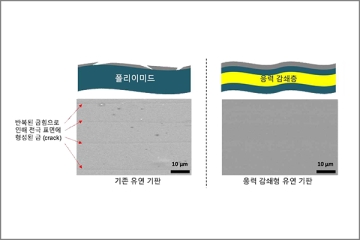
Flexible substrates that fold well can be made using existing materials
The global flexible display market is projected to reach $31.5 billion in 2025, maintaining a compound annual growth rate of 25.9% from $7.91 billion in 2019. In this context, Professor Jeong Yun-young's research team at POSTECH has successfully developed next-generation foldable electronic device implementation technology that induces stress mitigation effects by inserting soft materials into the substrate.
2020.05.07by 이수민 기자
UNIST succeeds in synthesizing flexible semiconductor material "exene" for the first time.
A joint research team from UNIST comprising Professors Park Young-seok, Lee Geun-sik, and Shin Hyung-jun successfully synthesized ixene, one of the polycyclic aromatic hydrocarbon (PAHs) materials, for the first time. Additionally, the team synthesized ixene with added nitrogen and boron, providing insight into the material's potential as an organic semiconductor material.
2020.08.26by 이수민 기자

Applied Materials launches new semiconductor inspection equipment based on big data and AI
Applied Materials, a global leader in materials engineering solutions, has unveiled an innovative process control system leveraging big data and AI technologies. This system supports semiconductor manufacturers in reducing time-to-market for semiconductor chip development and production systems, enabling them to generate greater revenue.
2021.04.21by 배종인 기자
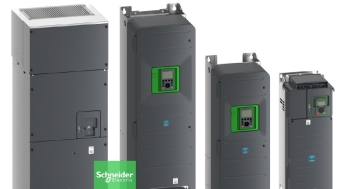
Schneider Aims for Building Energy Savings and Operational Stability with Next-Generation HVAC Drives
Schneider Electric has unveiled its next-generation HVAC drive product line 'Altivar HVAC'. The new product line's key features center on enhanced energy savings, system operational stability, and building management system integration. The products are divided into 'ATH200' for OEM and small equipment applications, and 'ATH600' for environments requiring continuous operation and advanced control. The company plans to expand the application scope from commercial buildings to facilities where HVAC system stability is critical, such as hospitals, airports, and data centers. The announcement includes over 30% energy savings, operation from -10°C to +60°C, Modbus and BACnet support, and compatibility with low global warming potential refrigerants.
2026.03.26by 명세환 기자

Ecolab Expands AI Data Center Cooling Business Through Acquisition of CoolIT
Ecolab has agreed to acquire CoolIT Systems, a liquid cooling company for AI data centers, for approximately $4.75 billion. The transaction is expected to close by Q3 2026, subject to regulatory approvals. CoolIT has been supplying direct-to-chip cooling-based coolant distribution units, cold plates, and manifolds, serving hyperscale data centers and colocation operators as customers. This acquisition is a measure to address the high-heat and high-density server environments created by AI proliferation. Ecolab plans to combine its water management and digital monitoring capabilities with CoolIT's hardware technology to expand its data center cooling business.
2026.03.26by 명세환 기자











