



MPS, “Complete Front-end Protection for Automotive Systems with Smart Ideal Diode Controllers”
 Published2026.03.31 08:59
MPQ5850-AEC1, Ultra-low Dropout · Powerful Gate Drive · Excellent EMI Performance
■ The Importance of Front-End Protection in Vehicle Electrical Design
Automotive electronic control units (ECUs) are designed to receive power from a battery, and if the battery terminals are connected with reverse polarity during jump starts or maintenance, critical damage to the internal components of the ECU may occur.
This goes beyond simply preventing wiring errors and is a reliability issue directly linked to vehicle safety.
In addition, the input voltage (VIN) of the vehicle battery is not maintained at a constant level even during normal operation.
Standards such as ISO 7637 and ISO 16750 define various transient voltage conditions, and under some test conditions, VIN can drop to the negative voltage region.
Therefore, the front-end protection circuit of the power input stage has established itself as an essential element in automotive electronics design.
Currently, Schottky diodes and P-channel MOSFETs (P-FETs) are widely used for reverse polarity protection and transient voltage response in automotive power systems.
However, these methods have limitations in terms of power loss and thermal efficiency, and face difficulties in satisfying the high-efficiency, miniaturized design requirements of modern vehicle systems.
This article examines the characteristics and limitations of each method and analyzes the technical advantages of the MPQ5850-AEC1-based smart ideal diode solution.
■ Limitations of the Schottky diode method
A Schottky diode is a simple reverse polarity protection device that performs the basic operations of forward conduction under normal conditions and blocking under reverse voltage.
It has been widely used in low-current applications due to its ease of circuit implementation and low cost.
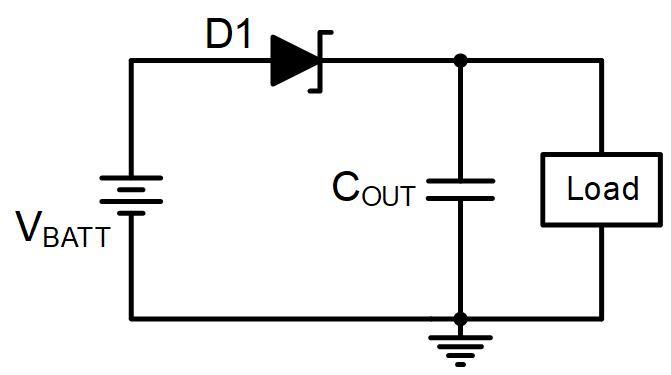
▲Figure 1. Reverse voltage protection using a Schottky diode
However, power loss due to forward voltage drop (VF) is inevitable, and heat generation problems intensify as the current increases.
In particular, the burden of thermal management increases significantly in high-current environments. Furthermore, due to relatively large reverse leakage current and low efficiency, there are limitations in meeting the requirements of modern automotive electronic systems.
As a result, the scope of application for Schottky diodes is gradually becoming limited.
■ Characteristics and Limitations of P-Channel MOSFET Method
P-FETs are a solution capable of improving efficiency compared to Schottky diodes by reducing conduction losses based on low on-resistance (RDS(on)).
.jpg)
▲Figure 2. Reverse voltage protection using P-FETs
The P-FET-based circuit has a structure in which, during normal operation, current flows through the body diode, and then the MOSFET is fully turned on as the gate-source voltage (VGS) is formed.
In reverse polarity situations, the system is protected by limiting VGS through a Zener diode to block the device.
However, this method has several structural limitations. In a cold crank situation, if the input voltage drops sharply, the on-resistance of the P-FET increases, and a system reset may occur as the device is shut down due to a change in the threshold voltage.
In addition, leakage current increases due to the Zener diode and resistor network, and if AC voltages are superimposed, heat generation problems caused by reverse current may occur.
■ Smart Ideal Diode Controller Method
To overcome these limitations, a smart ideal diode controller that actively drives an external N-channel MOSFET (N-FET) has emerged.
This method has the advantage of minimizing voltage drop while performing the same function as a diode.
.jpg)
▲Figure 3 Smart diode controller gate drive method
Driving an N-FET requires a gate voltage higher than VBATT, and the methods for implementing this are classified into charge pump and boost converter methods.
The charge pump method has a simple structure and is advantageous in terms of cost, but the driving current is limited and efficiency is low.
In particular, in environments with large input voltage fluctuations, gate drive stability may be degraded, and EMI problems may occur due to high switching frequencies.
On the other hand, the boost converter method provides high efficiency and strong gate drive current through an inductor-based step-up structure.
In addition, it has the characteristic that the switching frequency decreases depending on the load conditions, and thus As a result, it is also advantageous in terms of EMI performance.
These characteristics are suitable for automotive electronic systems requiring high current and high reliability.
■ MPQ5850-AEC1: Solution for High-Performance Automotive Electronic Systems
MPS's MPQ5850-AEC1 is a boost converter-based smart ideal diode controller designed to simultaneously meet the efficiency and response characteristics required in high-current environments.
In particular, it provides performance applicable even in global automotive OEM environments that require strict EMC and reliability standards.
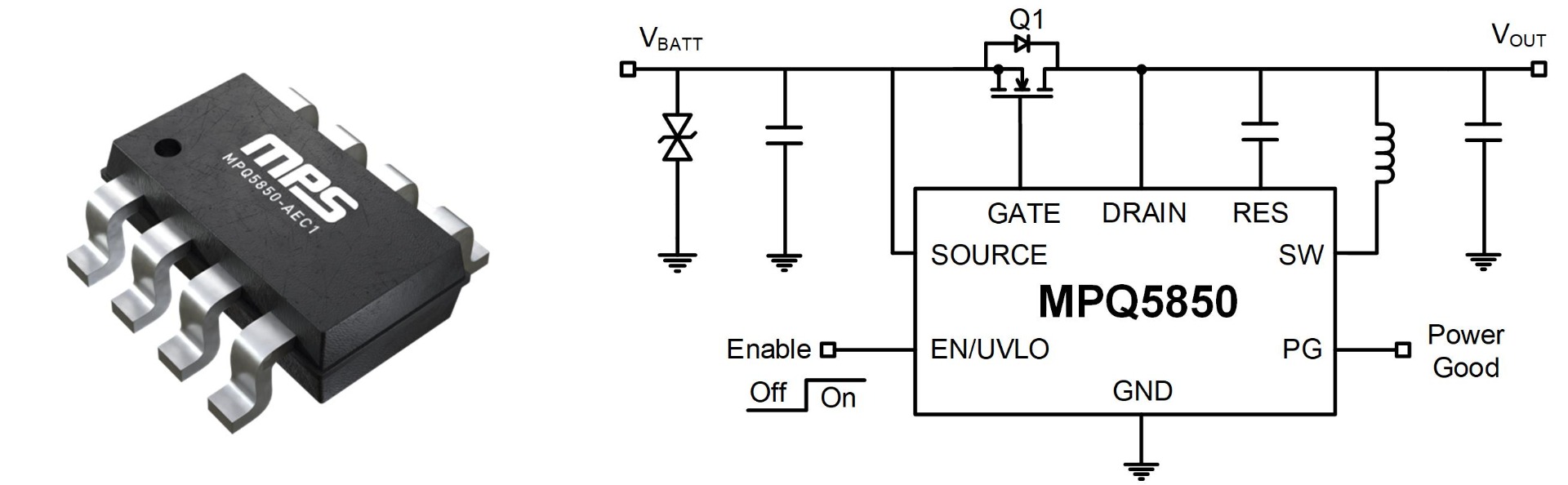
▲Figure 4. MPQ5850-AEC1 and General Application Circuits
This product minimizes power loss through an ultra-low dropout voltage of 20mV and increases battery efficiency with a low quiescent current of 30μA and a shutdown current of 4μA.
In addition, it ensures stable operation even under ISO 7637 and ISO 16750 conditions by providing a fast transient response through powerful gate driving capability.
By supplying power to the internal circuit based on the drain voltage, normal operation can be maintained even in extreme cold crank situations where VBATT drops to 0V.
This is a factor that significantly improves reliability compared to the existing P-FET method.
In addition, it secures excellent EMI performance through a low-frequency-based control structure and is advantageous for meeting demanding EMC requirements such as CISPR 25.
The condition monitoring function via PG (Power Good) signals, the compact package, and the AEC-Q100 Grade 1 certification are also suitable elements for automotive design.
■ Comparison of Frontend Protection Methods
The frontend protection method must be selected based on the application conditions.
Schottky diodes are advantageous in terms of simplicity and low cost, but they are inefficient in high-current environments.
Although the P-FET method can improve efficiency, performance degradation may occur under certain transient conditions.
Charge pump-based smart controllers are suitable for low-current applications, while boost converter-based methods are suitable for systems requiring high current and high reliability.
■ A New Approach to High-Efficiency Power Protection Design
Front-end protection of the vehicle power input terminal involves various electricalIt is a key design element that must reliably protect the ECU even in miraculous and transient situations.
While existing methods each have their own advantages, they have limitations in simultaneously satisfying the high efficiency, high reliability, and low heat generation characteristics required by the latest automotive electronic systems.
Smart ideal diode controllers such as the MPQ5850-AEC1 are an alternative that can effectively address these requirements, providing a design approach that ensures both efficiency and reliability.
Its value is further highlighted, especially in automotive electronic systems requiring high current and high performance.
As the complexity and power density of automotive electronic systems continue to increase, these highly integrated power protection solutions are expected to become a key element of future designs.
※ Author Introduction
 Jiyoung Kim, Technical Support Manager, is an engineer at MPS (Monolithic Power Systems) responsible for technical support of automotive electronics products, possessing over 16 years of experience in the related industry. At MPS, she provides customized technical support and design optimization based on various power semiconductor solutions, such as DC/DC converters, PMICs, and LED drivers, contributing to the realization of high-reliability power designs.
관련뉴스
.jpg)
MPS, “High-Current, Low-Voltage FPGA & ASIC Power Design, Multiphase Converter Solutions Rapidly Emerging”
We spoke with Thomas Hudson, MPS Senior Product Marketing Engineer, about design approaches for multiphase converters in high-current environments.
2026.02.06by 명세환 기자
.jpg)
Kim Seon-min, Director of Technical Support at MPS, “Current Sensors Rapidly Emerge as Key Elements in the Era of Solar, Wind, and ESS Expansion”
With the expansion of solar, wind, and ESS driven by carbon neutrality, the importance of current sensors in renewable energy systems is increasing. We heard from Kim Sun-min, Director of Technical Support at MPS, about the key role of current sensors in renewable energy systems.
2026.02.26by 편집부
MPS, “‘MPM3695 Family’ Meets High-Current, Low-Voltage Power Supply Design Demands”
MPS Technical Support Director Jung Tae-hoon discusses integrated power modules for high-current power design, a new approach to flexible output voltage configuration.
2026.03.11by 편집부

A single misaligned light means 'defect'… Vehicle interior lighting now guarded by semiconductors and software
Automotive interior lighting is moving beyond its role as 'auxiliary lighting.' As it becomes a core element of user experience (UX) that expresses brand identity through color and animation while reflecting driver preferences, the LED interior ambient lighting market is growing rapidly. In connection with this, we met in advance with Choi Young-jae, Research Director at Dabo Corporation, who will present a technical webinar session on "Intelligent LED Interior Lighting Solutions Illuminating Future Vehicles," to hear about market trends and changes in design requirements.
2026.08.28by 명세환 기자

Sang-Mo Yu, Dell President: "AI Is Now Infrastructure—Integrated Approach to Security, Power, and Data Centers Is Essential"
At Dell Technologies Forum 2026, Sang-Mo Yu, President of Dell Technologies Korea, emphasized that AI has transcended the role of a productivity tool to become core infrastructure for enterprises and everyday life, underscoring the necessity of a hybrid AI infrastructure strategy integrating power, cooling, security, and data centers. He disclosed that he utilizes more than 20 AI agents daily and identified embedded security and the absence of unified roadmaps as major challenges for enterprises.
2026.08.28by 배종인 기자











