



The information has been leaked! Dissolve the memory in water and destroy it!
 Published2016.12.26 11:08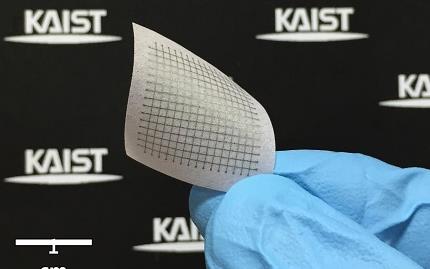
Produced using inkjet printing techniques on water-soluble paper soap
A research team led by Professor Yang-Kyu Choi of the Department of Electrical and Electronic Engineering at KAIST has developed a security memory device that can be dissolved in water and quickly disposed of.
The security non-volatile resistive random access memory (RRAM) developed by the research team is manufactured using an inkjet printing technique on water-soluble paper soap (Solid Sodium Glycerine: SSG). Stored information can be destroyed by dissolving it within about 10 seconds with a small amount of water.
This research, in which doctoral student Bae Hak-yeol participated as the first author, was published in the December 6th online edition of 'Scientific Reports,' a sister journal of Nature (Paper title: Physically transient memory on a rapidly dissoluble paper for security application).
In the past, the ability to stably maintain stored information for a long period was the primary indicator for gauging the performance of non-volatile memory devices. However, with the recent advent of the Internet of Things (IoT) era, where information can be easily shared anytime and anywhere, there is a growing demand for the development of security semiconductors capable of not only storing information but also fundamentally preventing data leakage.
To this end, meltable memory devices and fire-resistant security devices using paper substrates are being developed. However, existing meltable elements have limitations, such as taking a very long time to destroy and the burning technology requiring an ignition device and high temperatures.
To solve the problem, the research team succeeded in reducing the dissolution time to within seconds by fabricating a memory device on an SSG substrate that reacts and dissolves very quickly in water.
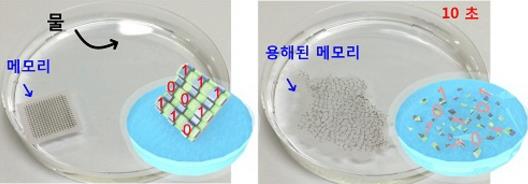
▲ The process of memory devices dissolving in water
This memory device is composed mainly of alkali metal elements sodium and glycerin and has hydrophilic groups, so it reacts with a small amount of water and decomposes.
Since soluble electronic devices can be vulnerable to heat and moisture, process conditions are critical. The research team deposited metal electrodes at room temperature and pressure using an inkjet printing technique with optimized viscosity and heat treatment conditions.
In addition, hafnium oxide (HfO2), which is a resistive switching layer that determines the characteristics of the memory device, was also deposited at a low temperature of 150 degrees or lower to obtain excellent memory characteristics. Through this, we fabricated a device that is stable at normal humidity but reacts only to a small amount of water.
The research team stated that the cost reduction effect is much greater than other security devices because they fabricated a two-terminal resistance change memory with a 'metal-insulator-metal' structure using a flexible paper soap-shaped SSG substrate and an inkjet printing technique.
"This technology can be manufactured at a cost one-tenth the level of existing silicon substrate-based technology by using resistance change memory devices," said doctoral student Bae Hak-yeol. "It can be quickly disposed of with a small amount of water, so it could be applied as a security device in the future."
관련뉴스
.jpg)
SalePoint Signs Multi-Year Partnership Agreement with AWS… Promoting Identity Security that Integrates Even AI Agents
Sailpoint has entered into a multi-year strategic partnership agreement with AWS and is moving forward with establishing an integrated governance system that manages both human and non-human identities together. The plan is to consistently manage access permissions in an environment where AI agents are increasing as work execution entities, while applying the principle of least privilege and automated policy enforcement. The two companies plan to jointly expand capabilities to manage the identities of various entities, including AI agents, within a single layer in the AWS environment. This collaboration is interpreted as a move to design security and governance together in corporate environments where AI adoption is expanding.
2026.03.26by 배종인 기자
.png)
Databricks Unveils Open AI Security Monitoring 'Lakewatch'
Databricks entered the security market on March 24 by unveiling LakeWatch, an open-source agentic SIEM. The core functionality of this product is to integrate and analyze security, IT, and business data in a single environment to support AI-based threat detection and investigation. The company explained that it reduces the limitations of existing security operations centers, which have had to forgo some data due to high cost structures, and enables large-scale data analysis and automation based on open formats and ecosystems. LakeWatch is currently offered as a private preview, with Adobe and Dropbox mentioned as early customers. Databricks also announced an expanded partnership with Anthropic as well as the acquisition of Antimatter and SiftD.ai.
2026.03.26by 배종인 기자
Ecolab Expands AI Data Center Cooling Business Through Acquisition of CoolIT
Ecolab has agreed to acquire CoolIT Systems, a liquid cooling company for AI data centers, for approximately $4.75 billion. The transaction is expected to close by Q3 2026, subject to regulatory approvals. CoolIT has been supplying direct-to-chip cooling-based coolant distribution units, cold plates, and manifolds, serving hyperscale data centers and colocation operators as customers. This acquisition is a measure to address the high-heat and high-density server environments created by AI proliferation. Ecolab plans to combine its water management and digital monitoring capabilities with CoolIT's hardware technology to expand its data center cooling business.
2026.03.26by 명세환 기자
Kaspersky Unveils Revamped 'NEXT' Combining SOC Integrated Management and AI Analytics
As enterprises increase demand for integrated management and automation in the construction and operation of Security Operations Centers (SOC), Kaspersky has disclosed updates to its B2B security product suite 'Kaspersky Next'. This update expands EPP, EDR, XDR, and SIEM integration through a single console based on OSMP, incorporates AI capabilities such as DLL hijacking detection and suspicious account takeover behavior identification, and includes integration with generative AI assistant tool KIRA. The company stated that in large-scale deployment environments, EDR Expert can reduce resource requirements by up to 30%, and XDR Expert by up to 60%.
2026.03.25by 배종인 기자
Arm Unveils First Data Center CPU Targeting 'Agentic AI' Era… Securing Both Cost-Effectiveness and Scalability for Large-Scale AI Infrastructure
Arm has unveiled the 'Arm AGI CPU,' the first data center CPU that simultaneously secures cost-efficiency and scalability for large-scale AI infrastructure, marking a new turning point in artificial intelligence (AI) infrastructure as it targets the 'agentic AI' era.
2026.03.25by 배종인 기자











