


ON Semiconductor Selects CEVA's Imaging Vision Platform to Bolster ADAS Products
 Published2017.01.12 10:39
CEVA announced that it will provide its imaging and vision platform to ON Semiconductor’s automotive Advanced Driver Assistance System (ADAS) product family.
ON Semiconductor said it will leverage the new image processing capabilities of CEVA's vision processing IP to enhance the performance of its future products and integrate embedded intelligence and machine learning into its ADAS roadmap.
Strategy Analytics predicts that demand for automotive cameras will surpass 200 million units by 2023, driven by the emergence of new camera applications and imaging concepts, and that the role of intelligent vision processors in automotive safety systems will evolve rapidly.
Additionally, intelligent vision processors are cost-effective because they come with advanced safety features available at various price points, making them suitable for widespread adoption in the automotive market.
Efficient vision processing can address computationally intensive imaging and machine learning challenges, enabling improved low-light image processing and the execution of deep neural networks. For these reasons, ON Semiconductor selected CEVA's imaging and vision platform to bolster its ADAS products and capitalize on this rapidly growing market opportunity.
Efficiently address video analytics, augmented reality, ADAS, and deep learning application requirements.
CEVA's imaging and vision platforms efficiently address the intensive processing requirements of sophisticated computer vision and deep learning applications such as video analytics, augmented reality, and ADAS. These high-efficiency vision DSPs (Digital Signal Processors) and accelerators reduce the power consumption of the entire system.
CEVA's XM DSPs incorporate a hybrid architecture consisting of vector DSP processors and scalars, combined with a comprehensive Application Development Kit (ADK) to simplify software deployment.
CEVA's ADK includes ▲CEVA-Link for software-level integration with the host processor ▲a range of widely used and optimized software algorithms ▲the second-generation deep neural network software framework (CEVA Deep Neural Network, CDNN2) that simplifies the introduction of machine learning at a fraction of the power consumption of leading GPU-based systems ▲state-of-the-art development and debugging tools.
Comments
Related news
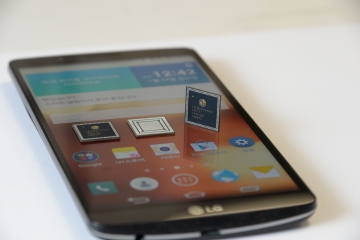
CEVA Imaging & Vision DSP to be Used in LG Electronics Mobile Devices.
CEVA, a leading licensor of mobile phone, multimedia and connectivity IP platforms and DSP cores, announced on the 17th that LG Electronics has adopted CEVA imaging and vision DSP in its mobile device product line.
2016.02.17by
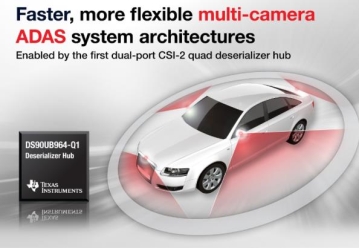
TI Launches Automotive-Standard Hub IC for Designing ADAS Applications
TI announced that it is launching the industry's first dual-port quad deserializer hub product that meets the MIPI Camera Serial Interface 2 (CSI-2) specification. This new automotive-grade hub IC can simultaneously aggregate and replicate high-resolution data from up to four cameras. Additionally, autonomous driving and sensor fusion-based ADAS systems such as surround view systems, rear-view cameras, driver monitoring cameras, camera monitoring systems, front-view camera systems, and satellite radar equipment require high data throughput and precision.
2016.10.19by 홍보라 기자
ON Semiconductor and Hexius Collaborate to Validate Analog IP Blocks
ON Semiconductor announced that it is collaborating with Hexius Semiconductor, a specialized IP development company for analog ICs, to validate various analog IP blocks in the ONC18 0.18 μm CMOS process.
2017.01.11by 김지혜 기자
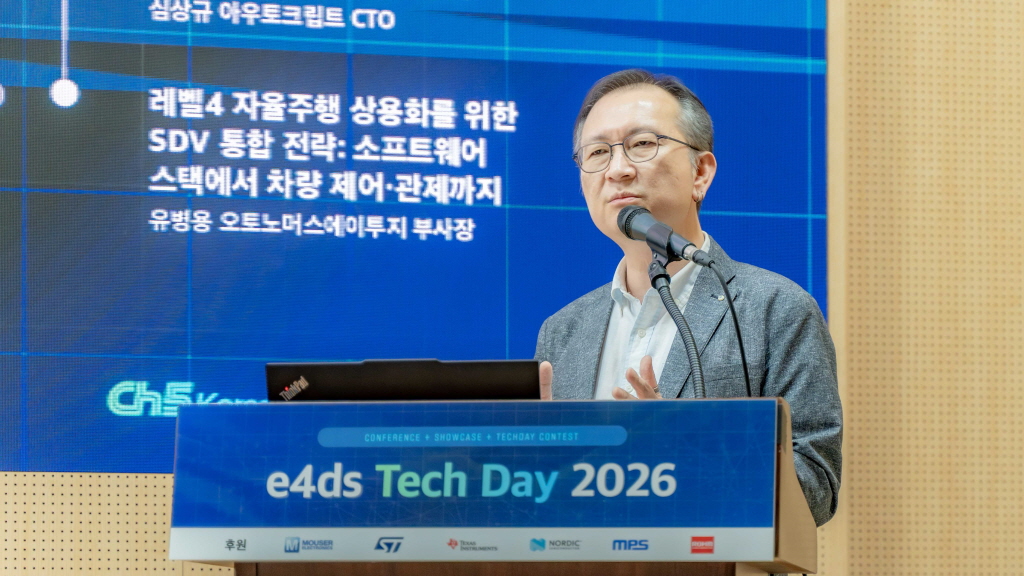
[e4ds Tech Day 2026 ⑨] Sim Sang-gyu, Autocrypt CTO: "In the Physical AI Era, Automotive Security Must Extend Beyond the Vehicle"
At e4ds Tech Day 2026, Sim Sang-gyu, CTO of Autocrypt, explained automotive cybersecurity strategies in the era of Physical AI and SDV (Software-Defined Vehicle). Automobiles are evolving as part of an ecosystem connected to AI, cloud, chargers, IoT, and robots, and he emphasized that the scope of security must expand beyond the vehicle interior to the entire connected environment. In particular, AI model tampering, adversarial attacks, OTA updates, and EV charger hacking were identified as major threats. He explained that response measures require zero trust, AI model integrity protection, intrusion detection, Security by Design and Default, and full lifecycle security management, and that proactive security system establishment beyond regulatory compliance is critical for securing future mobility competitiveness.
2026.10.12by 배종인 기자

Practical HIL Construction Strategy for Automotive and Off-Highway Controller Validation
As vehicle E/E architecture transitions to zonal structures and shifts to software-defined vehicles (SDV), the number of controllers (ECUs) requiring validation and software complexity are surging dramatically. Meanwhile, real vehicle testing cannot provide repeated verification under identical conditions and entails lead time and safety concerns. This white paper explains the principles of HIL (Hardware-in-the-Loop) validation and the structure of the NI platform composed of PXI, SLSC, and VeriStand, and through two actual implementation cases—Camera Record & Replay HIL for In-Cabin Monitoring Controller (ICMU) and Forklift Controller (VCU) HILS—describes how controller-level regression testing becomes possible. Additionally, it explicitly states application boundaries and limitations, such as lack of A2B support.
2026.10.12by 편집부











