


NI Launches Oscilloscope Based on High-Density Design Instrument Technology
 Published2017.07.17 09:12
National Instruments (NI) announced the release of a new 100 MHz, 8-channel oscilloscope based on NI's PXI high-density software-designed instrument technology, along with a new family of PXI arbitrary waveform generators featuring up to two channels and 80 MHz analog bandwidth in a single slot.
Engineers can generate high-performance signals and measure complex waveforms with this affordable and compact mixed-signal instrument mounted in a modular form factor.
The new PXIe-5413, PXIe-5423, and PXIe-5433 arbitrary waveform generators support a Spurious-Free Dynamic Range (SFDR) of -92 dB and an integrated system jitter of 435 fs, and provide precise waveform adjustment capabilities when used with a dedicated standard waveform generation engine.
Equipped with a new fractional resampling architecture for arbitrary waveform generation, it enables similar dynamic range and jitter performance regardless of the user's sampling rate. Additionally, users can utilize multi-instrument synchronization identical to PXI, along with high-speed waveform streaming capabilities.
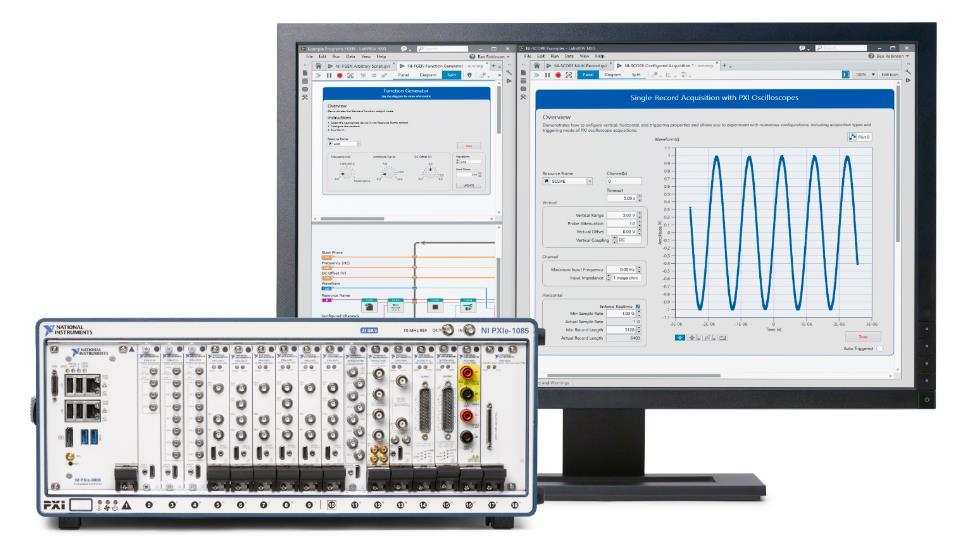
The latest PXIe-5172 oscilloscope includes a user-programmable FPGA. Engineers can use LabVIEW to customize the firmware of this oscilloscope, such as adding inline signal processing or advanced triggering.
Luke Schreier, Director of Marketing for Automated Test Products at NI, stated, “Test engineers need the best technology with the right price and channel count to meet cost, complexity, and time-to-market requirements. The new arbitrary waveform generator family provides software continuity with NI-FGEN drivers for easy technology insertion, and the latest oscilloscopes feature user-programmable FPGAs that can tailor functions to various applications. NI is confident that through PXI’s software-centric and standardized hardware approach to automated testing in both laboratory and production environments, we can provide the flexibility to balance continuous innovation with proven measurement technology.”
Comments
Related news
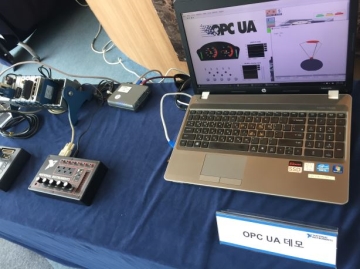
[Photo News] Introducing NI Smart Factory Solutions
National Instruments held a measurement and control symposium on Tuesday the 4th, introducing core technologies and solutions for implementing smart factories. A symposium on the same topic will also be held at BEXCO in Busan on Thursday the 6th.
2017.07.04by 김자영 기자

NI Releases Test Toolkit Compliant with IEEE 802.11ax Standard
National Instruments (NI) has announced WLAN Test Toolkit 17.0, which supports the IEEE 802.11ax standard draft 1.1. WLAN Test Toolkit 17.0, combined with NI's second-generation vector signal transceiver (VST), supports 802.11ax waveform generation as well as characterization, validation, and production test analysis for products implementing IEEE 802.11ax standard draft 1.1, such as RF front-end components, wireless modules, and user devices. WLAN Test Toolkit 17.0 provides designers and engineers with the capability to generate and analyze a comprehensive range of 802.11ax standard-compliant waveforms, including extended single-user, per-user configurable, and multi-user OFDMA and MIMO (Multiple Input, Multiple Output) with measurement results support.
2017.07.12by 김지혜 기자

Intel Unveils Next-Generation 'Core Ultra Series 3' and vPro Platform for Enterprise PCs
Intel has officially unveiled the "Intel Core Ultra Series 3" for next-generation enterprise PCs and the latest vPro platform, addressing a wide range of demands from enterprise notebooks to high-performance workstations.
2026.03.26by 배종인 기자

ROHM Launches ESD Protection Diode Compatible with High-Speed Interfaces of 10Gbps or Higher
Semiconductor specialist ROHM has developed the 'RESDxVx series' of ESD (electrostatic discharge) protection diodes capable of responding to next-generation high-speed data communication environments exceeding 10Gbps, simultaneously enhancing both signal quality maintenance required in high-speed interfaces and IC protection performance.
2026.03.26by 배종인 기자
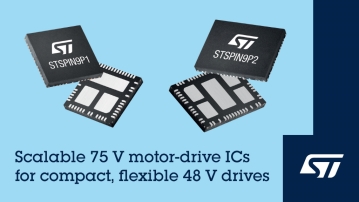
ST Launches 75V Drive IC Targeting 48V Industrial Motor Driving
ST Microelectronics has unveiled the 'STSPIN9P' series of 75V motor drive ICs tailored for 48V-class industrial drive system design. The new product family is characterized by half-bridge and full-bridge configurations that enable design scalability according to motor type and output conditions. Power supply circuits, protection functions, and current sensing circuits are integrated on-chip to simplify system configuration, and the devices are designed to support applications up to 500W maximum. The company plans to provide reference designs and demo boards to support development and evaluation in industrial automation, robotics, pumps, fans, lighting, and textile machinery.
2026.03.26by 배종인 기자











