



[Discussion] Only 3 Personal Information Management Agencies, “Urgent Need to Establish a Control Tower”
 Published2017.08.09 12:01
There has been a claim that the independence and expertise of the organization responsible for protecting and regulating the use of personal information in the big data industry, one of the core tasks of the 4th industrial revolution, should be strengthened.
A discussion was held at the National Assembly on the topic of “Personal Information Protection Control Tower in the Era of the Fourth Industrial Revolution.” The host, Democratic Party of Korea member Byun Jae-il, said in his opening remarks, “We are considering approaches to the technical and institutional issues of big data discussed in the Fourth Industrial Revolution. I hope that through discussions, we can come up with a plan to utilize it to improve the welfare of individuals as well as companies, beyond the level of protecting personal information.”
In Korea, the representative organizations responsible for personal information protection are the Personal Information Protection Commission (PIPC), the Financial Services Commission (FSC), and the Korea Communications Commission (KCC). Professor Kim Il-hwan of the Law School of Sungkyunkwan University, who gave the presentation, emphasized the need for a committee that guarantees independent third-party direction separate from personal information processing, strengthening independence and legal authority, securing expertise, and prohibiting concurrent positions.
“There are many conflicts of opinion because the policies of government ministries are inconsistent. For example, the Financial Services Commission investigated the issue and made legal revisions to the Financial Services Commission and made recommendations. However, when the Financial Services Commission did not accept it and asked for its opinion, the Financial Services Commission said it did not have the authority to do so and did not intend to follow it. Then, the next day, when 100 million pieces of personal information were leaked, they took action.”
Even if the Personal Information Protection Commission makes a decision, government departments do not follow it. The reason was that the evaluation subjects were inconsistent due to the introduction of the legal system. He added that considering trade relations, the EU’s General Data Protection Regulation (GDPR), an international standard, should be referred to.
“The EU has been integrating French and German-style personal data protection agencies, but the trend is to strengthen the French-style ‘permission system’ that grants intervention authority to the protection agency, rather than the German-style ‘consultation system’ that provides post-control and advice functions. This is something that our country can refer to in relation to expanding the authority of the Personal Information Protection Commission.”
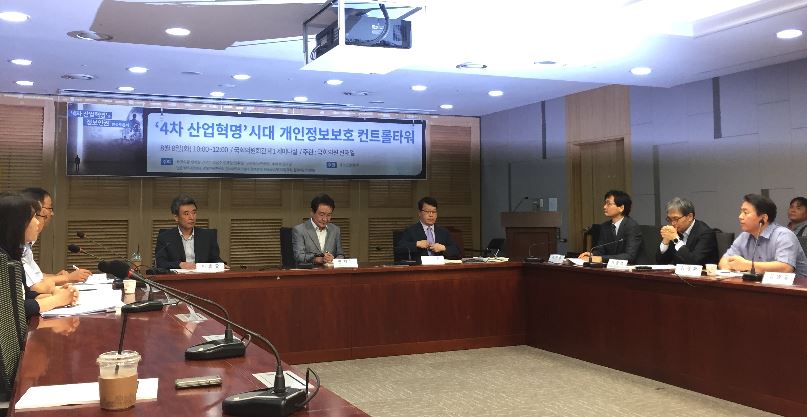
Discussion panel on the right and government officials on the left
Professor Kim Il-hwan: "The reality is that the public knows about Naver's privacy, but they don't know about the government's privacy.
The discussion was attended by lawyers, the Information Human Rights Research Institute, part-time professors at the Police Teachers College, and officials from the Personal Information Protection Commission, the Ministry of Government Administration and Home Affairs, and the Korea Communications Commission. They agreed that the independence of the supervisory body should be strengthened.
On the other hand, regarding the unification of the supervisory organization, Lee Chang-beom, a part-time professor at Dongguk University's Police Education College, and Kim Gyeong-hwan, a lawyer at Minhoo Law Firm, expressed differing opinions, saying, "It is still too early."
Attorney Kim: “I think it would be a realistic solution to integrate the Information and Communications Network Act and credit information, medical information, school information, etc. into the Personal Information Protection Act and add special laws for each field as needed. This functional integration would reduce overlapping regulations and make it easier to comply with the law.”
There were also voices acknowledging the unique nature of the Personal Information Protection Supervisory Commission and calling for increased efficiency in line with the characteristics of the field.
Eunwoo Lee, director of the Information Human Rights Research Institute, said about the use of personal information, “We need a supervisory body that has a vision for personal information protection and sets directions and theories. In that regard, he argued, “The Korea Communications Commission has a wide scope of work, so it is only scratching the surface, and there is a lack of new content and impact assessments.”
Photo source: Personal Information Protection Commission website
Since its launch in 2011, the Personal Information Protection Commission has been responsible for: △deliberating and deciding on major policies related to personal information protection and improving laws and systems; △coordinating opinions among public institutions related to personal information protection; △recommending improvement measures such as cessation of infringements by central administrative agencies, local governments, and constitutional institutions; and △preparing and submitting to the National Assembly the annual report on personal information protection.
Ministry officials expressed their views on each sector, saying that the agencies are divided because each industry requires expertise and understanding.
Jang Han, head of the Personal Information Protection Policy Division of the Ministry of the Interior and Safety, said, “We need to discuss ways to legislate ethical steps in the safety system and accurately hold people accountable and compensate them afterward. Even if the agency used personal information because it was necessary, from the perspective of the person in charge of the information, there is a need to adjust interests because misuse can cause damage.”
Bae Sang-ho, head of the Personal Information Protection Commission’s dispute resolution division, emphasized the need to ensure autonomy and independence in budget and personnel organization, saying, “The Personal Information Protection Commission has never had the authority to investigate and supervise, and has no budget, so it has no actual execution ability. Most of its members hold concurrent positions.” He continued, “The censorship procedures by field are complicated, and we are also confused. He suggested a direction, saying, “We need to set a single goal orientation through unification tailored to the customer’s position.”
Choi Yoon-jung, head of the Personal Information Protection Ethics Division of the Korea Communications Commission, supported Director Bae’s statement by saying, “If the Personal Information Protection Commission is to strengthen its control tower and suggest a direction to move forward, it is desirable for related ministries to take the Personal Information Protection Commission as their goal.” Regarding special laws by sector, Director Choi added, “It seems appropriate to supplement special laws to reflect the characteristics of each sector. However, overlapping parts need to be reorganized to increase the accuracy of the legal system.”
관련뉴스

Controversy over Haeundae vacationer count, big data technology identifies duration of stay
How accurately are the number of vacationers that are commonly used as a reference point in news actually measured? So far, the count of vacationers at Busan Beach, which is called the 'mecca' of domestic beaches in Korea, has been a matter of controversy. However, starting this year, Haeundae-gu is expected to resolve such controversies by utilizing big data analysis techniques based on location information from mobile phones to count the number of vacationers. SK Telecom and NexN Information Technology (CEO Lee Young-seon) investigated the number of vacationers at Haeundae and Songjeong beaches using location information from smartphones and supplied this information to Haeundae-gu, Busan. According to this information, during the first weekend of the full vacation season on July 28-30, the number of vacationers at Haeundae and Songjeong beaches was counted as 671,030.
2017.08.02by 신윤오 기자

[Survey Results] When asked what it was like to have a robot boss in the era of the Fourth Industrial Revolution, the answer was
Technology innovation promoted by intelligent information technology, the integration of digital into human daily life, an era where reality and virtuality are integrated through robots and artificial intelligence (AI) and objects can be intelligently controlled—there are various definitions of the Fourth Industrial Revolution. So what is the actual substance of the Fourth Industrial Revolution? In the current domestic context, the Fourth Industrial Revolution is viewed as timely and necessary, while there appears to be concern that the entities that should lead the Fourth Industrial Revolution are unclear and that it lacks concrete substance. It was found that the concept of the Fourth Industrial Revolution is deemed necessary for industrial restructuring centered on artificial intelligence, Internet of Things, and big data (34.52%), and because a new technological phase has arrived following the Internet information revolution (20.24%).
2017.08.07by 김지혜 기자
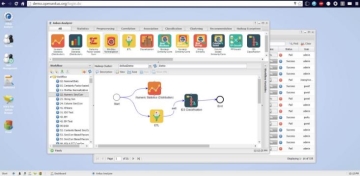
Honeycomb, Big Data Analysis with Open Source SW Platform
Big data is no longer an unfamiliar term. Beyond government and public sectors, the volume of data generated in real-time by individuals is increasing exponentially. How to collect and analyze the growing data determines the value of big data. To analyze big data, a big data platform—the IT environment necessary to process and analyze diversely collected data, extract knowledge, and provide intelligent services based on that knowledge—and experts are required. Onycom (www.onycom.com), a company providing solutions and services in big data, Internet of Things, and cloud, recently released 'Ankus Analyzer G', a big data analysis platform for public institutions, as open source. Ankus is divided into an open source version managed by the community and a commercial version managed by Onycom.
2017.08.09by 김지혜 기자

Nvidia invests $5 billion in Intel
NVIDIA and Intel, leaders in global AI computing technology, are now forging ahead in providing cutting-edge solutions through NVLink-based architecture integration. NVIDIA and Intel have officially announced a strategic partnership and stated that they will jointly develop customized data center and personal computing products to accelerate diverse applications and workloads ranging from hyperscale to enterprise and consumer markets, thereby laying the foundation for the next generation computing era.
2025.09.22by 배종인 기자
.jpg)
Applied Materials Launches Environmental Protection Campaign to Mark World Cleanup Day
Applied Materials Korea (CEO Park Kwang-seon) is carrying out environmental cleanup activities with employees and their families around the Dongtan Sinricheon area on the occasion of World Cleanup Day, evolving into a company that engages with the local community beyond technological innovation.
2025.09.22by 명세환 기자











