

.png)

What blockchain needs to be applied to the financial industry
 Published2017.08.10 06:38
Blockchain commercialization requires public awareness and technology
A forum has been prepared to discuss how blockchain, a technology gaining worldwide attention, is being applied to the financial industry and how it will be applied to the domestic financial industry.
The Ministry of Science and ICT and the Korea Information Society Development Institute (NIA) hosted the 'Blockchain Technology and the Future of the Financial Industry Workshop' on the 9th at Sangam Nuri Dream Square.
Lee Hyun-dong, team leader of the ICT Convergence Division at the Korea Information Society Development Institute, said, "The value of hyper-distribution and connectivity of blockchain aligns with the IoT activation foundation-building project that has been ongoing since 2015."
The event proceeded with topics including cryptocurrency market prospects and legal status, the future of blockchain technology and the financial industry, and IoT pilot projects utilizing blockchain technology.
Han Seung-hwan, CEO of Finector, stated, "Blockchain is a system that can become its own bank with the largest network and ripple effect among cryptocurrencies currently available" and "the ICO (Initial Coin Offering) sector is thriving," introducing the current status of ICOs including Ethereum, Cosmos, Aragon, Banco, EOS, and BOScoin.
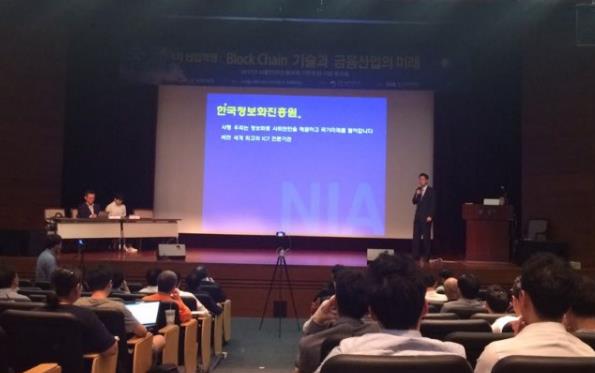
Currently, there are no regulations for cryptocurrencies. At best, Switzerland and Singapore, the countries where ICOs are currently most active, have specialized corporations and adopt legal forms. The United States, being sensitive to financial sanctions, has a considerable number of ICOs that block American citizens from participating.
The reason cryptocurrency is difficult to regulate is that perfect control is impossible with a P2P financial system. Additionally, since the issuing entity is neither government nor institution, it cannot function as an interest rate adjustment mechanism. Cases where customers self-authenticate and purchase quantity registration fails are common, and it is sometimes used for money laundering.
The CEO said, "Each country has different positions on how to define cryptocurrency," and explained, "In the case of Bitcoin, it is not something one specific country can regulate. Rather, countries that impose regulation could end up dropping out of the global economy."
He added, "Blockchain can be viewed from three perspectives: investment asset, currency, and technology, and it is currently receiving attention as an investment asset. However, for technology commercialization, it is necessary to enter the currency market," and noted that "the lack of public awareness and insufficient commercialization-level technology are problems," emphasizing the need for mass-market testing.
Baek Jong-chan, consultant at R3, cited reasons why blockchain should be applied from a financial perspective: "In existing finance, the reconciliation process of confirming whether information is identical involved recording first and then verification. Blockchain records simultaneously with verification, which is more efficient," and pointed out "in the concept of system upgrade, the speed of information is faster than the speed of funds."
He mentioned that for blockchain to be applied to the financial industry, confidentiality, ledger authority, compatibility with existing systems, scalability, asset modeling, and legal validity must be prerequisites.
Related news

Insurance claims can now be made via blockchain
As blockchain emerges as a key technology of the Fourth Industrial Revolution, the government has begun its preparations. The Ministry of Science, ICT and Future Planning and the Korea Information Society Development Institute have selected blockchain as a pilot project for 2017 and will hold a kick-off meeting. Blockchain is the underlying technology of Bitcoin, a virtual currency, and is a technology that enables data integrity and reliability to be secured without an authorized third party by jointly validating, recording, and storing data within a network.
2017.04.20by 김지혜 기자
Samsung SDS Presents Future Vision of Blockchain in Europe
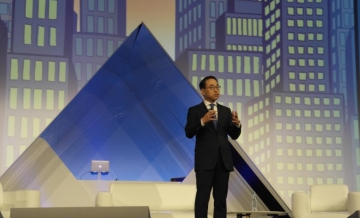
Samsung SDS introduced its blockchain technology and presented future business vision at "Money 20/20 Europe," Europe's largest global fintech conference. "Money 20/20 Europe" is a global financial innovation and fintech event where more than 1,500 global companies participate, including financial institutions such as banks and card companies, as well as companies from mobile and retail sectors. President Hong Won-pyo took the stage as a keynote speaker at "Money 20/20 Europe" and introduced Samsung SDS's blockchain platform NexledgerTM under the theme "Commercialization of Blockchain, Beyond Digital Finance." He presented blockchain expansion models including insurance claim processing and payment automation, which are types of smart contracts, as well as digital logistics.
2017.06.28by 김지혜 기자
KT Fasters Electronic Signature Image Processing with Blockchain
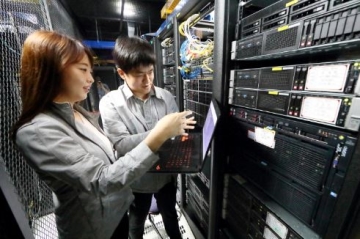
KT announced on the 4th that it has developed the world's first Electronic Data & Signature Capture (ESC) management system utilizing blockchain technology and applied it to BC Card. Blockchain is a technology that prevents data forgery and hacking by distributing and storing transaction information in blocks rather than storing it in a centralized server. For example, when A transmits electronically signed data, financial companies B and C connected via blockchain verify the transmitted data and share identical data. In this way, data is jointly (P2P) verified, recorded, and shared (Chain), which prevents data deletion and tampering or falsification. KT, in partnership with BC Card, independently developed an Electronic Signature Image (ESC) management system utilizing blockchain, which is evaluated as a next-generation security technology.
2017.07.04by 김자영 기자

The financial services industry is the most active in adopting hybrid cloud.
Nutanix announced the cloud adoption status and outlook for the financial services industry through its Enterprise Cloud Index report. According to a survey of current hybrid cloud adoption rates by industry, the financial services industry's hybrid cloud adoption rate was 21%, which was higher than the industry average of 18.5%. Financial services companies are facing the challenge of providing differentiated experiences to customers through methods such as leveraging emerging technologies like blockchain, while simultaneously simplifying operations.
2019.04.02by 이수민 기자

IBM Blockchain World Wire… Real-time global financial payment network expands to over 50 countries worldwide
IBM announced on the 19th the expansion of IBM Blockchain World Wire, a real-time global financial settlement network for financial institutions. World Wire was developed to accelerate and optimize foreign exchange transactions and cross-border payment and remittance speeds. Additionally, it integrates payment message transmission, clearing, and settlement procedures into a single network while supporting network participants in selecting various types of digital assets for settlement. Starting from the 19th, the payment service area will be expanded to 72 countries, including 47 global currencies and 44 financial endpoints. Busan Bank became the first domestic bank to join World Wire.
2019.03.19by 이수민 기자











