


Symantec warns of Dragonfly attacks targeting the energy sector.
 Published2017.09.08 15:21
Symantec has warned of a renewed surge in attacks targeting the energy industry by the cyber espionage group Dragonfly.
A new type of cyberattack targeting the energy industry in Europe and North America is potentially devastating. The group behind these attacks is known as Dragonfly. Active since at least 2011, the Dragonfly attack group was revealed in 2014 and then went quiet for a while before resurfacing in the past two years. The second wave of Dragonfly attacks appears to have begun in late 2015, employing the same tactics and methods employed in the initial attacks.
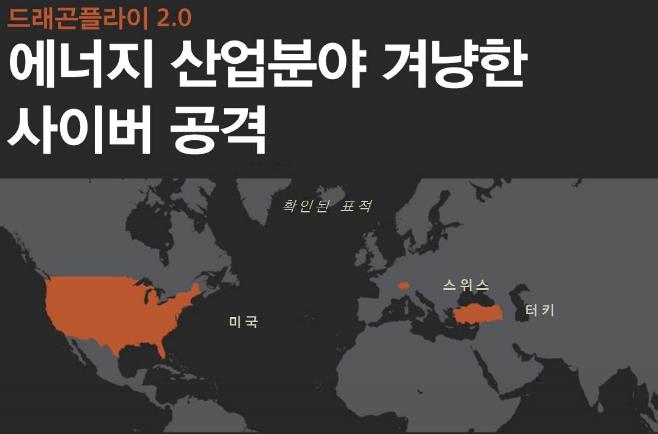
According to Symantec's research, so-called "Dragonfly 2.0" attacks have seen a marked increase this year. Symantec has observed strong indications of Dragonfly activity targeting companies in the US, Turkey, and Switzerland, as well as evidence of activity targeting companies in other countries. While the US and Turkey were also targeted during the initial Dragonfly attacks, the latest attacks reveal a significant increase in attacks targeting Turkish companies.
The Dragonfly 2.0 attack, similar to the initial attack, uses various attack methods to gain access to the victim's network, including ▲malicious emails ▲watering hole attacks ▲Trojan horse-loaded software. The first attack detected by Symantec in the resurfaced Dragonfly campaign was a December 2015 attack where malicious emails disguised as year-end party invitations were sent to targets in the energy sector.
They also used watering hole attacks to infect websites likely visited by industry workers, stealing network credentials. These stolen credentials were then used in subsequent attacks, including installing backdoors against targeted organizations. In attacks conducted in 2016 and 2017, the Dragonfly group leveraged the evasion framework Shellter to develop applications loaded with Trojans. Symantec has also observed the Dragonfly group compromising legitimate software to deliver malware to victims.
The "energy industry," targeted by the Dragonfly Group, has seen increased interest from cyber attackers over the past two years. The most notable cyberattack, the 2015-2016 Ukrainian power outage, was caused by a cyberattack, resulting in a blackout affecting hundreds of thousands of residents. More recently, there have been reports of attempted attacks on power grids in some European countries and hacking of companies managing nuclear power plants in the United States. The Dragonfly Group appears to be interested in learning how energy facilities operate and accessing the operating systems themselves, raising the possibility of sabotaging or controlling these systems.
The original Dragonfly campaign appears to have been nothing more than a "discovery phase," where the attackers simply sought to gain access to the networks of targeted organizations. However, given the potential for more destructive objectives in recent campaigns, including access to operating systems, this suggests a new phase of attack is likely.
The most notable aspect of the recently confirmed Dragonfly attack is the attackers' use of screen capture. Attackers have been observed displaying screen capture files using easily identifiable formats, such as [device description and location] and [organization name]. The string "cntrl" used in many device descriptions appears to indicate that the devices have access to the operating system.
Yoon Gwang-taek, CTO of Symantec Korea, said, “The Dragonfly attack group has been targeting energy companies’ networks using complex attack methods, and the level of their attacks suggests that they may not stop there but may even develop into cyber sabotage.” He urged, “Domestic companies should also always update their software to the latest version and apply security patches to avoid being harmed.”
Comments
Related news
Advantech "No IoT Standards Yet, Must Build Ecosystem First"
"IoT exists across all fields including smart farms, parking lots, roads, smart metering, and logistics. We must achieve innovation for future lifestyles. However, since there are no standards in IoT, we must build an ecosystem to drive innovation," said Miller Chang, president of the Embedded IoT Group, at the 2017 Advantech Embedded Design-in Forum. He continued, "We will establish close collaboration with various ecosystem partners and pioneer the IoT market to create real business opportunities." In the past, discussions with customers primarily focused on I/O and optimization-based functionality, but in the IoT era, 'connectivity' has become the priority. Additionally, he stated that services related to security and data analysis, as well as remote device management, have become increasingly important.
2017.09.07by 김자영 기자

Silicon Labs Launches Magnetic Sensors for Comprehensive Open/Close and Position Sensing
Silicon Labs has announced opening a new chapter in the hall-effect sensor field by introducing a magnetic sensor product family that delivers industry-leading power efficiency, best-in-class sensitivity, flexible I2C configuration, built-in tamper detection and temperature sensing capabilities. Silicon Labs' new Si72xx portfolio includes the most advanced and feature-rich magnetic sensor product family that surpasses reed switches and conventional hall-effect sensor products currently used in a wide range of open/close and position sensing applications. The Si72xx magnetic sensors provide robust reliability for white goods appliances, flow meters, cordless power tools, dial-type controls for consumer electronics, industrial alarms, motor control, and door/window security applications. These sensors guarantee AEC-Q100 quality for automotive applications and are designed to withstand harsh industrial environments.
2017.09.07by 김지혜 기자

The Backlash of IoT Security: Intact Drones Crash and Moving Cars Stop
There have been cases where refrigerators opened and closed multiple times a day, vacuum cleaners that traverse throughout the home, and TVs that people sit facing have been hacked. In 2014, when IoT security was being discussed, Proof Point, an American security company, revealed that malicious emails were being sent three times a day in units of 100,000 to not only enterprises and individuals but also home appliances. It goes beyond simply receiving them—hackers can control cameras attached to devices. The cameras in vacuum cleaners and TVs can become the eyes of hackers, allowing them to photograph every corner of the home.
2017.09.07by 김자영 기자
.png)
Databricks Unveils Open AI Security Monitoring 'Lakewatch'
Databricks entered the security market on March 24 by unveiling LakeWatch, an open-source agentic SIEM. The core functionality of this product is to integrate and analyze security, IT, and business data in a single environment to support AI-based threat detection and investigation. The company explained that it reduces the limitations of existing security operations centers, which have had to forgo some data due to high cost structures, and enables large-scale data analysis and automation based on open formats and ecosystems. LakeWatch is currently offered as a private preview, with Adobe and Dropbox mentioned as early customers. Databricks also announced an expanded partnership with Anthropic as well as the acquisition of Antimatter and SiftD.ai.
2026.03.26by 배종인 기자

Kaspersky Unveils Revamped 'NEXT' Combining SOC Integrated Management and AI Analytics
As enterprises increase demand for integrated management and automation in the construction and operation of Security Operations Centers (SOC), Kaspersky has disclosed updates to its B2B security product suite 'Kaspersky Next'. This update expands EPP, EDR, XDR, and SIEM integration through a single console based on OSMP, incorporates AI capabilities such as DLL hijacking detection and suspicious account takeover behavior identification, and includes integration with generative AI assistant tool KIRA. The company stated that in large-scale deployment environments, EDR Expert can reduce resource requirements by up to 30%, and XDR Expert by up to 60%.
2026.03.25by 배종인 기자











