


Successful development of next-generation magnetic memory technology operating at ultra-high speed
 Published2017.10.20 09:37
A technology has been developed to improve the speed of next-generation domain wall-based magnetic memory.
This research was developed by a research team led by Professor Gapjin Kim of the Korea Advanced Institute of Science and Technology and Professor Kyungjin Lee of Korea University, and was published in the September 25th issue of Nature Materials, a journal in the field of physics and materials science.
Conventional hard disks have the non-volatile characteristic of being able to retain information without an external power supply, but they had limitations such as high energy consumption and slow speed because they store information by rotating a disk.
Domain wall memory is a novel memory device characterized by non-volatile, low-power properties that operates through the movement of domain walls in magnetic nanowires rather than mechanical rotation. However, as the operating speed remains at several hundred m/s, the development of core technologies to increase the operating speed is required for practical application.
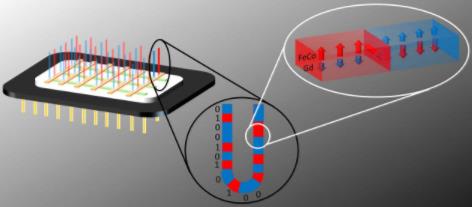
While most research on domain wall memory uses 'ferromagnetic' materials, the research team utilized the 'ferrimagnetic' GdFeCo and discovered a phenomenon where the movement speed of domain walls accelerates rapidly to several km/s under specific conditions.
In the case of ferromagnetic materials, the magnetization within the material is directed in one direction, making it impossible to avoid the Walker decay phenomenon, which is known as the cause of low speed.
However, in GdFeCo, the magnetization of Gd and FeCo is aligned antiparallel, so the Walker decay phenomenon disappears at the point where the sum of the two angular momentum is zero, and the velocity of the domain walls was successfully increased to more than 2 km/s at room temperature.
If ultra-high-speed operation characteristics are added to domain wall memory based on this research achievement, it is expected to become a next-generation memory with high integration, low power consumption, and non-volatility that surpasses hard disks.
Professor Kim Gap-jin stated, “This research is significant in that it discovered a new physical phenomenon that occurs at the point where the angular momentum of a ferrimagnetic material is zero, and it is expected to accelerate the realization of next-generation memory in the future.”
Comments
Related news
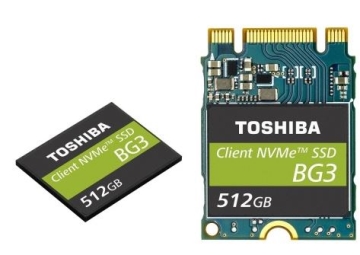
Toshiba Launches NVMe Client SSD Utilizing 64-Layer 3D Flash Memory
Toshiba Memory Corporation, a global leader in memory solutions, today announced the launch of its new BG3 series of single-package NVM Express (NVMe™) client SSDs that integrate its cutting-edge 64-layer 3-bit-per-cell (TLC) BiCS flash memory and ball grid array (BGA) package controller. Toshiba Memory Corporation has begun sample shipments to PC OEM customers in limited quantities today, with plans to gradually increase shipment volumes starting in the fourth quarter of this year.
2017.08.04by 김자영 기자
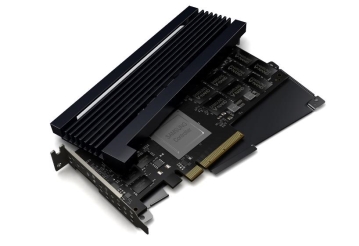
Samsung Electronics Unveils Largest Capacity V-NAND SSD Solution at Flash Memory Summit
Samsung Electronics showcased the world's largest capacity V-NAND and next-generation SSD solutions at the 'Flash Memory Summit 2017' held at the Santa Clara Convention Center in the United States. At this summit, Samsung Electronics unveiled innovative V-NAND-based new technologies including △the world's largest capacity '1Tb V-NAND' △'NGSFF (Next Generation Small Form Factor) SSD' which can improve integration density of server systems △'Z-SSD' which significantly enhances performance compared to existing SSDs △'Key Value SSD' which applies a novel data storage method. At the summit, Samsung Electronics announced a '1Tb NAND' that doubles the capacity of the '3-dimensional Cell' used for data storage compared to the existing standard (512Gb). The '1Tb NAND' can create 2TB in a single package by stacking 16 layers, making it possible to dramatically increase SSD capacity. Samsung plans to fully launch SSD products with maximum capacity featuring 1Tb V-NAND in 2018.
2017.08.09by 김지혜 기자
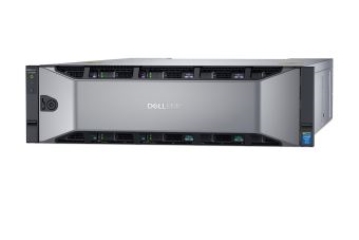
Dell EMC Launches New Mid-range Storage Products with Increased Bandwidth and Memory
Dell EMC introduces a new SC series enterprise-grade storage product, 'SCv3000'. Compared to the previous generation SCv2000, the new product features twice the memory and three times the bandwidth. Consequently, performance has increased by 50%, achieving a maximum of 270,000 IOPS (input/output operations per second).
2017.10.12by 김자영 기자
.jpg)
SalePoint Signs Multi-Year Partnership Agreement with AWS… Promoting Identity Security that Integrates Even AI Agents
Sailpoint has entered into a multi-year strategic partnership agreement with AWS and is moving forward with establishing an integrated governance system that manages both human and non-human identities together. The plan is to consistently manage access permissions in an environment where AI agents are increasing as work execution entities, while applying the principle of least privilege and automated policy enforcement. The two companies plan to jointly expand capabilities to manage the identities of various entities, including AI agents, within a single layer in the AWS environment. This collaboration is interpreted as a move to design security and governance together in corporate environments where AI adoption is expanding.
2026.03.26by 배종인 기자
.png)
Databricks Unveils Open AI Security Monitoring 'Lakewatch'
Databricks entered the security market on March 24 by unveiling LakeWatch, an open-source agentic SIEM. The core functionality of this product is to integrate and analyze security, IT, and business data in a single environment to support AI-based threat detection and investigation. The company explained that it reduces the limitations of existing security operations centers, which have had to forgo some data due to high cost structures, and enables large-scale data analysis and automation based on open formats and ecosystems. LakeWatch is currently offered as a private preview, with Adobe and Dropbox mentioned as early customers. Databricks also announced an expanded partnership with Anthropic as well as the acquisition of Antimatter and SiftD.ai.
2026.03.26by 배종인 기자











