



ST Launches ACEPACK Module Offering Cost-Effective High-Density Power Conversion
 Published2018.03.23 14:44
STMicroelectronics (ST) has launched a new ACEPACK (Adaptable Compact Easier PACKage) module that delivers cost-effective high-density power conversion.
The module is suitable for 3 to 30KW applications including industrial motor drives, air conditioning, photovoltaic generators, welders, battery chargers, UPS controllers, and electric vehicles.
ST's space-efficient low-profile ACEPACK technology combines high power density and reliability in an economical plastic package. The technology simplifies assembly by employing an optional solder-free press-fit connection method instead of conventional soldering pins, and provides metal screw clamps for fast and reliable mounting.
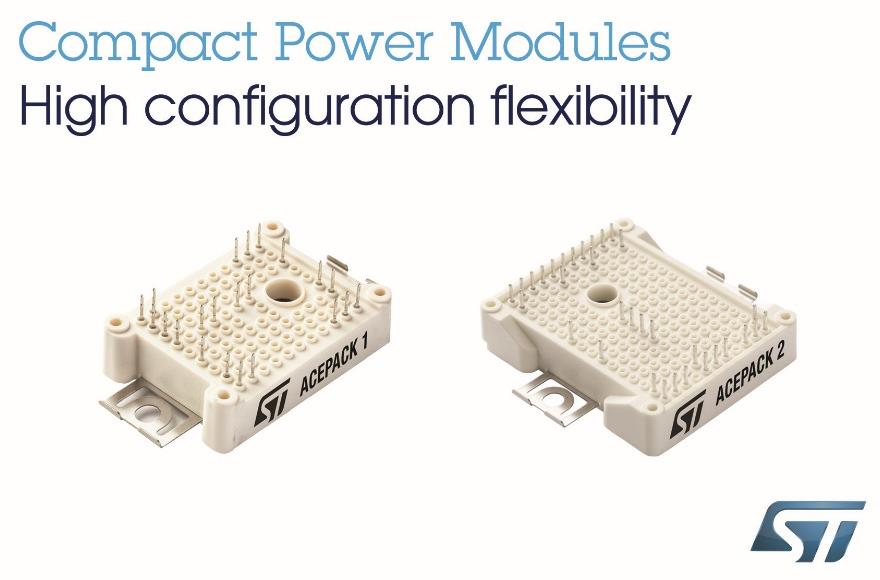
ST's third-generation Field-Stop Trench IGBT delivers an optimal combination of low on-resistance and high switching performance. Two configurations are optionally available: a 6-pack module containing six IGBTs with Freewheel diodes in a three-phase inverter, or a PIM (Power Integrated Module) providing a complete driver power stage. The PIM is a CIB (Converter-Inverter-Brake) device that integrates a three-phase rectifier, three-phase inverter, and a braking chopper that handles energy returned from the load. Both types include NTC thermistors for temperature sensing and control.
Various PIM/CIB and 6-pack devices are available in ACEPACK 1 size with 650V or 1200V IGBT, and in the larger ACEPACK 2 size, with rated currents ranging from 15A to 75A. The internal layout of this module is optimized for low parasitic inductance and low EMI emission, making it easy to meet EMC regulations, and 2.5kV isolation ensures reliable performance even under harsh operating conditions. Since all modules support a maximum operating temperature of 175°C, designers have greater flexibility in optimizing heatsink size and power consumption.
Comments
Related news
ST Launches STM32 PMSM FOC Development Kit with Integrated Ecosystem
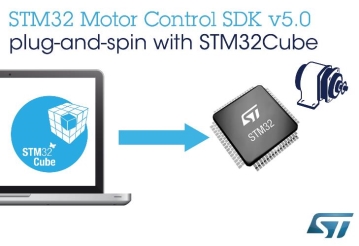
ST Microelectronics (ST) combines its latest STM32 PMSM FOC software development kit (SDK) with the STM32Cube ecosystem (order code: X-CUBE-MCSDK) to enable simpler development of energy-efficient advanced motor drives on STM32 microcontrollers. With the launch of this solution, engineers now have expanded opportunities to implement sophisticated drives for air conditioners, home appliances, drones, building automation, industrial machinery, medical devices, e-bikes and many other equipment without specialized experience.
2018.03.20by 김지혜 기자
ST Launches ToF Sensor with Improved Distance Measurement Range
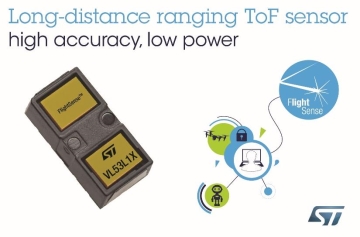
STMicroelectronics (ST) has launched the VL53L1X, a new time-of-flight (ToF) sensor that extends distance measurement range to 4 meters using FlightSense technology. Unlike simple infrared (IR) technology that only measures signal strength and is susceptible to the reflectivity of objects, FlightSense sensors directly measure the distance to a target by utilizing the time-of-flight of photons reflected from the target, enabling precise distance measurement regardless of the surface characteristics of the target object.
2018.03.21by 김지혜 기자

Belankani-ST, Cooperation on Smart Meters for 'Make in India' Program
ST Microelectronics has announced a collaboration with Velankai Electronics to design and develop Velankai's Prism smart meter for the Indian market. Through this technology partnership, ST's advanced components including the smart meter SoC (System-on-Chip) STCOMET, combined with Velankai's industrial manufacturing capabilities and expertise in smart meter design and implementation, will further advance India's advanced metering infrastructure. The G3-PLC smart meter based on STCOMET integrates all major smart meter functions on a single chip, addressing many requirements of the smart grid market. This meter connects consumers and suppliers to provide real-time metering and data analysis.
2018.03.22by 김지혜 기자

Intel Unveils Next-Generation 'Core Ultra Series 3' and vPro Platform for Enterprise PCs
Intel has officially unveiled the "Intel Core Ultra Series 3" for next-generation enterprise PCs and the latest vPro platform, addressing a wide range of demands from enterprise notebooks to high-performance workstations.
2026.03.26by 배종인 기자
ROHM Launches ESD Protection Diode Compatible with High-Speed Interfaces of 10Gbps or Higher
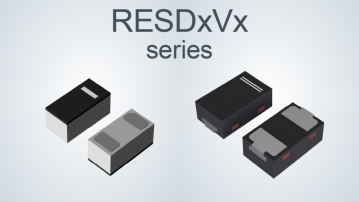
Semiconductor specialist ROHM has developed the 'RESDxVx series' of ESD (electrostatic discharge) protection diodes capable of responding to next-generation high-speed data communication environments exceeding 10Gbps, simultaneously enhancing both signal quality maintenance required in high-speed interfaces and IC protection performance.
2026.03.26by 배종인 기자











