



KETI Successfully Develops Solid-State Bonding Technology for SiC Power Semiconductor Packaging
 Published2018.12.11 07:01
High thermal conductivity and voltage withstand characteristics, low resistance
Silver sintered bonding, SiC high-temperature operation guaranteed

Electronics Components Research Institute
The Korea Electronics Technology Institute (KETI) announced on the 10th that it has developed a solid-state bonding technology for packaging silicon carbide (SiC) power semiconductors using silver (Ag).
Solid-state joining refers to joining different types of materials in a solid state without melting.
Silicon carbide (SiC) semiconductors, along with gallium nitride (GaN) and others, are wide bandgap (WBG) semiconductors that have stable high-temperature operation, high thermal conductivity, low resistance, and high breakdown voltage characteristics compared to conventional silicon (Si) semiconductors.
Therefore, WBG semiconductors can simplify the heat dissipation structure. Since the area is 1/300 and the thickness is 1/8 compared to Si semiconductors, integration of power conversion modules is possible, and energy loss during power conversion can also be reduced.
Generally, during power conversion, the energy loss of SiC semiconductors is more than 70% lower than that of Si semiconductors, and in the case of inverters made of SiC power semiconductors, the energy efficiency is more than 1~2% higher. This is the reason why research into the commercialization of WBG semiconductors has recently gained momentum.
The key is the packaging material and the packaging method. This is because when operating at high temperatures above 300°C, the bonding material of the packaging material applied to existing Si power semiconductors can turn into a liquid.
Currently, research is underway on soldering using high-melting-point solder, transition liquid-phase bonding using low-melting-point bonding materials, and sintering bonding using high-melting-point materials; however, the environmental issues caused by lead (Pb) in the case of soldering and the long process time in the case of transition liquid-phase bonding are disadvantages.
While research related to sintering bonding is receiving the most attention, defects caused by the high temperatures and pressures required for the process are cited as a stumbling block to commercialization. However, the solid-state bonding technology developed by the research team of Dr. Oh Cheol-min and Dr. Hong Won-sik at KETI has eliminated the root cause of these defects.
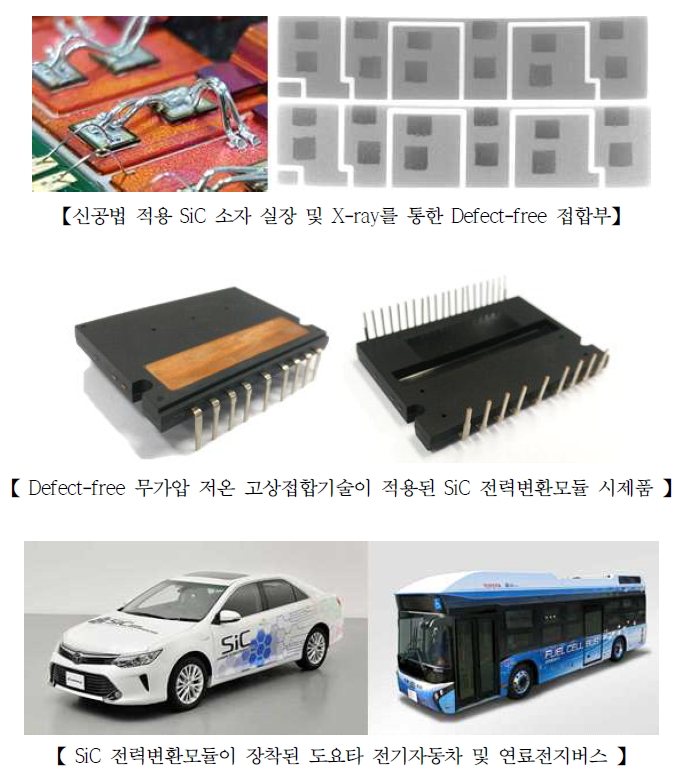
Since the process is conducted at low temperatures that reduce thermal deformation of semiconductors and modules without applying the pressure typically used in general solid-state bonding (such as sintering), separate pressure structures for each product are unnecessary. Furthermore, it has high reliability as there are no internal defects in the packaging material, such as voids, which can increase the electrical and thermal resistance of the semiconductor.
In addition, due to the material properties unique to Ag material, such as high melting point, high thermal conductivity, and high electrical conductivity, stable high-temperature operation of SiC is possible, and the thermal resistance is more than 30% lower than that of conventional bonding materials, so the heat dissipation properties are also excellent.
Dr. Oh Cheol-min of KETI stated, “With the newly developed pressureless low-temperature process, the performance of SiC semiconductors can be transferred directly to the module through the junction,” adding, “We expect it to be applied to power conversion modules requiring stricter durability, such as electric vehicles, robots, and smart factories in the future.”
Meanwhile, this technology was jointly developed with JMJECO and the Korea Advanced Institute of Science and Technology with support from the Ministry of Trade, Industry and Energy's energy technology development project, and was recently selected as one of the top 100 excellent national R&D projects of 2018 by the Ministry of Science and ICT.
Comments
Related news

KETI Develops Korea's First AI-Based Sign Language Recognition Technology
The Electronics and Telecommunications Research Institute has developed Korea's first artificial intelligence-based sign language recognition technology. The developed technology performs machine learning based on bidirectional LSTM, a type of recurrent neural network. This technology extracts feature points from the hands, face, and mouth of sign language performers and interprets them into Korean sentences.
2018.09.21by 이수민 기자
ST Launches STM32L MCU for Long-Lasting Small Smart Devices
STMicroelectronics has released the MCU STM32L412 and STM32L422 with key feature sets and compact package options. These MCUs deliver ultra-low power technology and excellent performance for cost-sensitive consumer, industrial, and medical applications, enabling use without concern for conditions such as core performance, energy consumption, physical space, and material costs.
2018.11.23by 이수민 기자

ROHM Launches 1700V SiC Power Module, Delivering Both Low Power and Reliability
Rohm has released the BSM250D17P2E004, a 1700V-rated full SiC power module that maintains low-power characteristics while enhancing reliability. Rohm's new power module has successfully suppressed leakage current by preventing insulation breakdown through the introduction of new coating materials and new manufacturing processes. In the HV-H3TRB test, no insulation breakdown occurs even after exceeding 1000 hours, enabling safe handling of high withstand voltage of 1700V even in high-temperature, high-humidity environments.
2018.12.10by 이수민 기자

Intel Unveils Next-Generation 'Core Ultra Series 3' and vPro Platform for Enterprise PCs
Intel has officially unveiled the "Intel Core Ultra Series 3" for next-generation enterprise PCs and the latest vPro platform, addressing a wide range of demands from enterprise notebooks to high-performance workstations.
2026.03.26by 배종인 기자

ROHM Launches ESD Protection Diode Compatible with High-Speed Interfaces of 10Gbps or Higher
Semiconductor specialist ROHM has developed the 'RESDxVx series' of ESD (electrostatic discharge) protection diodes capable of responding to next-generation high-speed data communication environments exceeding 10Gbps, simultaneously enhancing both signal quality maintenance required in high-speed interfaces and IC protection performance.
2026.03.26by 배종인 기자











