


ST Announces ePCM Performance and Benchmark for Automotive MCU
 Published2019.01.11 09:02
Operates at temperatures up to +165°C
Also provides radiation tolerance
STMicroelectronics announced the architecture and performance benchmarks of its ePCM (embedded Phase-Change Memory) designed for automotive MCUs and technology based on 28nm FD-SOI at IEDM (International Electron Devices Meeting) 2018, held in San Francisco, USA on December 4th.
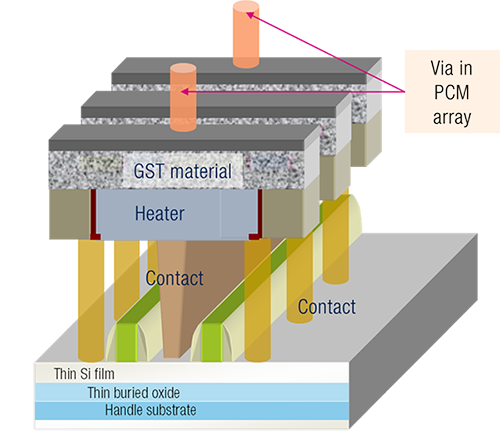
Phase-Change Memory Array
ST products based on ePCM are currently being supplied as samples to alpha customers, and field testing is underway in 2020 to meet automotive application requirements and achieve complete technical qualification.
This MCU, the world's first to use ePCM, targets powertrain systems and advanced secure gateways, safety/ADAS applications, and the automotive charging market.
Demanding automotive applications with constraints including processing performance, power consumption reduction, and large memory requirements need new automotive MCU architectures.
One of the most demanding requirements is the need to use large-capacity embedded memory as the complexity and size of firmware increases rapidly.
ePCM presents a solution to these chip-level and system-level challenges, meets AEC-Q100 Grade 0 automotive requirements, and can operate at temperatures up to +165°C. Additionally, ST's technology provides tolerance to high-temperature solder reflow processes and radiation, enabling firmware/data retention and enhanced data security.
Marco Monti, President of ST Automotive and Discrete Group, stated, "By applying ST's process, design, technology, and application expertise to ePCM, we were able to develop an innovative solution that combines 28nm FD-SOI and nonvolatile memory for the first time for high-performance, low-power automotive microcontrollers."
He added, "ePCM samples are already being provided to some leading customers, and with outstanding temperature performance and the ability to meet all automotive standards, we are confident in future market adoption and its success."
Comments
Related news
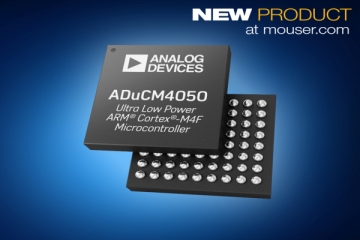
Mouser to Supply ADI MCUs for Power Saving IoT Edge Nodes
Mouser supplies Analog Devices' ADuCM4050 microcontroller. The ADuCM4050 is an ultralow-power device with integrated power management and sensor strobe technology that extends battery life by reducing system-level power consumption when used in IoT edge node applications.
2018.11.22by 이수민 기자
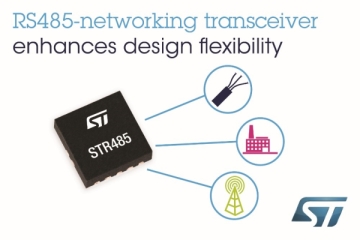
ST Launches STR485LV, 3.3V Transceiver for RS485
ST Microelectronics has launched the STR485LV, a 3.3V transceiver for RS485 applications. The transceiver provides external pins to select between 20Mbps or 250kbps communication, and supports direct interface with low-voltage logic as low as 1.8V, thereby improving design flexibility. By allowing users to select data transmission speed, designers can specify the same device, simplifying inventory management for RS485 networking applications.
2018.12.13by 이수민 기자
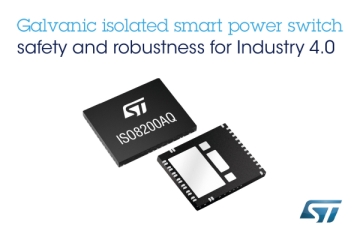
ST Launches SPI-Embedded Galvanic Isolation High-Side Smart Power Switch
ST Microelectronics has launched the ISO8200AQ, a galvanically isolated 8-channel high-side smart power switch. The ISO8200AQ provides the highest safety and robustness for demanding applications such as numerically controlled machines, industrial PLCs, PCs, and peripherals. Additionally, it features a 20MHz SPI port that supports both per-channel overtemperature signaling and efficient daisy-chaining of multiple devices, enhancing diagnostics and system management.
2019.01.10by 이수민 기자

Intel Unveils Next-Generation 'Core Ultra Series 3' and vPro Platform for Enterprise PCs
Intel has officially unveiled the "Intel Core Ultra Series 3" for next-generation enterprise PCs and the latest vPro platform, addressing a wide range of demands from enterprise notebooks to high-performance workstations.
2026.03.26by 배종인 기자
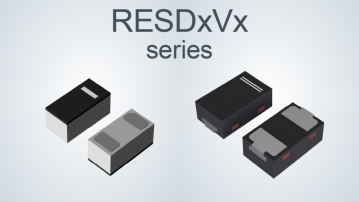
ROHM Launches ESD Protection Diode Compatible with High-Speed Interfaces of 10Gbps or Higher
Semiconductor specialist ROHM has developed the 'RESDxVx series' of ESD (electrostatic discharge) protection diodes capable of responding to next-generation high-speed data communication environments exceeding 10Gbps, simultaneously enhancing both signal quality maintenance required in high-speed interfaces and IC protection performance.
2026.03.26by 배종인 기자











