2026 Physical AI Conference
반도체 AI 인더스트리 4.0 SDV 스마트 IoT 컴퓨터 통신 특수 가스 소재 및 장비 e4ds plus

MRAM's Required Technology, Applications, and Market Outlook

기사입력2019.11.19 16:19

MRAM (Magnetic Random Access Memory) is a memory that is fast, large in capacity, and highly integrated. It is expected to replace existing memory in various fields, and the MRAM market size is also expected to continue to increase.


Required skills
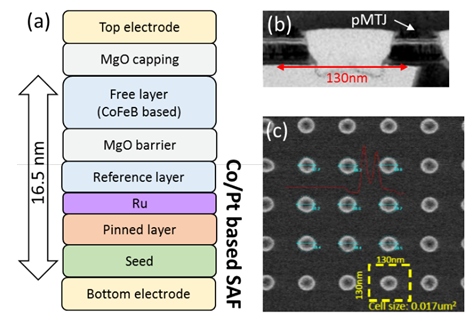
The MTJ (Magnetic Tunnel Junction) of MRAM must be stacked in layers of 2 to 30 nanometers. In particular, the CoFeB layer must be set to a thickness of 2 nm to obtain perpendicular magnetic anisotropy (PMA) when an electric field passes through the thin film layer.

Therefore, high-precision thin film deposition technology is required because even a small thickness change at the atomic diameter level can affect the overall chip performance and reliability.

Accordingly, Applied Materials developed the Endura Clover PVD process platform focused on MRAM.

Cross-section of MRAM
(a) MTJ Stack (b) Side View (c) Top View, Applied Materials, 2019

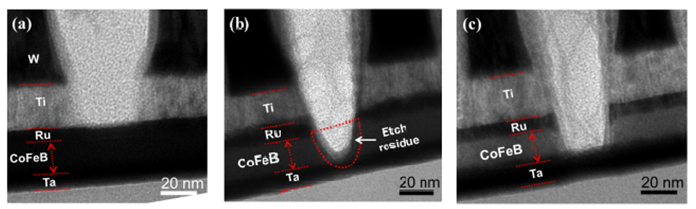
Precision is also required in the Etch and Litho processes for patterning cells. The existing method had problems such as residues remaining after etching or damage to the sidewall. To solve this problem, a method using RIBE (Reactive Ion Beam Etching) to remove residues using CO/NH3 as a gas mixture was introduced.
MRAM Etching Process
(a) Before Etching the Reference Layer Area
(b) Main Etching Using CO/NH3 Plasma
(c) After removing the etching residue for 50 minutes using CO/NH3 RIBE

Min Hwan Jeon, Sungkyunkwan University, “Etch residue removal of CoFeB using CO/NH3 reactive ion beam for spin transfer torque-magnetic random access memory device”, Journal of Vacuum Science & Technology, 2015

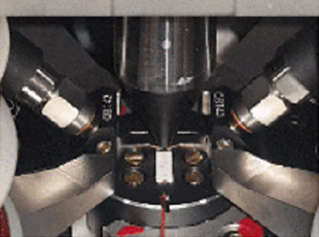
In the mass production process of MRAM, precision and fast measurement of testing equipment are also essential. Accordingly, Hprobe is supplying testing equipment with a technology called 'Ultra-Fast 3D Magnetic Field Generator'. According to Hprobe, it is applicable to wafers of 100 to 300 mm in size and has built-in software specialized for MRAM.

Hprobe’s testing equipment
“3D Magnetic Field Automated Test Equipment”

Areas of application
MRAM is expected to be used in various fields such as data centers, autonomous driving, IoT, and AI. Since it is non-volatile and highly integrated, it can be made into large quantities, so it can not only serve as storage memory, but also serve as working memory based on its high speed.

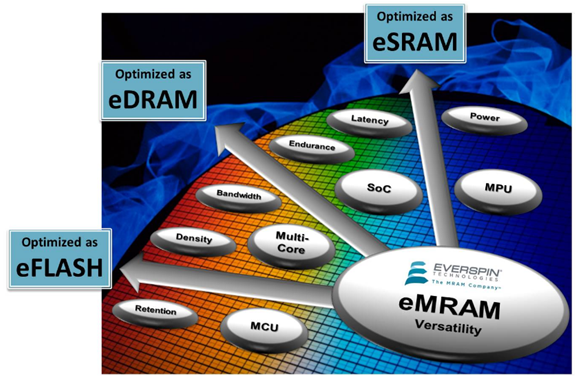
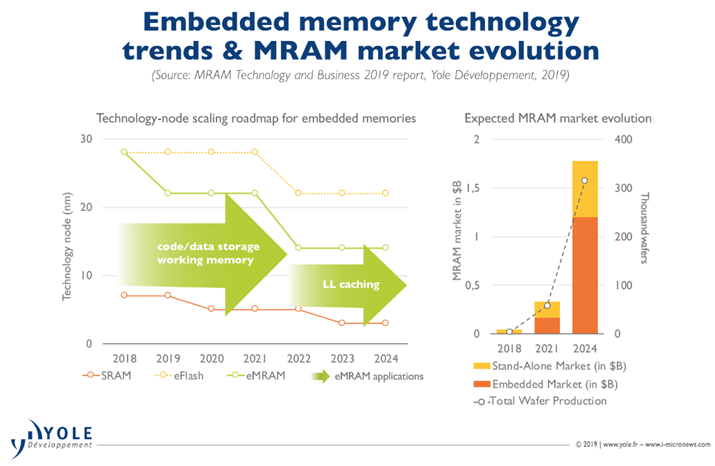
Therefore, eMRAM, which is called embedded memory when combined with a CPU or AP, is also drawing attention. It is also expected to replace flash memory, which is a storage device of MCUs used in small electronic products such as IoT devices, or SRAM, which is used as working memory in system semiconductors such as SoC.
eMRAM is expected to replace existing memory
Everspin, “Everspin's eMRAM as the next Mainstream Embedded Memory”

Market Outlook
According to data released by market research firm Yole Development in July 2019, the MRAM market is expected to expand to over KRW 1.5 trillion. In addition, the development of embedded MRAM technology is expected to accelerate further compared to existing memories.

MRAM market outlook
Yole Developmentpement, “MRAM Technology and Business 2019”, 2019

Companies and governments around the world are making steady efforts to secure next-generation memory technology. If the commercialization of STT-MRAM is currently in progress, further improvements in performance will be made in the future. The advent of SOT-MRAM is also imminent. Accordingly, MRAM is further solidifying its position as the next-generation memory.
김동욱 연구원
기사 전체보기