



Improvement of 5G Reception Environment in Approximately 120 Major Facilities Nationwide Starting in June
 Published2019.05.10 12:13
| 5G indoor reception environment improvement in buildings starting June
| Field inspections on 5G service quality improvement underway
The Ministry of Science and ICT held a public-private joint special task force meeting on 5G service inspection on the 9th at the ministry's conference room, with participation from mobile carriers and manufacturers, to review progress on 5G service quality improvement and discuss solutions.

5G base stations, which have the greatest impact on service quality such as 5G service coverage, increased by 3,064 units compared to April 29th as of the 8th, with a total of 57,266 base stations established. Equipment installations also increased by 7,688 units, reaching a total of 124,689 units.
At this meeting, mobile carriers announced that starting from June, they will sequentially carry out joint facility construction work to enable seamless 5G service in approximately 120 buildings, including 24 major KTX/SRT stations, 12 major airports, large shopping malls, exhibition centers, and major sports facilities. They stated that they plan to additionally select buildings for joint construction to improve indoor reception environments for users as soon as possible.
Regarding speed degradation and service interruptions that occur when using 5G smartphones, mobile carriers and manufacturers announced that they are continuously improving major issues through software supplementary patch distribution and network interworking optimization. The phenomenon of 5G appearing on the terminal's status bar even while using LTE service is expected to be improved by patch distribution as early as the 4th week of May.
Meanwhile, manufacturers announced that following 'Galaxy S10 5G,' devices such as 'V50 ThinQ' and various other terminals will be released, suggesting that consumer choices regarding 5G smartphones will expand in the future.
The ministry requested that mobile carriers conduct active promotion, as citizens need to make efforts such as installing supplementary patches to experience the effects of 5G quality improvement. The ministry also urged attention to launching new services so that consumers can enjoy more diverse 5G-based content.
The ministry plans to make full preparations for demonstration of the five core services (immersive content, smart factories, autonomous vehicles, smart cities, digital healthcare) outlined in the 5G+ strategy announced in April, to enable early application and dissemination of 5G.
The next meeting will be conducted in the form of on-site visits related to 5G service quality improvement, with plans to inspect the on-site implementation status of matters discussed at the 5G service inspection public-private joint task force meeting.
Related news

SK Telecom to build a '5G-based smart city' in Songdo, Incheon
SK Telecom's Park Jin-hyo, Head of ICT Technology Center, and Kim Jin-yong, Commissioner of IFEZ, signed a 'Memorandum of Understanding for 5G-based Autonomous Driving Infrastructure Construction and Related Industry Development' at the Incheon Free Economic Zone headquarters in Songdo-dong, Incheon. Both parties agreed to collaborate in transforming Incheon Free Economic Zone into a 5G smart city through the construction of 5G-based autonomous driving infrastructure and fostering related industries, establishing IFEZ's 'Startup Venture Polis', and building a data hub.
2019.04.29by 이수민 기자

5G service display method on top bar of mobile phone to be improved within May
The Ministry of Science and ICT held a meeting of the "5G Mobile Communication Service Inspection Public-Private Joint Special Team" attended by mobile carriers and manufacturers on April 30 at the ministry's conference room, where major issues related to 5G service quality and solutions were discussed collectively. 5G base stations, which have the greatest impact on service quality including 5G service coverage, were deployed at 54,202 units as of April 22, representing a 7% increase from the previous 50,512 units. The number of 5G subscribers stood at approximately 260,000 as of April 29. The three mobile carriers reported that complaints regarding 5G-related inconveniences have been steadily declining compared to the early stages; however, as user inconvenience may occur in various usage scenarios, they are continuously pursuing optimization work on base stations, equipment, and other infrastructure.
2019.05.02by 이수민 기자
The IIoT Environment of the 5G Era That Edge Computing Will Transform
In 2017, Gartner selected "Cloud to the Edge" as one of the top 10 strategic technology trends for 2018. In 2018, the Information and Communications Technology Promotion Center also cited "the growth of edge computing and AI semiconductors due to the proliferation of IoT" as one of the top 10 ICT issues for 2019. Why exactly is edge computing such an issue? Smart devices are increasing day by day. Until now, all data generated from devices has been sent to the cloud for processing. However, recognizing this process as inefficient, movements are emerging in various places to process data at the location where it is generated or in nearby locations. This attempt to perform computing at the network edge and process critical data close to real-time is referred to as edge computing.
2019.05.08by 이수민 기자
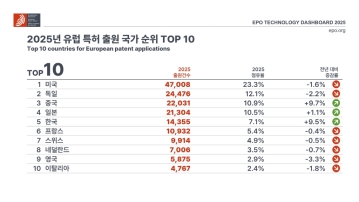
European Patent Applications Surpass 200,000 for the First Time… South Korea Maintains 5th Place, Led by Batteries and Telecommunications
According to the European Patent Office (EPO)'s 'Technology Dashboard 2025', European patent applications last year reached 201,974, surpassing 200,000 for the first time. Korean companies and inventors filed 14,355 applications, representing a 9.5% increase from the previous year and maintaining 5th place by country. Battery, digital communication, and semiconductor technologies led the growth, with Samsung ranking as the top EPO applicant for the second consecutive year and LG reaching 3rd place. The presence of major domestic cities such as Seoul, Suwon, and Yongin was also confirmed. It was also revealed that Korea's European patent strategy is expanding beyond individual technologies to span the entire industry.
2026.03.24by 명세환 기자

SK Telecom First Applies AI-Based Network Operations at Gwanghwamun K-Pop Concert
SK Telecom announced that it applied an AI-based network operation system for the first time at a large-scale K-pop concert held in the Gwanghwamun area of Seoul on March 21st, managing communication quality throughout the event. Mobile data usage during the three hours before and after the concert reached 12.15TB, approximately doubling compared to the same time slot the previous weekend. SK Telecom monitored traffic using the AI system 'A-One' in five-minute and 50-meter units to respond to potential overload situations, while also operating temporary communication facilities and on-site personnel in parallel. This case is interpreted as confirmation of the practical applicability of AI-based autonomous network operation in an environment where demand from dense events and foreign users increases simultaneously.
2026.03.23by 명세환 기자











