

.png)

To increase battery life and system usage time? Consider active battery cell balancing
 Published2019.07.05 09:01
| Frequent battery charging and discharging due to mismatch reduces battery life
| Active balancing, less charging time and heat generation than passive
As applications using batteries increase in number, from smartphones to electric vehicles, engineers are now starting to think about how to use batteries efficiently and reduce replacement costs.
Monitoring each cell in the battery stack using passive and active cell balancing maintains a healthy battery state of charge (SoC). This not only extends battery cycle life, but also provides an additional level of protection by preventing battery cell damage due to over-discharge.
Passive balancing dissipates excess charge through external resistors to ensure that all battery cells have similar SoCs, but does not increase system runtime.
Active balancing is a more complex balancing technique. It increases the total charge available in the battery stack by redistributing charge between battery cells during the charge and discharge cycles, thereby increasing the system runtime. It reduces charge time and reduces heat generated during balancing compared to using passive balancing.
Active cell balancing during discharge
The diagram in Figure 1 shows a typical battery stack where all cells start at full capacity. In this figure, full capacity is shown as 90% charge. This is because if a battery is kept at close to 100% capacity for a long period of time, its lifespan will decrease rapidly. The maximum discharge is 30%, which is to prevent over-discharge.
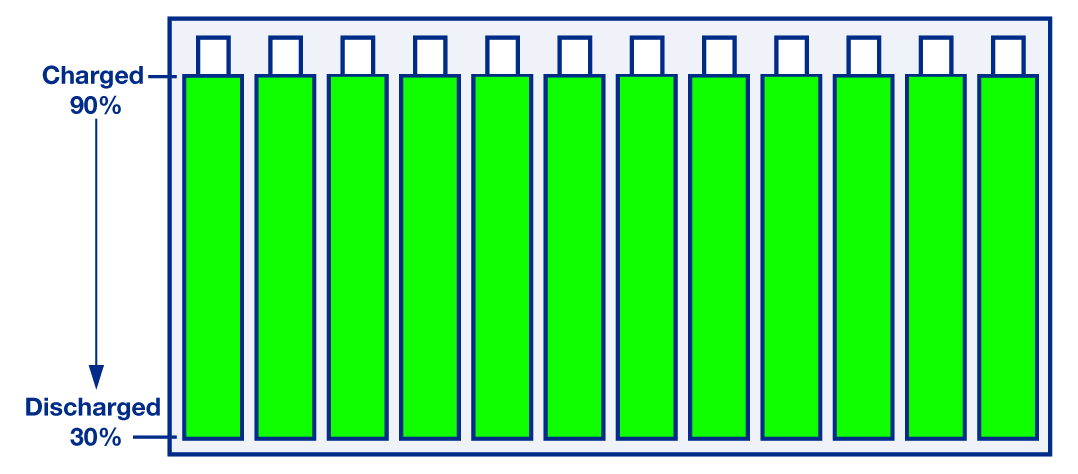
Over time, some cells become weaker than others, resulting in a discharge profile similar to that in Figure 2.
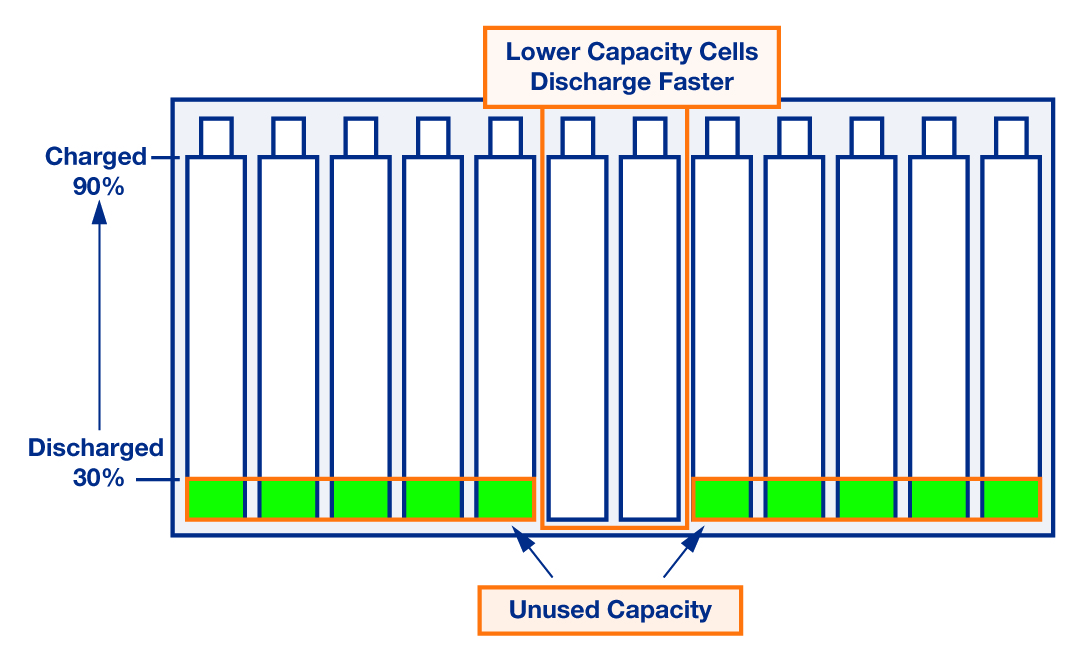
As you can see in the picture, there is considerable capacity left in many cells, but weak cells are the limiting factor, limiting the system usage time.
A 5% battery mismatch means 5% of the capacity is unused. Therefore, for large capacity batteries, the amount of unused energy can be significant.
Unused energy results in increased battery charging and discharging, which in turn reduces battery life and increases costs by requiring more frequent battery replacement.
By using active balancing, charge can be redistributed from strong cells to weak cells. This allows achieving a fully discharged battery stack profile.
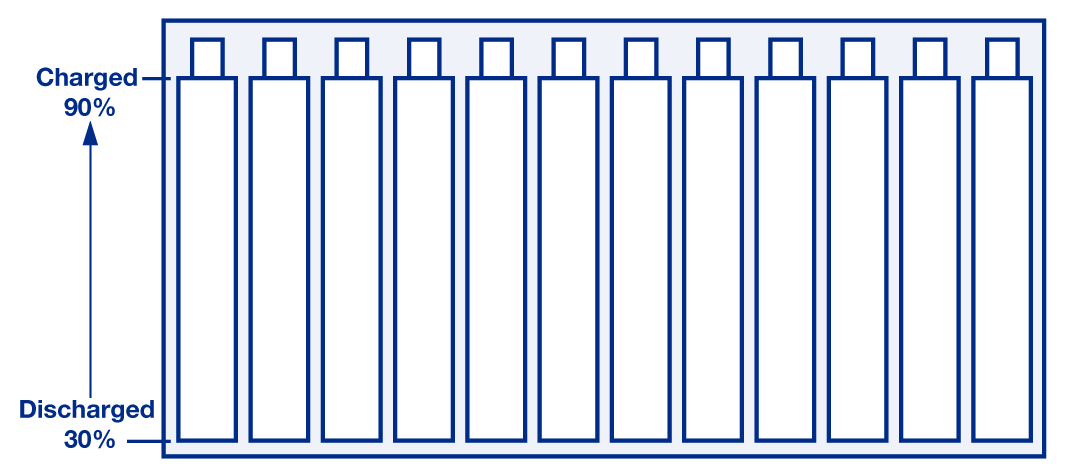
Active cell balancing during charging
When charging a battery stack without balancing, the weaker cells will reach full capacity before the stronger cells. In this case, the weaker cells will also limit the total charge that can be stored in the system. Figure 4 shows this limitation during charging.
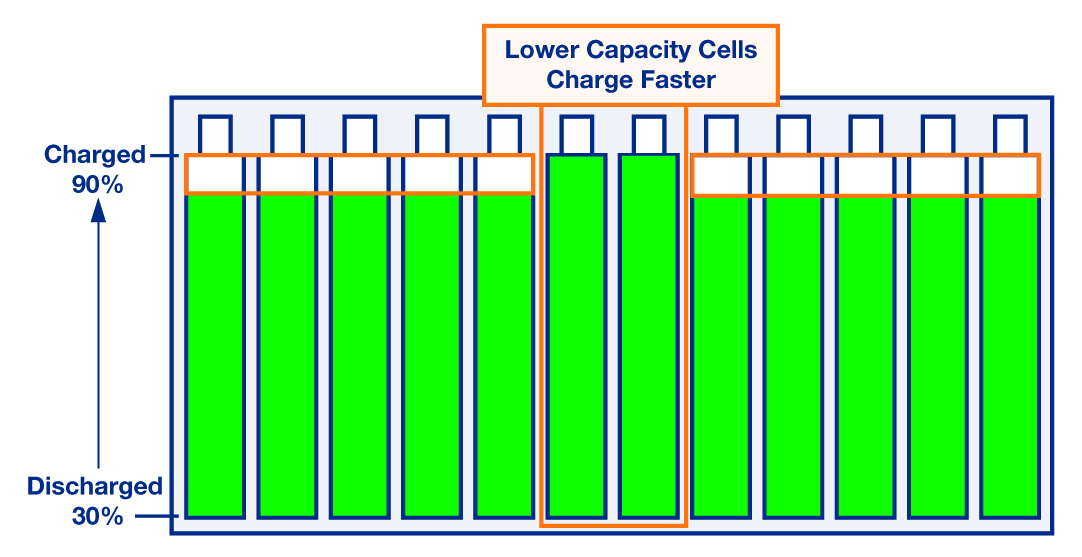
Active balancing allows the stack to be fully charged by redistributing charge during charging. This article does not address the time allocated to balancing or the effect of balancing current on balancing time, but these issues are also important to consider.
ADI Active Cell Balancer Products
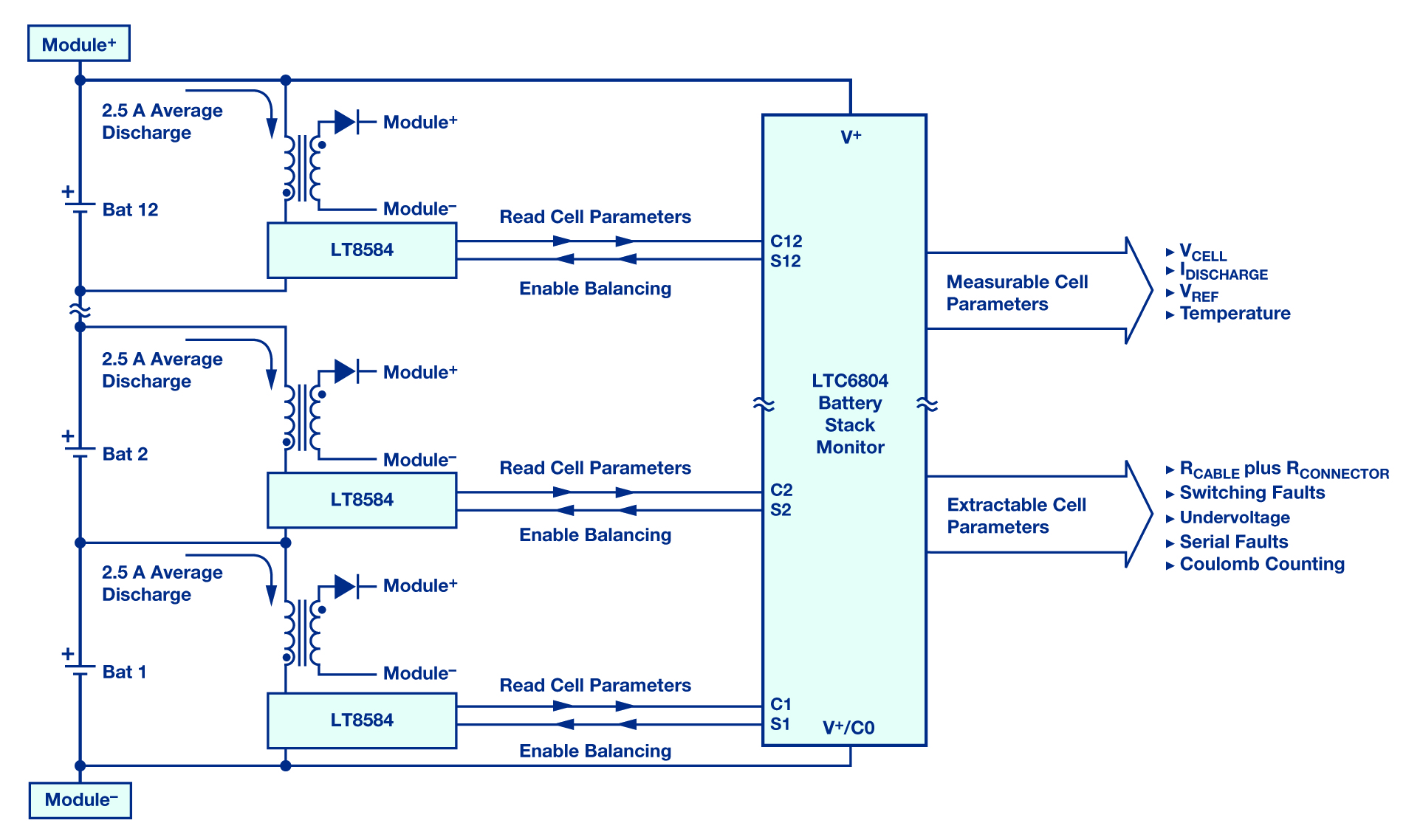
ADI offers a variety of active cell balancer products to meet a variety of system requirements. The LT8584 is a 2.5A discharge current monolithic flyback converter ideal for use with the LTC680x multi-material battery cell monitors.
Charge can be redistributed from one cell to the top cell of the battery stack, to another battery cell or combination of cells within the stack. One LT8584 is used per battery cell.
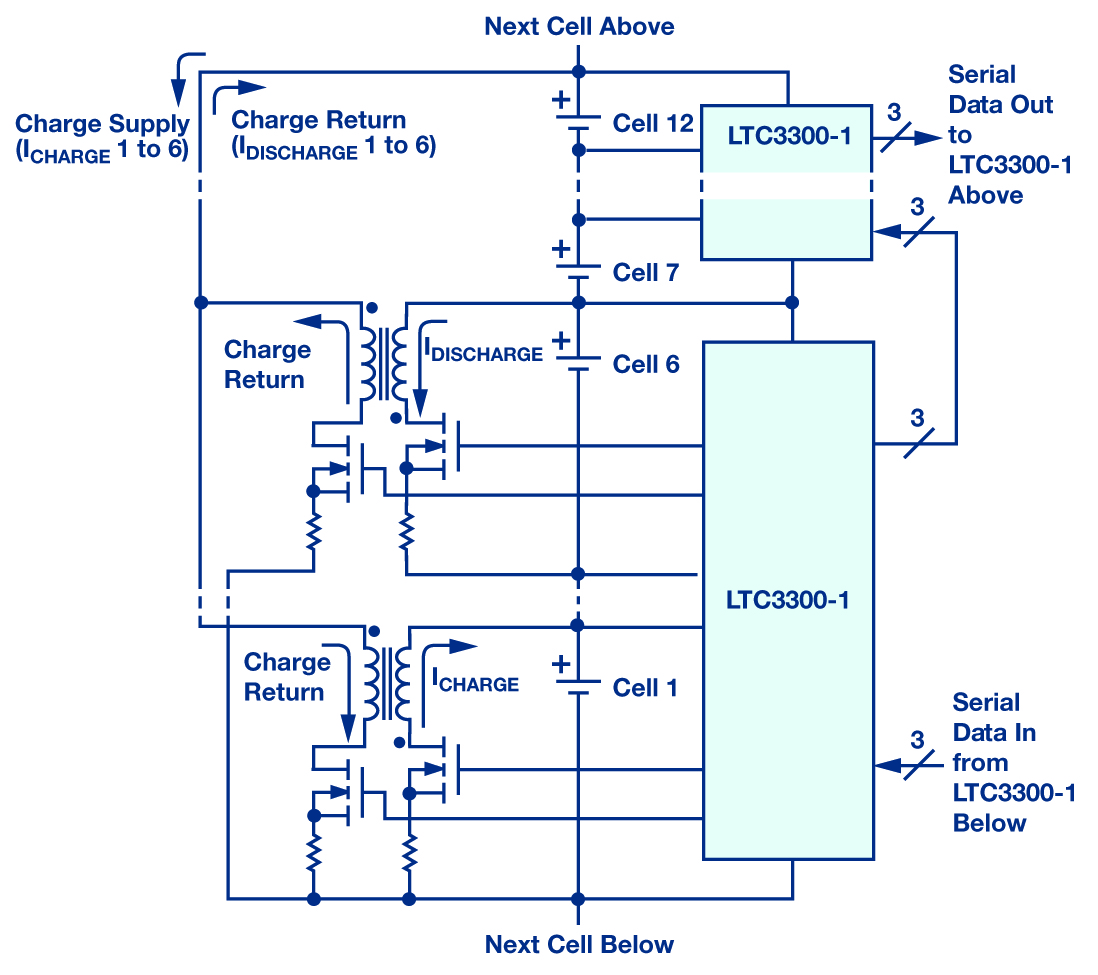
The LTC3300 is a standalone bidirectional flyback controller for lithium and LiFePO4 batteries, providing up to 10A of balancing current.
This product supports bidirectional, allowing charge from one cell to be transferred to 12 or more adjacent cells with high efficiency. A single LTC3300 can balance up to six cells.
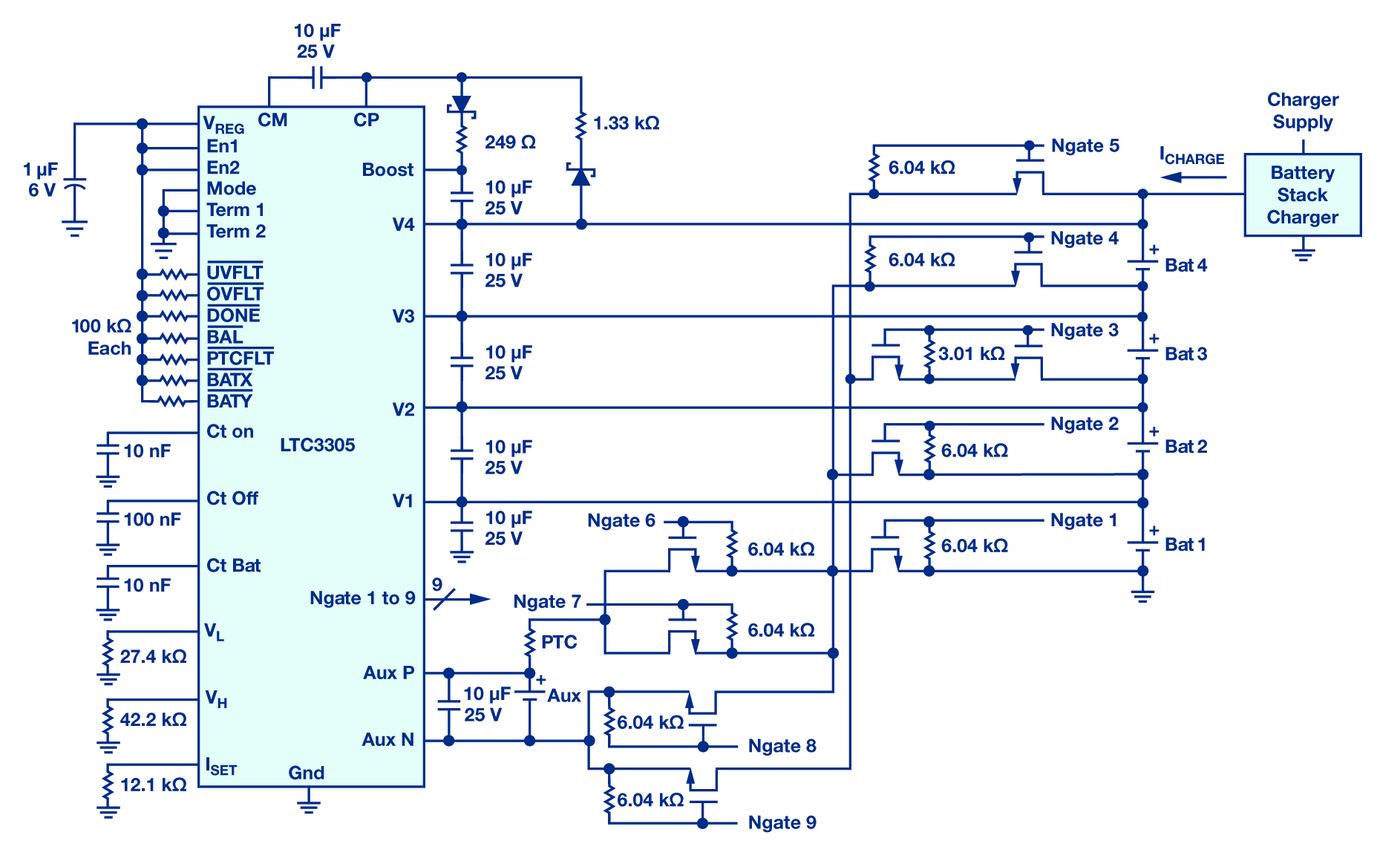
The LTC3305 is a standalone lead acid battery balancer that can balance up to four cells. It uses a fifth storage battery cell (Aux) and places it in parallel with each of the other batteries, balancing all the battery cells one at a time. This is possible because lead acid batteries are robust.
Depending on the application, you need to choose the appropriate method.
Active and passive balancing are effective ways to improve system health by monitoring and matching the SoC of each cell.
Active cell balancing redistributes charge during charging and discharging, whereas passive cell balancing dissipates charge during the charge cycle. Therefore, active cell balancing increases the system usage time and improves the charging efficiency. However, active balancing requires a more complex and larger footprint solution. Passive balancing is more economical. Which technique is more suitable will depend on the application.
ADI offers solutions that can be applied to both techniques, either integrated into battery management ICs (LTC6803 and LTC6804) or as devices that can be paired with these ICs to achieve a precise and robust battery management system.

This article is adapted from an article titled “Active Battery Cell Balancing” by Kevin Scott, Director of Product Marketing for Analog Devices’ Power Products Group, and Sam Nork, Director of Analog Devices’ Boston Design Center.
관련뉴스
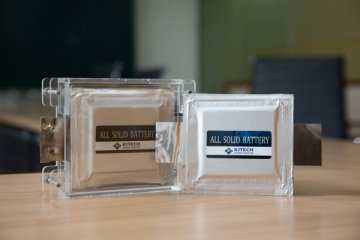
Domestic Researchers Successfully Develop Manufacturing Technology for 'All-Solid State Batteries' That Are Smaller and Safer Than Lithium-Ion Batteries
The Korea Institute of Industrial Technology has developed a manufacturing technology for all-solid-state batteries with a bipolar structure that can reduce the volume of battery packs while eliminating explosion and fire hazards. All-solid-state batteries refer to next-generation secondary batteries in which the electrolyte between the positive and negative electrodes inside the battery is changed from liquid to solid. Currently commercialized secondary batteries are lithium-ion batteries that use flammable liquid electrolytes, which carry a risk of explosion due to expansion when overheated or overcharged. The all-solid-state battery developed by the research team led by Dr. Kim Ho-sung, director of the Jeju Regional Headquarters of the Korea Institute of Industrial Technology, uses oxide-based solid electrolyte materials, making it safe with no explosion or fire hazards.
2019.06.18by 이수민 기자
Schneider Electric Launches the Galaxy VS UPS, Optimized for Edge Computing and Small Data Centers
Schneider Electric has launched Galaxy VS, a modular three-phase uninterruptible power supply (UPS). Galaxy VS is a UPS designed to meet critical power requirements for commercial and industrial facilities, including IT infrastructure. With a compact and flexible design, Galaxy VS meets the requirements of edge computing and small-scale data centers where space and accessibility are critical. It offers a wide power range of 20~100kW (400·480V) and 10~50kW (208V), features maximum efficiency of 99%, and has doubled battery lifespan through lithium-ion batteries.
2019.06.29by 이수민 기자
.png)
Nordic's cellular IoT module, the nRF9160 SiP, has achieved key certifications and is now entering volume production.
Nordic Semiconductor announced on the 4th that its nRF9160 SiP, an LTE-M/NB-IoT and GPS cellular IoT module, has successfully completed quality validation and obtained major certifications, and has entered the final mass production silicon manufacturing phase. Major certifications include GCF and PTCRB, FCC (United States and Latin America), CE (Europe), ISED (Canada), ACMA (Australia and New Zealand), TELEC/RA (Japan), NCC (Taiwan), and IMDA (Singapore). The nRF9160 SiP, measuring 10 x 16 x 1mm, is suitable for compact wearable consumer and medical devices as well as small asset tracking devices, and is a solution that can integrate IoT applications and cellular connectivity with only an external battery, SIM, and antenna.
2019.07.04by 이수민 기자

A single misaligned light means 'defect'… Vehicle interior lighting now guarded by semiconductors and software
자동차 실내조명이 '보조 조명'의 자리를 벗어나고 있다. 색상과 애니메이션으로 브랜드 아이덴티티를 드러내고 운전자 취향을 담아내는 사용자 경험(UX)의 핵심 요소로 올라서면서, LED 실내 앰비언트 시장도 빠르게 커지는 중이다. 이에 관하여 '미래 자동차를 밝히는 지능형 LED 실내 조명 솔루션' 이라는 내용으로 기술 웨비나 세션을 발표하는 최영재 다보코퍼레이션 연구위원을 앞서 만나, 시장의 온도와 설계 요구의 변화를 들었다.
2026.08.28by 명세환 기자
TI, HEV·EV 트랙션 인버터용 다축 코어리스 전류 센서 TMCS2100-Q1 공개
Texas Instruments가 HEV·EV 트랙션 인버터용 다축 코어리스 홀 효과 전류 센서 TMCS2100-Q1을 공개했다. 수평·수직 자기장을 동시에 측정하는 다축 센싱 기술로 기존 단일 축 센서 대비 최대 20배 높은 정확도를 달성하며, 버스바 무개조 설계로 기계 설계 유연성을 확보했다. 800V 아키텍처 확산에 따른 고정확도 요구 충족과 소형화를 동시에 구현한다.
2026.08.27by 배종인 기자











