


Can You Make Your Own Special Car with a 3D Printer?
 Published2019.09.23 10:44
The automobile is one of the objects through which we can glimpse people's individuality. Many people will select a car considering practical aspects such as passenger capacity, load capacity, and maintenance costs. Some people might prioritize a car's performance and appearance, and a small minority might view a car as a means to display their wealth.
However, even most "rational and practical" consumers want to reflect their own individuality within a limited range when selecting a car, such as manufacturer, model, and color. This is natural. According to statistical research conducted at Harvard University, we spend 38,000 hours driving in a car throughout our lifetime. This corresponds to the average American driving 101 minutes per day.
In the early automobile market, choices were limited, and Henry Ford famously said, "Customers can choose any color they want. As long as it is black." Today, there are more diverse vehicle types, interiors, and styles to choose from. However, even if the probability of encountering an identical car on the road is not high, true customization to the extent of full personalization is not yet possible.
I am not saying that everyone wants a 'custom car' that evokes tremendous power, luxurious decoration, and bold colors. What I mean is that people may want to impart something uniquely their own in automobile design and appearance without going to such extremes. What makes this wish possible is the 3D printer.
Limitations of Possibility
In theory, it is possible to manufacture automobiles using 3D printing technology. However, the scenario in which a customer visits an automobile dealership, specifies what they want, orders a car made to order, and immediately drives it away is close to fantasy, difficult to realize at least in the near future.
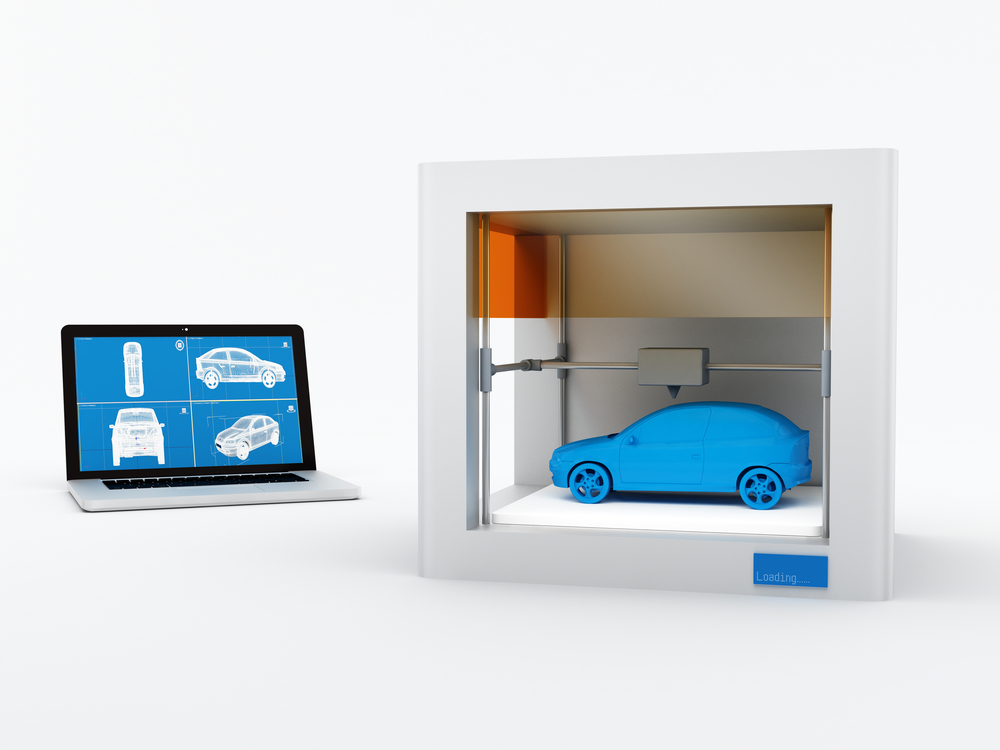
Today's automobiles are composed of nearly 20,000 components of various shapes, sizes, and materials. It is impossible to print all of this with a single machine at once on the spot. This is aside from the complexity of electronic components that require specialized manufacturing processes.
Another issue is economies of scale. Today's automobile assembly lines have evolved from teams of multiple people assembling one car at a time to processes divided among workers, with manufacturing conducted by process. Multiple automobiles are manufactured simultaneously within factories, and the use of robotic machinery is increasing to perform individual tasks more efficiently. Even acknowledging the advantages of automation and robot adoption, attempting to reverse this manufacturing strategy would lose the cost advantages of mass production.
I am not saying that manufacturing cars with 3D printing is mere fantasy. Local Motors is demonstrating what is possible regarding autonomous vehicles. Despite these possibilities, most industry experts believe that large-scale customized production of automobiles will be impossible even after another 100 years. This is because the infrastructure to support it has not been established, and there are too many design constraints that need to be resolved. Compliance with safety regulations is of course also necessary. A different perspective is needed to utilize 3D printing in the automobile industry.
Individual Component Manufacturing
Automobile design and rational mass manufacturing have changed and developed over not just several decades but nearly over a century. Therefore, even though 3D printing technology is evolving rapidly, it will not change everything overnight. It has now become possible to print the mechanical framework of current automobiles. However, it is necessary to understand the requirements of design aspects and the importance of material selection.
Regardless of how materials are formed to manufacture a specific component, what is more important is how it is designed to achieve the required functionality. At this point, experts commonly reiterate the phrase, "Leave design to the designers." Even if you know well what you want, designing it to function properly is difficult. Setting aside safety concerns, that is.
Mechanical components must meet additional requirements. While achieving strength and rigidity, they must be lightweight and durable. The impact these components have on automobile handling and aerodynamic performance is a difficult issue even for the most capable designers. And another important consideration is safety and reliability. Safety is subject to strict regulations and must pass specified tests. Of course, cost-effectiveness is also an essential factor.
Currently, the most suitable materials for 3D printers are plastic and metal. However, manufacturing plastic bumpers or steel body panels would not only require large-scale printers but would also be less cost-effective than using injection molding equipment or sheet metal presses.
On the other hand, 3D printers could utilize materials such as aluminum. Aluminum is difficult to work with using current production techniques, but 3D printing could be used to manufacture lightweight aluminum frames.
Challenging the Impossible
Returning to the question of economics between customization and mass manufacturing, today's automobile companies face material management challenges by allowing selection of various options.
While it is true that mass production can reduce costs, when consumers order models that are not in inventory, to avoid further delays in procuring the relevant components while already waiting, it is necessary to secure necessary components in advance based on demand forecasts for options.
The broader the range of options available to choose from, the more serious this problem becomes. In such cases, 3D printing can be used to reduce costs in this dilemma related to consumer choices.
There is a cost involved in securing components, and this cost increases by the number of available options. For example, if each body accessory such as radiator grille, door trim, mirror cover, and trunk sill protector were to be available in black, chrome, and several other colors, the variety of components that would need to be secured would already amount to about 20 types. In such cases, printing on demand might be more economically justified.
Furthermore, customized body panels could be manufactured. There are also proposals for automobile manufacturers to allow consumers to add functionality and detailed styling to pre-made automobile chassis and bodies. To do this, CAD software can be used to ensure everything works properly, and virtual wind tunnel testing and performance testing can also be conducted.
Whether this will be the future of the automobile industry remains to be seen. What is certain is that the automobile industry will adopt 3D printing technology in some form, just as the aerospace industry did to design lighter and performance-innovative components.
3D printing will be able to solve problems arising from the explosive increase in automobile options. However, using 3D printing for fully customized production will be another challenge. This will still remain the domain of the aftermarket and specialty shops.
This article is a summary of a Mouser Electronics contributed article on Custom Cars for Everyone with 3D Printing.
Comments
Related news

LG Uplus to Apply LTE-M1 Technology to Hyundai Motor Company's Personal Mobility Service ZET
LG Uplus has applied 'LTE-M1', the latest IoT technology, to ZET, a shared personal mobility service newly launched by Hyundai Motor in Jeju Island. ZET is a last-mile mobility platform developed by Hyundai Motor that provides single-person transportation services such as electric bicycles and electric kickboards within designated areas. LG Uplus implemented mobility-optimized communication connectivity through IoT technology that enables seamless data processing even during movement. Through this, customers can accurately identify the location and status of bicycles and kickboards they wish to use.
2019.08.19by 이수민 기자
2019 Global Autonomous Driving Industry Outlook Report Released
Frost & Sullivan Announces 2019 Global Autonomous Driving Industry Outlook Report One out of every four vehicles sold worldwide by 2030 is projected to be an autonomous vehicle (Level 3 or higher)
2019.08.26by 명세환 기자
ROHM Launches High-Voltage SBD to Replace FRD for Automotive Applications
There is a growing trend to replace rectifier diodes and FRDs with SBDs in automotive and power supply circuits. This is because many automotive OEMs are pursuing integrated motor drive modules that consolidate motors and peripheral components into a single module in drive systems such as 48V mild hybrids. However, SBDs tend to experience thermal runaway as their IR characteristics degrade with increasing operating temperature. In response, Rohm has launched new ultra-low IR 200V rated voltage SBDs—the RBxx8BM200 and RBxx8NS200—for automotive systems.
2019.09.05by 최인영 기자

[Technical Contribution] Caltera: "Evolution of Precision Sensing, UWB Infrastructure Enhances Parking Safety"
Discussing new possibilities in parking assistance and precision sensing with UWB, Lee Sang-min, Korea Branch Manager at Caltera.
2026.10.23by 편집부
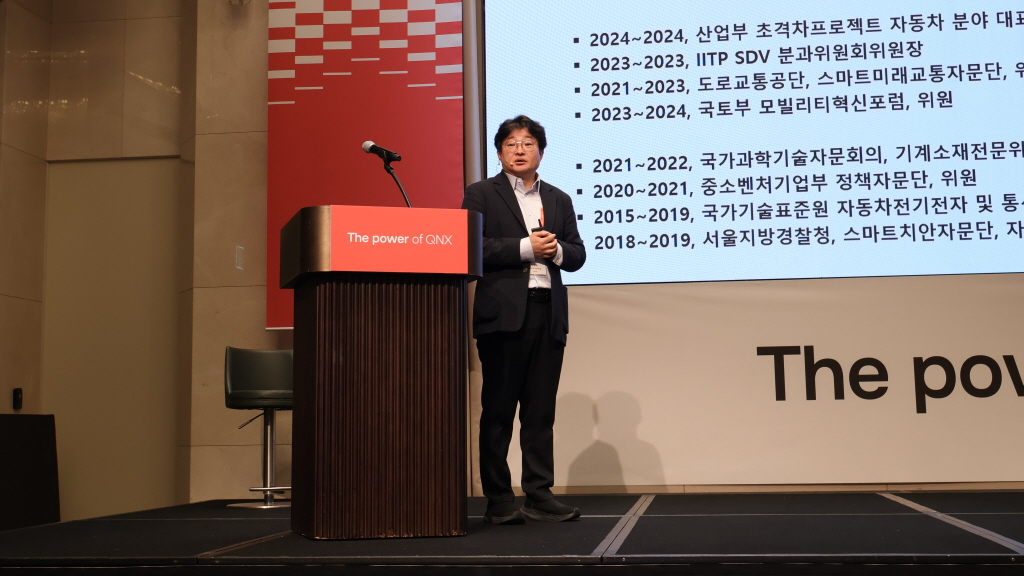
Professor Jeong Gu-min from Kookmin University, "QNX RTOS will become an important foundational technology in the physical AI era"
As software-defined vehicles (SDV) establish themselves as a new standard in the automotive industry, forecasts indicate that future competitiveness will be determined not by vehicle hardware but by software platforms and AI utilization capabilities. With the automotive industry rapidly transitioning to centralized architecture and AI-based development systems, an analysis suggests that how effectively vehicle platforms can be simplified and operated cost-efficiently will become core competitiveness for next-generation SDV and AI-defined vehicles. Professor Jeong Gu-min from Kookmin University emphasized at QNX TechForum Korea 2026 that "the automotive industry is now shifting from hardware competition to software ecosystem competition," highlighting that API-centric platforms and AI utilization will determine success or failure in the future automotive industry.
2026.10.23by 배종인 기자











