


KIST Develops Lithium Metal Battery Technology with Improved Explosion Risk
 Published2019.11.27 09:51
Resolution of lithium anode instability
Increased battery life through electrolyte optimization
The development of 'lithium metal batteries,' a next-generation battery system known to have a theoretical energy density about 10 times higher than that of lithium-ion batteries, is gaining momentum again.
The Korea Institute of Science and Technology (KIST) announced on the 18th that its research team has developed a lithium-aluminum alloy-based anode material that eliminates the physicochemical instability of lithium metal batteries.
Dr. Wonil Cho's team at the Energy Storage Research Group, which developed the cathode material, also succeeded in optimizing the electrolyte system to extend the lifespan by more than double compared to previously developed lithium-ion batteries.
A lithium metal battery is a battery that uses lithium metal as the negative electrode.
Lithium metal possesses the highest energy density among cathode materials identified to date. On the other hand, its very low redox potential has made it a highly anticipated material suitable for secondary batteries requiring lightweight and high capacity.
However, due to the possibility of electrode short circuits and explosions caused by dendrites occurring on the surface of lithium metal, lithium-ion batteries using graphite anodes were commercialized first.
Dendrites are tree-branch-shaped crystals that grow abnormally on parts of a metal surface, causing electrode volume expansion and adverse reactions between the electrode and the electrolyte, thereby reducing the safety and lifespan of the battery.
Lithium-ion batteries are recently assessed to have reached a limit where it is difficult to further increase energy density per unit weight. On the other hand, as there is a demand for higher-performance, high-capacity batteries in various fields such as electric vehicles and drones, research to ensure the electrochemical stability of lithium metal anodes is actively underway worldwide.
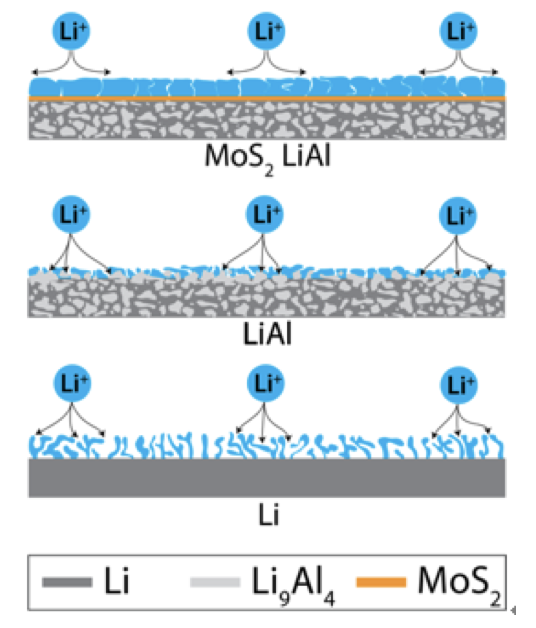
Researchers at KIST replaced the existing pure lithium metal anode with a lithium-aluminum alloy to control instability, while forming an ultra-thin artificial protective film based on molybdenum disulfide (MoS) on the anode surface to suppress the growth of dendrites that rapidly degrade battery capacity and lifespan.
The ultrathin artificial protective film is an artificial solid-electrolyte interphase developed by Dr. Won-il Cho. The artificial solid-electrolyte interface is a thin layer ranging from several to thousands of nanometers in thickness that is artificially created on the surface of the anode or cathode to control the reaction occurring between each electrode and the electrolyte, and last year, its performance and stability were proven by evenly transferring graphene-based nanomaterials onto the surface of lithium metal.
In this study, research efforts were focused on lowering costs by using molybdenum disulfide and lithium-aluminum alloy instead of graphene to ensure the actual mass production feasibility of ultrathin artificial protective films, as well as simplifying complex manufacturing processes and stabilizing the battery.
Dr. Wonil Cho of KIST stated, “As the capacity limits of existing lithium-ion batteries are anticipated, the demand for the development of lithium-metal batteries is increasing,” adding, “I hope that lithium anode stabilization and electrolyte technologies, which are key to the development of next-generation rechargeable batteries, will contribute to the advancement of drones, autonomous vehicles, and energy storage systems (ESS) that require high-capacity batteries.”
Comments
Related news
KIST and KAIST Prove Potential of "Step-on Charging" Lithium-ion Batteries
As demand for large-capacity energy storage media increases, interest in developing high-capacity lithium alloy batteries is growing. However, these batteries face the problem of severe capacity degradation and significant volume changes due to pressure generated during charging and discharging processes. In particular, since phenomena that occur when pressure is applied to lithium battery electrodes take place at the nanoscale level, there have been difficulties in creating experimental environments, making direct measurement and observation challenging. In response, Dr. Kim Sang-tae's team at KIST's Electronic Materials Research Division conducted joint research with Professor Yuk Jong-min's team at KAIST to elucidate the effects of pressure during battery charging and discharging processes, and based on this, presented the feasibility of lithium-ion batteries that can be charged under applied pressure.
2019.09.04by 이수민 기자
TI Launches Switching Battery Charger IC Suitable for Compact Devices
Texas Instruments has launched the BQ25619, a switching battery charger IC that supports a termination current of 20mA. With the BQ25619, designers can efficiently design compact medical and personal electronic device applications such as hearing aids, earbuds, wireless charging cases, IP network cameras, patient monitoring devices, and personal care applications. The BQ25619's low termination current of 20mA increases battery capacity and usage time by 7%. Additionally, by using a configurable top-off timer, usage time can be extended further, providing the advantage that users need to charge their devices relatively less frequently.
2019.09.05by 명세환 기자
Maxim Launches ASIL-D Compliant EV Battery Monitor IC 'MAX17853'
In automotive applications, redundant components are sometimes added to systems to comply with safety standards. Maxim Integrated has launched MAX17853, a battery monitoring IC that enables implementation of a battery management system (BMS) for automotive applications in compliance with ASIL-D specifications on a single chip. The MAX17853 achieves system reliability through compliance with ASIL-D standards for large cell voltage and temperature monitoring, as well as communication.
2019.10.17by 이수민 기자

[Technical Contribution] Caltera: "Evolution of Precision Sensing, UWB Infrastructure Enhances Parking Safety"
Discussing new possibilities in parking assistance and precision sensing with UWB, Lee Sang-min, Korea Branch Manager at Caltera.
2026.10.23by 편집부
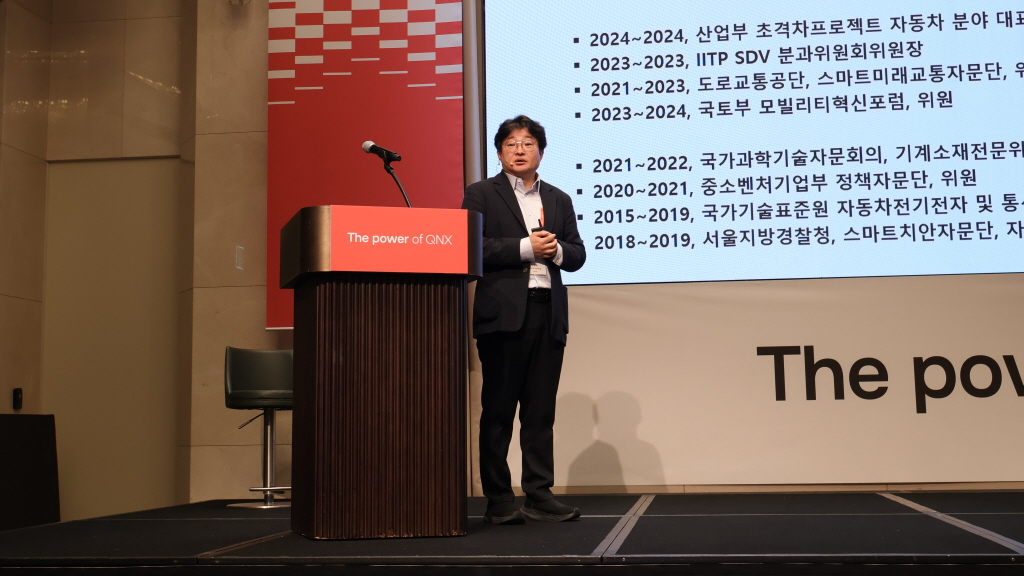
Professor Jeong Gu-min from Kookmin University, "QNX RTOS will become an important foundational technology in the physical AI era"
As software-defined vehicles (SDV) establish themselves as a new standard in the automotive industry, forecasts indicate that future competitiveness will be determined not by vehicle hardware but by software platforms and AI utilization capabilities. With the automotive industry rapidly transitioning to centralized architecture and AI-based development systems, an analysis suggests that how effectively vehicle platforms can be simplified and operated cost-efficiently will become core competitiveness for next-generation SDV and AI-defined vehicles. Professor Jeong Gu-min from Kookmin University emphasized at QNX TechForum Korea 2026 that "the automotive industry is now shifting from hardware competition to software ecosystem competition," highlighting that API-centric platforms and AI utilization will determine success or failure in the future automotive industry.
2026.10.23by 배종인 기자











