


Z-Wave Specification Opened to Semiconductor and Stack Suppliers
 Published2019.12.23 14:20
Opening Multisource Wireless Standard Specification Resolves Interoperability Issues
Silicon Labs and the Z-Wave Alliance will open the Z-Wave specification, a multisource wireless standard approved by member companies, to all semiconductor and software stack developers.
▲ Z-Wave specification corresponding to a multisource wireless standard will be opened in Q3 2020 <Image=Silicon Labs>
Through this, semiconductor and software companies will be able to participate in the future Z-Wave ecosystem, contribute to the advancement of smart home standards, and develop and supply sub-GHz Z-Wave wireless devices and software stacks.
The Z-Wave specification scheduled to be released in the second half of 2020 includes the ITU.G9959 PHY/MAC wireless specification, application layer, network layer, and communication protocols between host and client devices.
Z-Wave is changing to a multisource wireless smart home standard form where member companies of the Z-Wave Alliance working groups collectively develop the specification, rather than a single organization developing the specification alone.
Z-Wave currently has over 100 million interoperable devices deployed worldwide, over 3,200 certified products, and over 700 member companies.
A Silicon Labs representative stated, "With this measure to expand and open access to Z-Wave as a standard supported by various vendors for IoT standardization, the smart home ecosystem will experience the effect of gaining more extensive technical support and faster market adoption rates."
Alliance member companies and smart home consumers can benefit from this measure through interoperability, backward compatibility, the S2 security framework, easy installation using SmartStart, low-power characteristics guaranteeing 10 years of battery life, and long-range connectivity through sub-GHz mesh networks.
Mitch Klein, Executive Director of the Z-Wave Alliance, stated, "The Z-Wave Alliance, which is developing into a standardization organization, will help solve interoperability issues that are obstacles to smart home device adoption," and added, "Member companies will cooperate on a single sub-GHz connectivity solution to ensure backward and forward compatibility as well as interoperability, security, and robustness necessary for IoT expansion."
Meanwhile, the Z-Wave Alliance plans to expand its activities as a standard development organization for the Z-Wave specification and will continue the Z-Wave certification program for related software and hardware.
Development work on the Z-Wave specification to be released will be handled by a new working group of the Z-Wave Alliance in the third quarter of 2020, and details regarding the semiconductor and stack platform certification program will be announced in Q3 2020.
Related news
Nuvoton, embarking on full-scale domestic market penetration through embedded engineer seminars
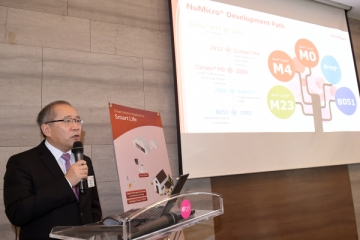
Nuvoton Technology will hold its first seminar targeting engineers on the 24th at COEX in Samsung-dong, Seoul. Alongside the seminar, Nuvoton plans to introduce specialized applications in four sectors—industrial control, low-power applications, IoT security, and smart home applications—based on recently launched MCU products. Nuvoton plans to launch over 100 MCU products adopting 8051, Cortex-M0/M4/M23, and ARM9 cores within this year. The newly launched MS51, ML51, M031, NUC029, M2351, and NUC980 series include products with diverse configurations consisting of 8~32-bit cores, 23MHz~400MHz system frequencies, 8KB~512KB flash, and 10-pin~216-pin packages.
2019.04.23by 이수민 기자

Silicon Labs Launches AEC-Q100 Compliant Timing Solutions
As automotive systems become increasingly complex, clocking requirements in automotive applications are also becoming more demanding. In response, Silicon Labs has launched a timing solution portfolio for automotive applications. The new portfolio, which complies with AEC-Q100, consists of the 'Si5332 arbitrary frequency programmable clock generator', 'Si5225x PCIe Gen 1/2/3/4/5 clock', 'Si5325x PCIe buffer', and 'Si5335x clock buffer'. These products can be utilized in various automotive applications including radar, LiDAR, camera, ECU, ADAS, and IVI.
2019.09.24by 이수민 기자

Silicon Labs Supports Simplifying IoT Product Design with New Mesh Networking Module
Silicon Labs has launched new wireless Gecko modules to help IoT developers reduce product development costs and design complexity. The MGM210x and BGM210x Series2 modules support mesh protocols such as Zigbee, Thread, and Bluetooth Mesh, as well as Bluetooth Low Energy and multi-protocol communication. By utilizing the xGM210x modules that have received pre-certification in Korea, North America, Europe, and Japan, developers can reduce research and development time related to RF design and protocol optimization, allowing them to focus on final application development.
2019.10.04by 이수민 기자

Intel Unveils Next-Generation 'Core Ultra Series 3' and vPro Platform for Enterprise PCs
Intel has officially unveiled the "Intel Core Ultra Series 3" for next-generation enterprise PCs and the latest vPro platform, addressing a wide range of demands from enterprise notebooks to high-performance workstations.
2026.03.26by 배종인 기자

ROHM Launches ESD Protection Diode Compatible with High-Speed Interfaces of 10Gbps or Higher
Semiconductor specialist ROHM has developed the 'RESDxVx series' of ESD (electrostatic discharge) protection diodes capable of responding to next-generation high-speed data communication environments exceeding 10Gbps, simultaneously enhancing both signal quality maintenance required in high-speed interfaces and IC protection performance.
2026.03.26by 배종인 기자











