



Launch of New, More Precise 3D Positioning Pressure Sensor
 Published2012.09.10 20:21
September 10, 2012, Seoul — STMicroelectronics (ST), a global semiconductor company providing a wide range of electronic applications, the world's leading MEMS manufacturer, and a leader in MEMS sensors for mobile devices, has launched a new pressure sensor, the LPS331AP. This new product enables highly precise measurement of elevation relative to sea level in mobile devices such as mobile phones. This means it is possible to provide precise figures capable of determining "which step" one is on, rather than "which floor" one is currently on.
Accurate location determination on mobile devices is a core element of various location-based services that have recently gained popularity. Furthermore, these services are garnering high expectations as the next generation of "trending apps" in the mobile industry. The challenge is to provide a method to determine the location of mobile devices in three dimensions while overcoming constraints such as spatial resolution, reliability, physical size, durability, and cost.
Regarding latitude and longitude, GNSS (Global Navigation Satellite System) is a widely used solution worldwide, capable of measuring the horizontal position of a device with an error of within 1 meter under optimal conditions where signals can be received from four or more satellites. However, ST, together with CSR, developed and successfully demonstrated an indoor navigation solution that can determine the vertical and horizontal position of a mobile device even in areas with no satellite signals at all.
Barometric pressure measurement can provide a better solution than GNSS for verifying three-dimensional position (vertical elevation). This is because it utilizes the characteristic that pressure gradually decreases as altitude increases, making it useful even when four or fewer satellite signals are detected. ST's latest pressure sensor, recently released, can measure pressure very accurately between 260 millibars and 1,260 millibars. 260 millibars is the typical atmospheric pressure at an altitude of approximately 10 km, which is 1,500 meters higher than the summit of Mount Everest, while 1,260 millibars is the pressure found 1,800 meters below sea level, equivalent to half the depth of the deepest mine ever dug. Because this new product is manufactured in a 3x3mm package and guarantees low voltage and ultra-low power consumption, it is ideal not only for smartphones and sports watches but also for weather stations, automotive, and industrial applications. The LPS331AP is also featured in Samsung's most recently unveiled cutting-edge smartphone.
Benedetto Vigna, Vice President of STMicroelectronics’ Analog, MEMS, and Sensors Group, introduced the product, stating, “Since the integration of MEMS devices into consumer devices began, we have developed and provided products capable of detecting gravity, acceleration, angular velocity, and the Earth’s magnetic field. These sensors support the detection and response to the operation of smart devices, and the newly introduced device helps recognize whether a person or object is moving up or down by determining the weight of the atmosphere.”
The LPS331AP is manufactured using a MEMS-specific manufacturing technique called “VENSENS,” which fabricates pressure sensors on an integrated silicon chip. This method eliminates the need for wafer-to-wafer bonding and increases product reliability. The sensing element of the LPS331AP originates from a flexible silicon membrane positioned over an air cavity where the gap is controlled and internal pressure is verified. This membrane is not only much smaller than silicon membranes fabricated by conventional micromachines, but an embedded mechanical stopper prevents breakage. A piezoresistor is a very small structure in which the electrical resistance changes when this silicon film is bent according to external pressure. The piezoresistor is embedded in the silicon film, and the change in resistance is monitored. The electrical resistance changes as it bends according to changes in external pressure on the silicon. The piezoresistor is a small structure in which the electrical resistance changes, and the resistance change is monitored, compensates for temperature changes, and is converted into a digital pressure value that can be read through the industry standard I2C or SPI interface of the host processor.
Key Features of LPS331AP
• High resolution, low-noise sensor capable of detecting centimeter-level altitude differences
• Utilizes ST's exclusive VENSENS technology, providing high rupture resistance of up to 20 times.
• ODR selectable between 1Hz and 25Hz
• Low power consumption: Low resolution mode 5.5µA, High resolution mode 30µA
• Supply voltage: 1.71~ 3.6 V
• Temperature range from -40 °C to +85 °C
• Integrated temperature sensor that compensates for temperature differences
• Since temperature and pressure are calibrated at the factory, there is no need to recalibrate the shipped unit.
• 3x3x1mm plastic land grid array (HCLGA-16L) package. The package has holes to allow external pressure to reach the sensing element.
The LPS331AP is currently in mass production and is priced at $2.60 per unit for orders of 1,000. Samples and evaluation kits are also available for custom design and shortened product cycles. ST's pressure sensor evaluation kit consists of a motherboard (STEVAL-MKI109V2), a plug-in module, and a STEVALMKI120V1 adapter including an LPS331AP pressure sensor.

관련뉴스

Intel Unveils Next-Generation 'Core Ultra Series 3' and vPro Platform for Enterprise PCs
Intel has officially unveiled the "Intel Core Ultra Series 3" for next-generation enterprise PCs and the latest vPro platform, addressing a wide range of demands from enterprise notebooks to high-performance workstations.
2026.03.26by 배종인 기자

ROHM Launches ESD Protection Diode Compatible with High-Speed Interfaces of 10Gbps or Higher
반도체 전문 기업 로옴(ROHM)이 10Gbps를 넘어서는 차세대 고속 데이터 통신 환경에 대응할 수 있는 ESD(정전기 방전) 보호 다이오드 ‘RESDxVx 시리즈’를 개발하며, 고속 인터페이스에서 요구되는 신호 품질 유지와 IC 보호 성능을 동시에 끌어올렸다.
2026.03.26by 배종인 기자
ST Launches 75V Drive IC Targeting 48V Industrial Motor Driving
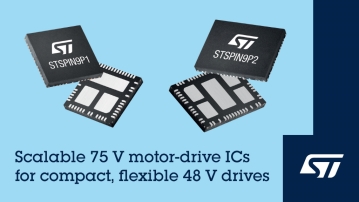
ST Microelectronics has unveiled the 'STSPIN9P' series of 75V motor drive ICs tailored for 48V-class industrial drive system design. The new product family is characterized by half-bridge and full-bridge configurations that enable design scalability according to motor type and output conditions. Power supply circuits, protection functions, and current sensing circuits are integrated on-chip to simplify system configuration, and the devices are designed to support applications up to 500W maximum. The company plans to provide reference designs and demo boards to support development and evaluation in industrial automation, robotics, pumps, fans, lighting, and textile machinery.
2026.03.26by 배종인 기자

Nordic supports security updates for the entire lifecycle of IoT devices at a single fixed cost
Nordic Semiconductor, a global leader in low-power wireless connectivity solutions, has unveiled a single fixed-cost licensing model that delivers FOTA (Firmware Over-the-Air) and device management capabilities throughout the device lifecycle via nRF Cloud, and introduced a new firmware update solution to prepare for the enforcement of the European Union's Cyber Resilience Act (CRA).
2026.03.26by 배종인 기자
Practical Training in Low-Noise, Low-Power Circuit Design All in One Place… Training Fee Support
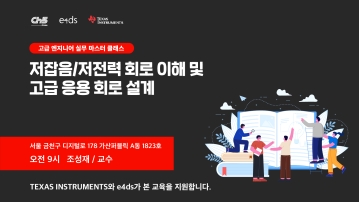
The "2026 Advanced Engineer Practical Masterclass" to strengthen competencies in high-sensitivity analog circuit and sensor-based system design will be held on April 16 at the e4ds Conference Center in Gasan-dong, Seoul. This program will be conducted as an offline paid hands-on training session, not online, and is targeted at engineers seeking on-site intensive learning. Texas Instruments will provide educational support for this training, allowing participation at 150,000 won, a 100,000 won discount from the original price of 250,000 won.
2026.03.26by 배종인 기자











