


The race for next-generation DRAM, DDR5, has begun: "2021 will be the start of a fierce battle in 2022."
 Published2020.11.02 16:15
Full-scale launch in 2021, market activation in 2022
Higher performance and lower power consumption compared to DDR4, but larger in size
At the 22nd Semiconductor Exhibition (SEDEX 2020), which closed on the 30th, Samsung Electronics and SK Hynix, the world's top two memory semiconductor companies, had the largest booths.
The product both companies emphasized was DDR5, the next-generation DRAM. In July of this year, the Joint Electron Device Engineering Council (JEDEC) officially announced the standard specifications for DDR5, the next-generation DRAM.
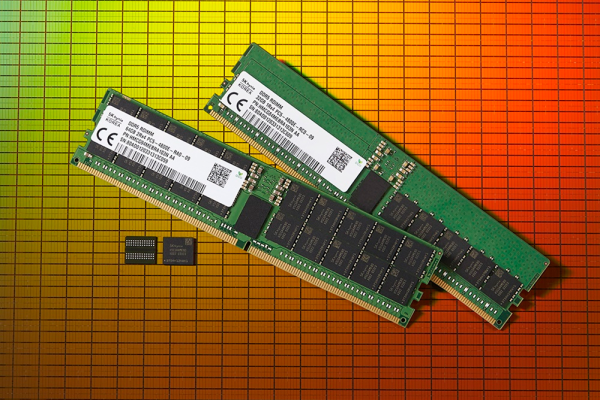
DDR5 DRAM [Photo = SK Hynix]
Samsung Electronics unveiled its largest-ever 512GB (gigabyte) DDR5 RDIMM DRAM for servers, utilizing the extreme ultraviolet (EUV) process. SK Hynix also showcased a finished 256GB DDR5 DRAM for servers, along with the world's first 16Gb (gigabit) DDR5 DRAM, which it launched in October.
Going forward, DDR5, along with LPDDR5 and GDDR6, is expected to drive changes in memory technology. DDR5 will be introduced for PC/server applications, LPDDR5 for mobile applications, and GDDR6 for graphics applications starting this year, with related markets expected to gain traction starting in 2021.
DDR5 is a next-generation DRAM standard that is optimized for big data, AI, and machine learning, offering ultra-high speed and high capacity. According to market research firm Omdia, demand for DDR5 is expected to begin in earnest in 2021 and continue to expand to 10% of the total DRAM market in 2022 and 43% in 2024.
DDR5 offers higher performance, lower power consumption, and greater stability than DDR4.
DDR5's performance is known to be about twice as high as its predecessor, DDR4. DDR4's speed is 3,200 Mbps, while DDR5 is about twice as fast, from 4,800 Mbps to 5,600 Mbps.
Unlike DDR4, which uses up to 4 bank groups, DDR5 can implement up to 8 bank groups and can achieve higher speeds by using a 16n prefetch buffer.
Additionally, unlike DDR4, which operates at 1.2V, DDR5 operates at 1.1V, which is expected to contribute to reduced power consumption, increased battery life, and reduced energy costs in PC/server applications.
Unlike DDR4, DDR5 has an error correction circuit (Error Correction Code; ECC) built into each chip, and adopts two external ECCs at the module level, one more than DDR4.
Accordingly, DDR5 is implemented with 8 chips and 2 controllers for an 80-bit interface (8bit x 8 + 8bit x 2), which significantly enhances security and stability.
SK Hynix focuses on preemptive strikes, while Samsung Electronics focuses on production efficiency.
Among memory semiconductor companies, SK Hynix was the first to enter the DDR5 market.
SK Hynix completed the world's first DDR5 RAM product in November 2018, and launched commercial DDR5 RAM products for servers and PCs in October of this year.
In this process, SK Hynix completed operational verification through joint operation of an on-site lab with SoC (System On Chip) companies, system level tests, and various simulations.
In addition, modules such as RCD (Register Clock Driver) and PMIC (Power Management IC) that affect DRAM characteristics Compatibility verification between the main components has also been completed.
Samsung Electronics, on the other hand, appears to be focusing more on production efficiency than dominating the market. This appears to be because no CPUs supporting DDR5 have yet been released.
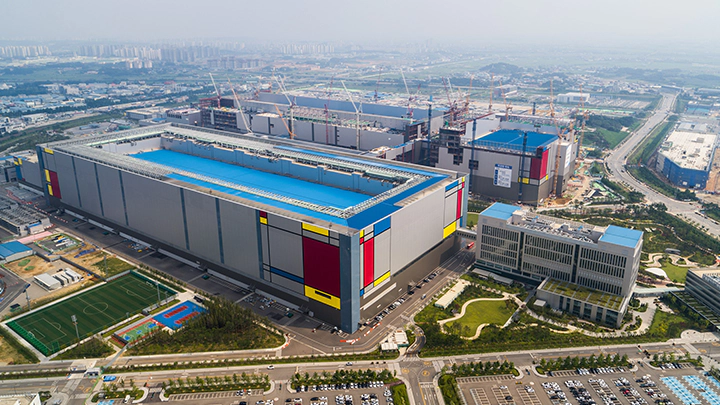
It is also planned to be used in memory production [Photo = Samsung Electronics]
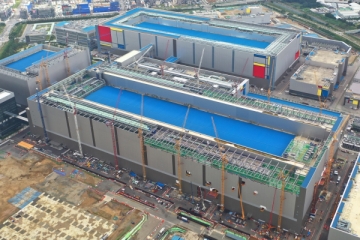
Samsung Electronics plans to mass-produce DDR5 using the EUV process at its Pyeongtaek 2 plant, which began operations last August. Pyeongtaek 2 has a foundry production line equipped with EUV lithography equipment. The company plans to utilize this line for the production of memory semiconductors as well as system semiconductors.
When will CPUs support DDR5? It won't be until 2022.
No matter how fast it is, it is useless if there is no place to use it. When will CPUs supporting DDR5 be released? Samsung Electronics predicted in a conference call in July that such CPUs would not be released until 2022.
Intel's codenamed 'Sapphire Rapids' CPU, scheduled for release in the fourth quarter of 2021, belongs to the 'Intel Xeon Scalable processor' product line for servers, and is said to support DDR5 DRAM and the PCIe 5.0 interface.
AMD, which has not yet made an official announcement, is also expected in the industry to release a CPU equipped with a DDR5-supporting memory controller in 2022.
Overall, DDR5 DRAM is expected to see full-scale adoption in 2022. SK Hynix's preemptive strategy is interpreted as targeting the server market rather than the PC market.
“Intel and SK hynix have worked closely together from the initial architectural concept through the development of the DDR5 standard specification through JEDEC standardization,” said Carolyn Duran, vice president and general manager of Intel’s Data Platforms Group. “We are now ready to respond to customers by collaborating on prototype design and validation to ensure performance.”
DDR5's Full-Scale Implementation: What Impact Will It Have on the DRAM Market? EUV Expansion
DDR5 runs on 8 chips and 2 controllers for an 80-bit interface, while DDR4 runs on 8 chips and 1 DRAM ECC for a 72-bit interface (8bit×8 + 8bit×1), and ECC is not built into each chip.
Therefore, DDR5 products are expected to be 15% to 20% larger than DDR4 products produced in the same process. This is expected to act as a limiting factor in DRAM production and also affect the mid- to long-term supply and demand for DRAM.
The DRAM industry believes that EUV processes are increasingly needed to reduce chip sizes as the chip sizes of the latest DRAM products, such as DDR5, LPDDR5, and GDDR6, grow after 2020.
The early adoption of EUV by DRAM manufacturers is expected to facilitate the smooth adoption of EUV, both for DRAM technology transfer and for improving server DRAM quality. EUV, with a wavelength one-fourteenth that of existing argon fluoride (ArF) light sources, is considered a key technology for semiconductor production at 10nm and below.
Additionally, the total number of masks and layers is 20% smaller than the currently used DPT/QPT process, which is expected to further simplify the DRAM production process.
HBM2E vs. DDR5? HBM2E vs. GDDR6!
In July of this year, SK Hynix began mass production of 'HBM2E', the next-generation high-bandwidth memory (HBM) DRAM, and Samsung Electronics also announced in February that it would begin mass production within the year.
HBM2E's competitor is GDDR6, not DDR5, and is expected to be primarily used in high-performance computing (HPC) and AI-based ultra-high-speed data analysis.
Comments
Related news
SK Hynix Develops Third-Generation 10nm DDR4 DRAM, Produced Without EUV Process
SK Hynix announced the development of 16Gbit DDR4 DRAM using third-generation 10-nanometer-class (1z) advanced process technology. The third-generation product achieved approximately 27% improvement in productivity compared to the second-generation (1y) product, and enhanced cost competitiveness by enabling production without EUV lithography processes. The company applied new materials not used in previous generation production processes to increase capacitance, and introduced new design techniques to enhance operational stability. SK Hynix plans to expand the application of third-generation 10-nanometer-class advanced process technology across various applications including LPDDR5 and HBM3.
2019.10.22by 이수민 기자
Samsung Electronics begins mass production of industry-first 16GB mobile DRAM.
Samsung Electronics has begun mass production of 16GB LPDDR5 mobile DRAM. The 16GB mobile DRAM package is equipped with eight 12Gb (=1.5GB) chips and four 8Gb (=1GB) chips based on second-generation 10-nanometer-class (1y) technology. The product operates at approximately 1.3 times faster speed than LPDDR4X (4,266Mb/s), achieving 5,500Mb/s, and is capable of processing 44GB of data in one second.
2020.02.25by 이수민 기자
Samsung Electronics Ships First EUV Process-Applied DRAM at Pyeongtaek Line 2
Samsung Electronics announced the commencement of operations at Pyeongtaek Line 2, the world's largest semiconductor production line. The line will produce third-generation 10-nanometer-class LPDDR5 mobile DRAM with EUV process technology applied for the first time in the industry. Additionally, the company plans to manufacture next-generation V-NAND and ultra-fine-pitch foundry products starting from the second half of 2021.
2020.08.31by 이수민 기자
[e4ds Tech Day 2026 ⑨] Sim Sang-gyu, Autocrypt CTO: "In the Physical AI Era, Automotive Security Must Extend Beyond the Vehicle"
At e4ds Tech Day 2026, Sim Sang-gyu, CTO of Autocrypt, explained automotive cybersecurity strategies in the era of Physical AI and SDV (Software-Defined Vehicle). Automobiles are evolving as part of an ecosystem connected to AI, cloud, chargers, IoT, and robots, and he emphasized that the scope of security must expand beyond the vehicle interior to the entire connected environment. In particular, AI model tampering, adversarial attacks, OTA updates, and EV charger hacking were identified as major threats. He explained that response measures require zero trust, AI model integrity protection, intrusion detection, Security by Design and Default, and full lifecycle security management, and that proactive security system establishment beyond regulatory compliance is critical for securing future mobility competitiveness.
2026.10.12by 배종인 기자
NVIDIA to Invest $1 Billion in U.S. Science Over Next Five Years
NVIDIA has announced plans to invest $1 billion over the next five years to strengthen U.S. scientific and technological competitiveness. The company will enhance cutting-edge artificial intelligence research and development capabilities in key areas including quantum computing, healthcare, and energy security, while expanding support for higher education research institutions and cloud service providers. NVIDIA is participating as a major industry partner in the White House Office of Science and Technology Policy's Genesis Mission, and is promoting supercomputer construction in collaboration with national laboratories including Argonne and Los Alamos.
2026.10.12by 배종인 기자











