


Full-scale domestic production of ultra-pure semiconductor water
 Published2021.07.30 10:10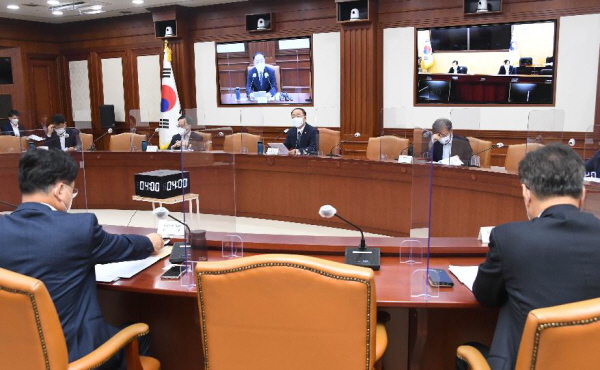
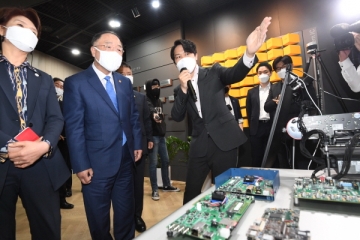
▲제13차 혁신성장 빅3 추진회의 모습
5년간 480억 투입 범용 기술 확보, 민간주도 추진

정부가 미국, 프랑스, 일본 등이 주요 기술을 독점하고 있는 반도체용 초순수의 본격 국산화를 추진한다.
정부는 29일 정부서울청사에서 ‘제13차 혁신성장 빅3 추진회의’를 개최했다. 이번 회의는 홍남기 부총리 겸 기획재정부 장관이 주재하고, 정만기 자동차산업협회장, 최창식 DB하이텍 부회장, 이지효 파두 공동대표, 백은정 한양대 교수 등 민간전문가도 참석했다.
이 자리에서 두 번째 안건으로 반도체용 초순수(Ultra pure water) 생산 국산화 기술개발 추진방안이 발표됐다.
초순수는 물 속에 포함된 불순물들을 극히 낮은 값으로 억제한 이론순수에 가장 근접한 물로 반도체 공정에는 공업용수가 1일 약 20만㎥ 사용되고, 이 중 초순수는 약 50% 정도로 파악되고 있다.
국내 금속제조에는 일일 5만㎥, 화학산업에는 일일 10만㎥의 공업용수가 사용되기에 반도체 산업은 공업용수 사용량이 높은 편이다.
우선 정부는 2021년부터 2025년까지 반도체 초순수 설계·운영기술의 자립화 및 반도체폐수 재이용률 향상을 위한 국가 기술개발사업을 추진할 계획이다.
예산은 총 480억원이 투입된다.
폐수 재이용율 향상 1개 과제, 실증플랜트 국산화 3개 과제, 성능검증 1개 과제 등 총 5개 세부과제로 구성된다.
초순수 생산과 관련해서는 고순도 공업용수 생산 핵심공정 국산화 및 설계, 시공, 운영 자립화를 위한 기술 실증이 이뤄진다.
폐수 재이용과 관련해서는 반도체 기업 대상 일 12톤 규모의 파일럿을 구축해 반도체 폐수 재이용률 향상을 위한 기술개발에 나선다.
검증체계와 관련해서는 고순도 공업용수 생산과정에 적용되는 소재, 장치, 공정에 대한 성능평가 기법을 개발해 신뢰도를 확보한다.
한편 국내 고순도 공업용수 생산 관련 설계·운영 분야는 일본 등 외국기업에서 선점 중으로 국내 기업은 단순시공에 그치고 있다.
주요기자재도 일본 및 선진 외국 제품이 적용되고 있으며, 국산 제품은 성능 확인 미비로 현장적용 실적이 전무하다.
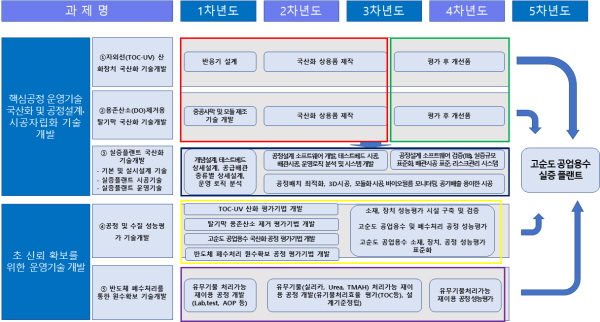
▲초순수 기술개발 로드맵
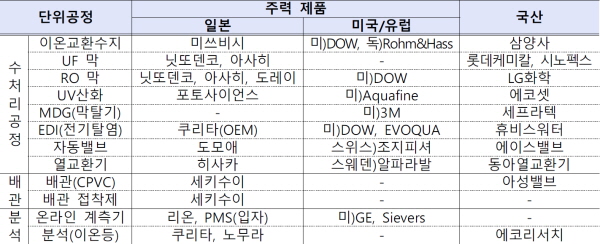
▲주요기자재 공급현황

Comments
Related news
2021 Budget Announcement for Small Business and Big 3 Sectors, Focusing Investment on Semiconductors and New Materials
The Ministry of Science and ICT deliberated and approved five agendas, including the government's research and development investment direction for the materials, parts, and equipment (MPE) sector in 2021, which contains field-specific support priorities for semiconductors and displays, as well as investment directions for the BIG3 sectors including system semiconductors, future vehicle core components, and biohealth materials. Medium to long-term customized support and the establishment of industry-academic-research collaboration systems will be promoted.
2020.03.17by 최인영 기자
The Ministry of Trade, Industry and Energy will invest 5 trillion won to boost data and small business R&D.
The Ministry of Trade, Industry and Energy announced the 2021 Integrated Implementation Plan for Industrial Technology Innovation Projects, which contains a plan to support industrial technology R&D with a scale of 4.9518 trillion won. This represents an 18.7% increase compared to 2020 (4.1718 trillion won). In 2021, the Ministry of Trade, Industry and Energy will continuously expand investment in △materials, components, and equipment (MCE) sectors and △three major emerging industries for innovative growth (Big 3), strengthen investment in △the Korean version of the New Deal including the Green New Deal and Digital New Deal, and △the realization of carbon neutrality (net-zero) by 2030.
2020.12.30by 이수민 기자
Deputy Prime Minister Hong Nam-ki: "280 billion won in new investment in system semiconductors this year."
The government will actively support the cultivation of system semiconductors through fiscal, tax, financial, and regulatory measures, including an injection of 280 billion won in new funding for system semiconductors this year.
2021.05.06by 배종인 기자
Schneider Aims for Building Energy Savings and Operational Stability with Next-Generation HVAC Drives
Schneider Electric has unveiled its next-generation HVAC drive product line 'Altivar HVAC'. The new product line's key features center on enhanced energy savings, system operational stability, and building management system integration. The products are divided into 'ATH200' for OEM and small equipment applications, and 'ATH600' for environments requiring continuous operation and advanced control. The company plans to expand the application scope from commercial buildings to facilities where HVAC system stability is critical, such as hospitals, airports, and data centers. The announcement includes over 30% energy savings, operation from -10°C to +60°C, Modbus and BACnet support, and compatibility with low global warming potential refrigerants.
2026.03.26by 명세환 기자
Ecolab Expands AI Data Center Cooling Business Through Acquisition of CoolIT
Ecolab has agreed to acquire CoolIT Systems, a liquid cooling company for AI data centers, for approximately $4.75 billion. The transaction is expected to close by Q3 2026, subject to regulatory approvals. CoolIT has been supplying direct-to-chip cooling-based coolant distribution units, cold plates, and manifolds, serving hyperscale data centers and colocation operators as customers. This acquisition is a measure to address the high-heat and high-density server environments created by AI proliferation. Ecolab plans to combine its water management and digital monitoring capabilities with CoolIT's hardware technology to expand its data center cooling business.
2026.03.26by 명세환 기자











