


IBS Discovers Next-Generation Magnetic Semiconductor Materials
 Published2021.11.25 17:07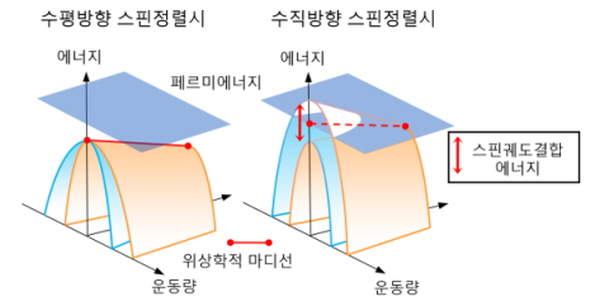
▲Topological magnetic semiconductor
A domestic research team has discovered the world's first next-generation magnetic semiconductor material, which is expected to play a significant role in the implementation of spin information elements that are robust to external noise and have no information loss.
The Institute for Basic Science (President Noh Do-young) Atomic Control Low-Dimensional Electromagnetic Research Group (Director Yeom Han-woong) and the Correlated Matter Research Group (Director Noh Tae-won) announced on the 25th that they had discovered the world's first super-giant magnetoresistance phenomenon in a magnetic semiconductor material.
This achievement is significant in that it is the first in the world to discover a magnetic semiconductor material whose magnetoresistance can vary significantly by up to a billion times depending on the spin angle when the magnetic field size is constant.
The phenomenon of super-giant magnetoresistance is expected to not only provide an opportunity to combine the properties of conventional semiconductors with those of topological magnets, but also to be utilized as a spin information element that is robust to external noise and has no information loss. Spin information element technology (spintronics) is considered a technology that will complement and replace the limitations of existing semiconductor technology, as it is energy efficient and allows for simultaneous information computation and storage.
This study focused on finding candidate materials for topological magnets with semiconductor properties, considering that most of the topological magnets reported so far were metallic.
As a result, it was discovered through measurements of the conduction and optical properties that the spin direction of the magnetic semiconductor manganese silicon telluride compound (hereinafter, Mn3Si2Te6) can be easily controlled between an insulator state in which no current flows and a metallic state in which current flows by rotating the spin direction using an external magnetic field.
Theoretically, it was determined through electronic structure calculations and phase analysis that this is due to the insulator-metal phase transition.
Topological electronic state is a unique characteristic that appears in magnetic materials that have a topological electronic state, and is resistant to external noise or impurities.
Mn3Si2Te6 magnetic materials with these properties can control the flow of current not only by electric field like conventional semiconductors, but also effectively control the flow of current in the direction of magnetic field or spin.
Therefore, if these characteristics are utilized well, it is possible to accelerate the implementation of ultra-high-speed, ultra-low-power, large-capacity spin memory devices that utilize charge and spin information simultaneously.
This is an example showing that domestic joint research teams are playing a leading role in the field of topological magnetic materials, a field where international competition is fierce.
The research team included many researchers, including Kim Jun-seong, a research fellow at the Atomic Controlled Low-Dimensional Electron Research Group (Professor, Department of Physics, POSTECH), Yang Beom-jeong, a research fellow at the Correlated Matter Research Group (Professor, Department of Physics and Astronomy, Seoul National University), Dr. Kim Gyu of the Korea Atomic Energy Research Institute, and Professor Kim Jae-hoon of the Department of Physics, Yonsei University.
Kim Jun-seong, research fellow at the Academic Research Institute “Following the discovery of magnetic metals with topological electronic states in 2018, this result was obtained by applying the same principle to magnetic semiconductors,” he said, explaining its significance, saying, “It is an example that shows that domestic joint research teams are playing a leading role in the field of magnetic topological materials.”
This study was published online on November 25 in the prestigious academic journal Nature (IF 49.962).

Comments
Related news
"Electronic device form factors are becoming more diverse." IBS succeeds in synthesizing large-area single-crystal metal thin films.
The Institute for Basic Science has succeeded in diversifying the surface patterns of metal substrates for synthesizing high-performance two-dimensional materials such as graphene. Two-dimensional single-crystalline materials are materials with regular atomic arrangements and orientations, and are used as materials for high-performance electronic devices due to their excellent thermal and electrical conductivity. Until now, there had been a limitation in the variety of single-crystalline metal thin film patterns required for synthesizing two-dimensional single-crystalline materials, and this research has found a clue to resolving this issue.
2020.05.28by 이수민 기자
Wiring spacing within semiconductor devices can be further reduced
A research team led by Professor Shin Hyun-seok at UNIST has successfully developed an ultra-low dielectric constant insulator that enables more precise fabrication of semiconductor devices through collaborative research with Samsung Electronics' Advanced Institute of Technology, IBS, and others. The insulators currently used in semiconductor processes are porous organosilicates with a dielectric constant of approximately 2.5. The amorphous boron nitride synthesized by the research team in this study has a dielectric constant of 1.78, representing the discovery of a novel material with a dielectric constant below 2.5, which has been regarded as a technical challenge.
2020.06.25by 이수민 기자
Black phosphorus, could it become the main material for angstrom semiconductors smaller than nanometers?
The IBS Multidimensional Carbon Materials Research Group has realized a conductive channel with a linewidth of 0.43nm using two-dimensional black phosphorus. Two-dimensional black phosphorus is considered a leading semiconductor device for the post-graphene era. With a thickness of approximately one atomic layer, it can be applied to flexible and transparent devices that are difficult to implement with silicon-based semiconductors. Additionally, it exhibits the highest electron mobility among two-dimensional semiconductor devices.
2021.07.30by 이수민 기자

Intel Unveils Next-Generation 'Core Ultra Series 3' and vPro Platform for Enterprise PCs
Intel has officially unveiled the "Intel Core Ultra Series 3" for next-generation enterprise PCs and the latest vPro platform, addressing a wide range of demands from enterprise notebooks to high-performance workstations.
2026.03.26by 배종인 기자

ROHM Launches ESD Protection Diode Compatible with High-Speed Interfaces of 10Gbps or Higher
Semiconductor specialist ROHM has developed the 'RESDxVx series' of ESD (electrostatic discharge) protection diodes capable of responding to next-generation high-speed data communication environments exceeding 10Gbps, simultaneously enhancing both signal quality maintenance required in high-speed interfaces and IC protection performance.
2026.03.26by 배종인 기자











