



Xilinx Achieves Industry Record with 4.4M Logic Cells, Doubling Highest Capacity Device Density One Generation Ahead
 Published2013.12.27 15:15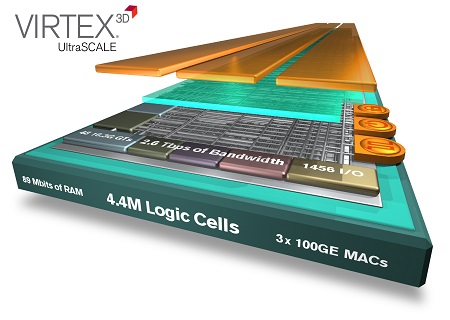
Xilinx Korea (Regional Director An Heung-shik) December 11, 2013 – Xilinx announced that it has achieved an industry record with a 4.4M logic cell device, doubling the capacity of its industry-leading high-capacity Virtex®-7 2000T device. With this achievement, Xilinx has maintained leadership in high-end FPGAs for two consecutive generations while providing customers with additional nodes advantage. The Virtex® UltraScale™ VU440 3D IC, the most advanced device in Xilinx's All Programmable UltraScale™ portfolio, has extended industry leadership by expanding density from 2x at 28nm to 4x at 20nm, representing the highest capacity offered by any programmable device currently available. Utilizing advanced 3D IC technology, the VU440 device at 20nm provides substantially greater advantages compared to competitors' disclosed 14/16nm roadmaps.
The Virtex UltraScale VU440 device sets new industry benchmarks, delivering approximately 50M ASIC gate equivalents for next-generation production prototype applications. Additionally, the 20nm Virtex UltraScale device provides the highest system performance and bandwidth required for single-chip implementation of 400G MuxSAR, 400G transponder, and 400G MAC-to-Interlaken bridge applications.
John Koeter, Vice President of IP System Marketing at Synopsys, stated, "Synopsys has used six generations of Xilinx devices in its fully integrated HAPS® FPGA-based hardware and software prototyping system. Combined with the capabilities of Xilinx Virtex UltraScale VU440, the unique system capabilities of HAPS will increase overall system performance and capacity, thereby enhancing productivity required for fast software development, hardware/software integration, and SoC system verification."
The Virtex UltraScale product family adds re-programmability functionality, providing customers with a new dimension of performance, system throughput, and bandwidth. The Virtex UltraScale VU440 device adopts ASIC-class architecture to further enhance scalability, achieving utilization rates up to 90% through next-generation routing, ASIC-like clocking, power management, elimination of interconnect bottlenecks, and critical path optimization. Beyond key architectural block improvements such as expanded multipliers, high-speed memory cascading, 33G performance transceivers, and the addition of industry-leading integrated 100Gb/s Ethernet MAC and 150Gb/s Interlaken IP cores, the device delivers hundreds of gigabits per second of system performance through smart processing at full line rate.
Spencer Sauders, Hardware Acceleration Director at ARM, stated, "ARM has utilized previous-generation Virtex FPGAs for IP verification. The innovations of the UltraScale architecture combined with Vivado have enabled higher utilization and performance than ever before. The extensive gate capacity, superior serial bandwidth, and impressive I/O pin count of Virtex UltraScale make it ideal for next-generation IP development."
The key to this device's industry-leading bandwidth and capacity lies in second-generation SSI (Stacked Silicon Interconnect) technology. Based on TSMC's CoWoS manufacturing technology, this generation of SSI technology features 5x greater inter-die bandwidth and an integrated clocking architecture at slice boundaries, enabling a virtual monolithic design experience. Xilinx's SSI technology enables device development with 2-4x greater capacity than competing products while consistently advancing ahead of Moore's Law. First introduced in 2011 with the Virtex-7 2000T device, SSI technology was built with 6.8 billion transistors and enabled the use of an unprecedented 2M logic cells, equivalent to 20M ASIC gates.
Xilinx UltraScale devices represent the industry's only ASIC-class programmable architecture extended from monolithic designs through 3D IC and 20nm planar technology via 16nm FinFET technology, propagating ASIC-class strengths. Through the combination with TSMC's latest technology, co-optimization with Vivado ASIC-strength design suite, and recently introduced UltraFast™ design methodology, Xilinx achieves 1.5-2x improved system-level performance and integration while demonstrating technology up to 2 years ahead of the curve.

Related news
Intel Unveils Next-Generation 'Core Ultra Series 3' and vPro Platform for Enterprise PCs
Intel has officially unveiled the "Intel Core Ultra Series 3" for next-generation enterprise PCs and the latest vPro platform, addressing a wide range of demands from enterprise notebooks to high-performance workstations.
2026.03.26by 배종인 기자
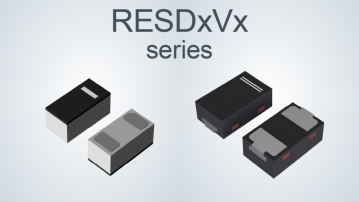
ROHM Launches ESD Protection Diode Compatible with High-Speed Interfaces of 10Gbps or Higher
Semiconductor specialist ROHM has developed the 'RESDxVx series' of ESD (electrostatic discharge) protection diodes capable of responding to next-generation high-speed data communication environments exceeding 10Gbps, simultaneously enhancing both signal quality maintenance required in high-speed interfaces and IC protection performance.
2026.03.26by 배종인 기자
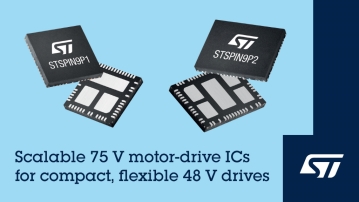
ST Launches 75V Drive IC Targeting 48V Industrial Motor Driving
ST Microelectronics has unveiled the 'STSPIN9P' series of 75V motor drive ICs tailored for 48V-class industrial drive system design. The new product family is characterized by half-bridge and full-bridge configurations that enable design scalability according to motor type and output conditions. Power supply circuits, protection functions, and current sensing circuits are integrated on-chip to simplify system configuration, and the devices are designed to support applications up to 500W maximum. The company plans to provide reference designs and demo boards to support development and evaluation in industrial automation, robotics, pumps, fans, lighting, and textile machinery.
2026.03.26by 배종인 기자

Nordic supports security updates for the entire lifecycle of IoT devices at a single fixed cost
Nordic Semiconductor, a global leader in low-power wireless connectivity solutions, has unveiled a single fixed-cost licensing model that delivers FOTA (Firmware Over-the-Air) and device management capabilities throughout the device lifecycle via nRF Cloud, and introduced a new firmware update solution to prepare for the enforcement of the European Union's Cyber Resilience Act (CRA).
2026.03.26by 배종인 기자

Practical Training in Low-Noise, Low-Power Circuit Design All in One Place… Training Fee Support
The "2026 Advanced Engineer Practical Masterclass" to strengthen competencies in high-sensitivity analog circuit and sensor-based system design will be held on April 16 at the e4ds Conference Center in Gasan-dong, Seoul. This program will be conducted as an offline paid hands-on training session, not online, and is targeted at engineers seeking on-site intensive learning. Texas Instruments will provide educational support for this training, allowing participation at 150,000 won, a 100,000 won discount from the original price of 250,000 won.
2026.03.26by 배종인 기자











