



DMC Convergence Research Group Develops High-Voltage Power Semiconductors for Pulse Power
 Published2022.10.27 14:13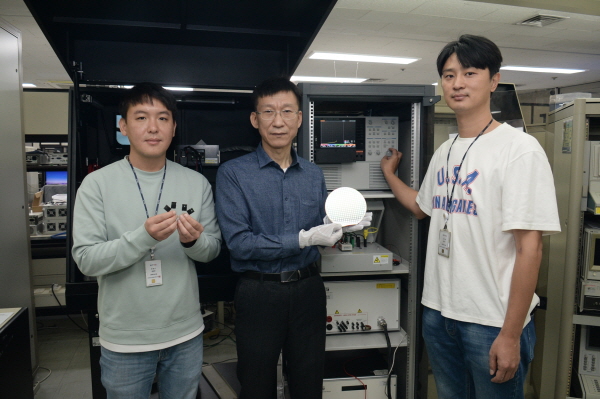
▲ETRI researchers holding MCT power semiconductor package samples and wafers.
A domestic research team has developed a power semiconductor for high-voltage switches used in high-energy military detonators and electric vehicles. This achievement, made with purely domestic technology, is expected to be of great help in achieving self-reliance in power semiconductor technology.
The DMC Convergence Research Group (led by ETRI), established as part of the National Research Council of Science and Technology (NST) Convergence Research Group project, announced on the 27th that it has developed 1,400V and 2,500V silicon MCT power semiconductor technology for high-voltage switches in the pulse power field for the first time in Korea.
Pulse power is a technology that stores and compresses electrical energy for a certain period of time at low power and then explosively releases a large amount of energy in a very short period of time.
It is mainly used in the defense field, such as railguns, warships, fighter jets, and missiles, and in various industrial fields, such as electromagnetic accelerators, gas and water treatment, plasma generators, and laser systems.
A device that controls the high instantaneous current of pulse power is a high-voltage switch.
MCT power semiconductors are key components of high-voltage switches, but currently, 1,400V-class MCT power semiconductors are designated as export-import restricted items for exclusive foreign production.
The DMC Convergence Research Group has successfully developed 1,400V and 2,500V MCT power semiconductors for the first time in Korea, thereby successfully producing semiconductors for defense components domestically.
The MCTs developed by the research team can withstand high voltages of 1,600 V and 3,000 V, respectively.
It boasts performance equivalent to that of products exclusively produced overseas, with a pulse current of 3kA or more and a current rising slope of 40kA/㎲ or more.
It is an essential performance element of power semiconductors for pulse power.
Additionally, the research team developed a prototype of an 800V-class precharge relay and an electrostatic discharge test generator for civilian use using the developed MCT power semiconductor.
The precharge relay controls the power discharge of all electrical and electronic products that use high-voltage battery systems, such as electric vehicles and energy storage devices. It is an essential component for stable control.
The electrostatic discharge test generator also requires a control component to discharge a high current momentarily to evaluate the electrostatic resistance of electronic products.
Applying MCT power semiconductors to precharge relays is expected to solve the problems of existing mechanical switches and relays, such as short lifespan and noise.
Compared to other power semiconductors such as IGBTs and SiC MOSFETs, the system configuration is very simple and the chip size is only 1/3, making it economical.
Additionally, the relay for the electrostatic discharge test generator developed by the research team can overcome the limitations of existing mercury relays, the use of which is restricted due to global environmental issues.
In other words, this technology is not only used as a core component in the defense pulse power field, but also has a very high utility as a civilian power component.
The significance is even greater because the design and production of MCT power semiconductor components and the high-voltage semiconductor relay prototype were all achieved using domestic research technology.
The research team said that they were able to achieve this result through MCT element design technology, manufacturing process technology, performance evaluation technology, semiconductor relay design technology utilizing MCT, module manufacturing technology, and testing and evaluation technology accumulated over many years.
Dr. Park Geon-sik of the DMC Convergence Research Group said, “We secured high-voltage MCT power semiconductor technology through the convergence of excellent facilities and research capabilities of domestic research institutes through the ETRI Semiconductor Laboratory, which possesses silicon semiconductor development know-how, and the NST Convergence Research Group project. “We hope that this technology will be used in the development of various power components not only in the defense sector but also in the civilian sector,” he said.
The research team plans to conduct follow-up research to develop high-voltage switches of 4,000 V or higher, bidirectional high-voltage switches, and other application components utilizing this technology.
In addition, we plan to further develop high-voltage switch technology for pulse power and support commercialization through technology transfer to industrial companies and promotion of research institutes.
This achievement was achieved through the National Research Council for Science and Technology's Convergence Research Group's project, "Development of a Platform for Self-Sufficiency in Core Semiconductor Components for National Defense Weapon Systems."
ETRI, the Korea Institute of Machinery and Materials, and the Korea Institute of Nanotechnology are participating. This is a valuable product of convergence research, utilizing leading technologies from government-funded research institutes and the private sector to study core semiconductor technologies for defense weapon systems.

Comments
Related news
ETRI Establishes Smart Edge Device SW Development Platform
Domestic researchers are developing a software development platform that enables easy and convenient automatic generation and integrated development of various artificial intelligence (AI) services deployed in smart devices, such as visual intelligence, emotional intelligence, object intelligence, and healthcare intelligence. This is expected to become a major driving force in revitalizing the domestic AI semiconductor ecosystem and securing technological dominance in smart devices in the future.
2022.09.14by 배종인 기자
ETRI Localizes World-Class GaN Power Devices
Domestic researchers have successfully developed gallium nitride (GaN) power devices, which are considered key components for next-generation semiconductors, using purely domestic technology, and this is expected to significantly contribute to enhancing the competitiveness of Korea's semiconductor industry and securing technological leadership.
2022.09.22by 배종인 기자

ETRI Publishes Comic Book '2035 Future World'
Domestic researchers have republished the "Technology Development Roadmap 2035," which led to the formulation of the 2020 National Intelligence Plan, in a comic format that is easy and entertaining to understand.
2022.10.25by 배종인 기자

Intel Unveils Next-Generation 'Core Ultra Series 3' and vPro Platform for Enterprise PCs
Intel has officially unveiled the "Intel Core Ultra Series 3" for next-generation enterprise PCs and the latest vPro platform, addressing a wide range of demands from enterprise notebooks to high-performance workstations.
2026.03.26by 배종인 기자

ROHM Launches ESD Protection Diode Compatible with High-Speed Interfaces of 10Gbps or Higher
Semiconductor specialist ROHM has developed the 'RESDxVx series' of ESD (electrostatic discharge) protection diodes capable of responding to next-generation high-speed data communication environments exceeding 10Gbps, simultaneously enhancing both signal quality maintenance required in high-speed interfaces and IC protection performance.
2026.03.26by 배종인 기자











