


Launch of 'Advanced Strategic Industries Association' to Consolidate National Technological Capabilities
 Published2022.11.09 10:55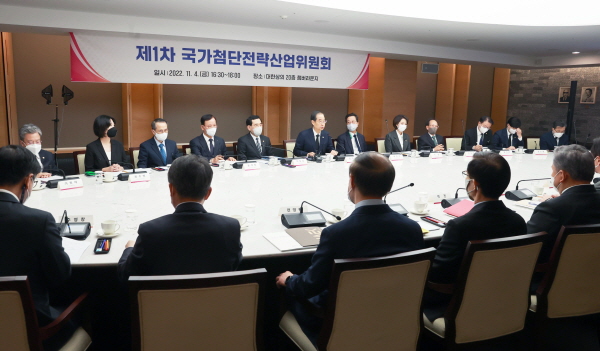
15 fields selected in semiconductors, secondary batteries, and displays
Selection of specialized complexes and graduate schools, focused support for advanced strategic industries
Plan to train 30,000 'semiconductor' master's and doctoral graduates over the next 10 years
The government has launched the 'National Advanced Strategic Industry Committee' to respond to the global competition for technological hegemony and is providing focused support to the advanced strategic industry ecosystem.
The government announced on the 4th that it had formed the first 'National Advanced Strategic Industry Committee,' chaired by Prime Minister Han Duck-soo, as the command center for the pan-government advanced strategic industry policy.
The Committee serves as the highest decision-making body for discussing relevant policies and plans, including investment, workforce training, regulatory reform, and finance, to support securing a significant lead in domestic advanced strategic industries.
The government announced last month that it would promote the 'National Strategic Technology Project,' which involves setting goals and making joint investments through the public and private sectors, by presenting 12 national strategic technologies.
Based on this, the committee, which was launched, is composed of private members with diverse expertise from government ministries, economic organizations, industry, academia, and research institutions, and plans to establish national strategies.br />
■ Key Agenda Items for Public-Private Joint Advanced Strategic Industries
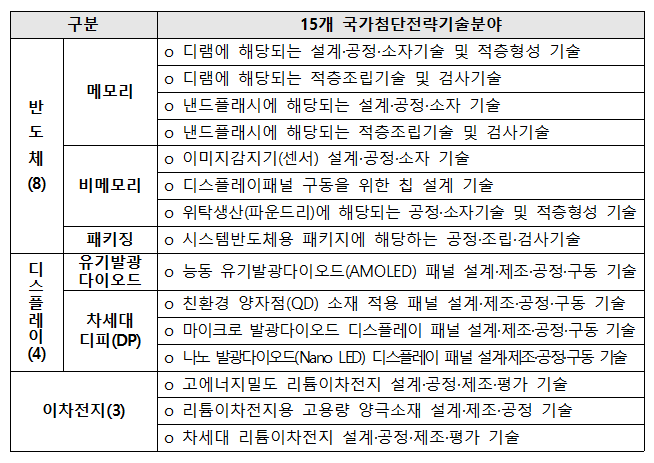
Fifteen new national advanced strategic technology fields were selected across three industries: semiconductors, secondary batteries, and displays.
The government announced that it conducted a technology demand survey to identify the demand for 43 national advanced strategic technologies across a total of 9 industries, and selected the semiconductor sector (8 technologies), the display sector (4 technologies), and secondary batteries (3 technologies) by gathering opinions from experts in industry, academia, and research institutes.
In addition, specialized complexes will be designated to provide focused support to the advanced strategic industry ecosystem, including leading domestic companies, materials, parts, and equipment firms, as well as universities and research institutes. This will involve the establishment of infrastructure, expedited licensing, and customized support in areas such as technology, human resources, and finance. These complexes will be designated by the first half of next year following an open call this year.
To resolve the shortage of skilled personnel in national advanced strategic industries, the government designates and provides focused support to specialized graduate schools in specific technology fields and encourages them to conduct research and development projects in collaboration with companies.
In particular, the semiconductor sector plans to train 30,000 master's and doctoral graduates over the next 10 years, of whom about 5,000 will be trained through specialized graduate schools. To this end, three semiconductor-specialized graduate schools will be designated first by early next year.
In the fields of secondary batteries and displays, the pilot designation of at least one specialized graduate school is planned for 2024, and a preliminary feasibility study for additional designations is planned.
Meanwhile, in line with the rapid growth of high-tech strategic industries, the 2nd National High-tech Strategic Industry Committee is scheduled to be held as soon as possible early next year, and plans are in place to identify and formulate various policies to strengthen the competitiveness of the national high-tech strategic industry ecosystem.

관련뉴스
.jpg)
Embedded Development 'No People'
반도체, 인공지능(Ai), 자율주행 등 개발자에 대한 수요가 폭발하고 있는 가운데 이들 영역에서 사용되는 칩 및 제품을 설계, 개발할 수 있는 임베디드(embedded) 개발자들이 없어 향후 일반 소기업을 넘어 중견, 대기업도 개발자 부족에 직면하며, 첨단 기술 개발에서 뒤처질 수 있다는 우려가 제기되고 있다.
2022.10.11by 배종인 기자
Full-scale acquisition of technological sovereignty for '12 major national strategic technologies'
과학기술정보통신부가 10월 28일(금) 용산 대통령실에서 윤석열 대통령 주재로 개최된 국가과학기술자문회의 전원 회의에서 ‘국가전략기술 육성방안’을 발표했다.
2022.10.28by 김예지 기자
AI Semiconductors Will Be a Breakthrough That Determines Technological Hegemony
AI technology, which has transformed the semiconductor paradigm, is shaping hegemony, and expert opinion suggests that semiconductors will become a critical determining factor.
2022.11.07by 김예지 기자

Intel Unveils Next-Generation 'Core Ultra Series 3' and vPro Platform for Enterprise PCs
Intel has officially unveiled the "Intel Core Ultra Series 3" for next-generation enterprise PCs and the latest vPro platform, addressing a wide range of demands from enterprise notebooks to high-performance workstations.
2026.03.26by 배종인 기자

ROHM Launches ESD Protection Diode Compatible with High-Speed Interfaces of 10Gbps or Higher
반도체 전문 기업 로옴(ROHM)이 10Gbps를 넘어서는 차세대 고속 데이터 통신 환경에 대응할 수 있는 ESD(정전기 방전) 보호 다이오드 ‘RESDxVx 시리즈’를 개발하며, 고속 인터페이스에서 요구되는 신호 품질 유지와 IC 보호 성능을 동시에 끌어올렸다.
2026.03.26by 배종인 기자











