



Joint public-private forum on IRA response discusses government and industry response
 Published2022.11.30 10:01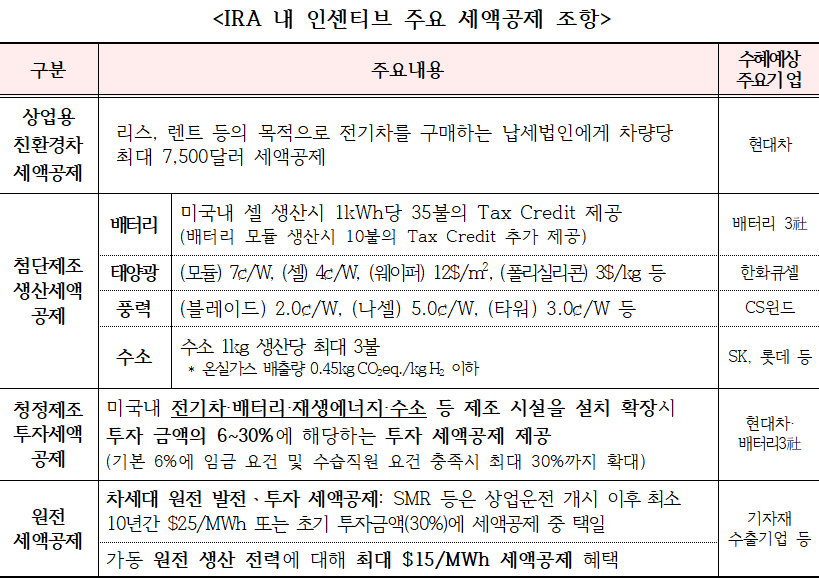
▲ Key new incentive deduction provisions within IRAs (Image source: Ministry of Trade, Industry and Energy)
The three battery companies are enhancing their price competitiveness through investment and production tax credits.
Benefits of 500 trillion won are expected over 10 years with the application of IRA incentives.
On the 29th, Minister of Trade, Industry and Energy Lee Chang-yang held a joint public-private meeting with eight companies and related associations at the Korea Chamber of Commerce and Industry to collect opinions and discuss future response measures regarding the US Inflation Reduction Act (IRA).
This joint public-private meeting was held to assess the overall situation ahead of the full implementation of the IRA in January next year and to discuss future response directions with the government and industry.
At the meeting that day, Minister Lee, in his opening remarks, said, “The government has continuously presented our opinions to the United States more quickly and actively than any other country through summits and consultations with the US Congress and the administration,” and evaluated that as a result, “some results have been produced, such as a personal letter from President Biden, the expression of the will for continued consultations between the two leaders, and the introduction of amendments in the US Senate and House of Representatives.”
He continued, “We will continue to do our best to maximize the benefits of IRA and minimize the burden,” and added, “At today’s meeting,He stated, “With this as an opportunity, the government plans to pursue short-term, mid- to long-term measures in various ways together with the industry.”
As a short-term measure, it includes the plan to make the most of the new tax credit benefits for commercial eco-friendly vehicles.
Our government is currently in discussions with the U.S. government to expand the scope of commercial vehicle coverage as much as possible, and our electric vehicle industry also plans to prepare to increase the proportion of commercial exports to the U.S.
Battery procurement measures are viewed from a mid- to long-term perspective.
Even if North American final assembly requirements are relaxed, our industry will take time to procure batteries that meet IRA requirements, and we are fully prepared.
Meanwhile, the Ministry of Trade, Industry and Energy plans to continue its outreach to the U.S. Congress, focusing on the amendment proposed in both the Senate and House of Representatives (three-year deferral of requirements for electric vehicle tax credits), although it is realistically difficult to revise the law in relation to future specific negotiations with the U.S. IRA.
First, after the midterm elections, the Minister will send a letter urging the revision of the IRA to 24 lawmakers, including the leaders of both parties in the Senate and House of Representatives, key members of the Senate Finance Committee and the House Ways and Means Committee, which are the committees in charge of the IRA, and lawmakers from districts where our companies are operating. In addition, in early December, the Director of the Trade Negotiation Headquarters of the Ministry of Trade, Industry and Energy and members of the National Assembly’s Industry, Trade and Culture Committee will make a joint visit to the United States to contact and persuade U.S. lawmakers.
Regarding the U.S. administration's lower-level regulations, after the government officially submitted its opinion to the U.S. Treasury Department on November 4, it held working-level consultations between Korea and the U.S. and a meeting with the White House to propose the following: △easing final assembly requirements; △specifying requirements for batteries, minerals, and parts; △expanding the use of commercial eco-friendly vehicles; and △expanding the clean manufacturing investment tax credit. Furthermore, the government plans to continue efforts to reflect the opinions of our industry by contacting key figures in the U.S. administration during the Trade Negotiation Chief's visit to the U.S. in early December.
Our industry has several areas within the IRA. We anticipate large-scale benefits (estimated by the U.S. government: 500 trillion won over 10 years) based on the incentive provisions, and we plan to respond in close consultation with the government.
In relation to electric vehicles, Hyundai Motor Company plans to actively pursue marketing, review hybrid production of electric vehicles at existing internal combustion engine vehicle plants, such as those in Georgia, operate electric vehicle-only plants as planned, and quickly secure batteries that meet mineral and component requirements to meet the tax credit requirements set by the IRA.
In addition, we plan to make full use of the beneficial provisions, such as the commercial eco-friendly vehicle tax credit stipulated in the IRA (for leasing and rental purposes → up to $7,500 per vehicle) and the tax credit for investment in electric vehicle production facilities.
Looking at the battery industry, the United States provides tax credits for investment in battery manufacturing facilities (Clean Manufacturing Facility Investment Tax Credit) and tax credits for battery production (Advanced Manufacturing Production Tax Credit). The three battery companies that are aggressively advancing into the United States to secure the market plan to maximize the use of investment and production tax credits to enhance price competitiveness.
Minister Lee Chang-yang said, “We will also pursue domestic measures such as consultations with relevant ministries to reform the domestic electric vehicle subsidy system and strengthening the core competitiveness of electric vehicles and batteries,” adding, “While local investment is inevitable for the industry to secure the U.S. market, I ask that you also pay special attention to domestic employment and investment.”

관련뉴스
.jpg)
산업부, 산업혁신기반구축 로드맵 기술경쟁력 향상 방점
산업부가 산업혁신기반구축을 통해 기업의 산업기술혁신 역량을 강화해 산업기술생태계를 활성화하고 글로벌 기술경쟁력 향상 추진한다.
2022.04.29by 성유창 기자

19 regulatory improvements in the hydrogen industry, including self-charging hydrogen vehicles.
운전자 편의성 및 수소충전소 운영 경쟁력 확대를 위한 수소차 셀프충전 필요성이 제기되어 산업부가 본격적으로 규제 개선에 나섰다.
2022.08.29by 성유창 기자
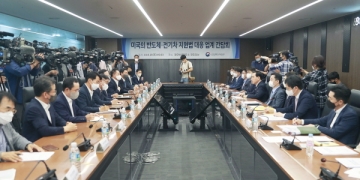
The Ministry of Trade, Industry and Energy announced efforts to minimize the burden on the industry from the US semiconductor support law.
산업통상자원부가 미국 반도체 지원법으로 인한 ‘가드레일’ 조항에 따른 우리나라 반도체 업계 부담이 최소화 되도록 노력하겠다고 밝혔다.
2022.08.29by 배종인 기자
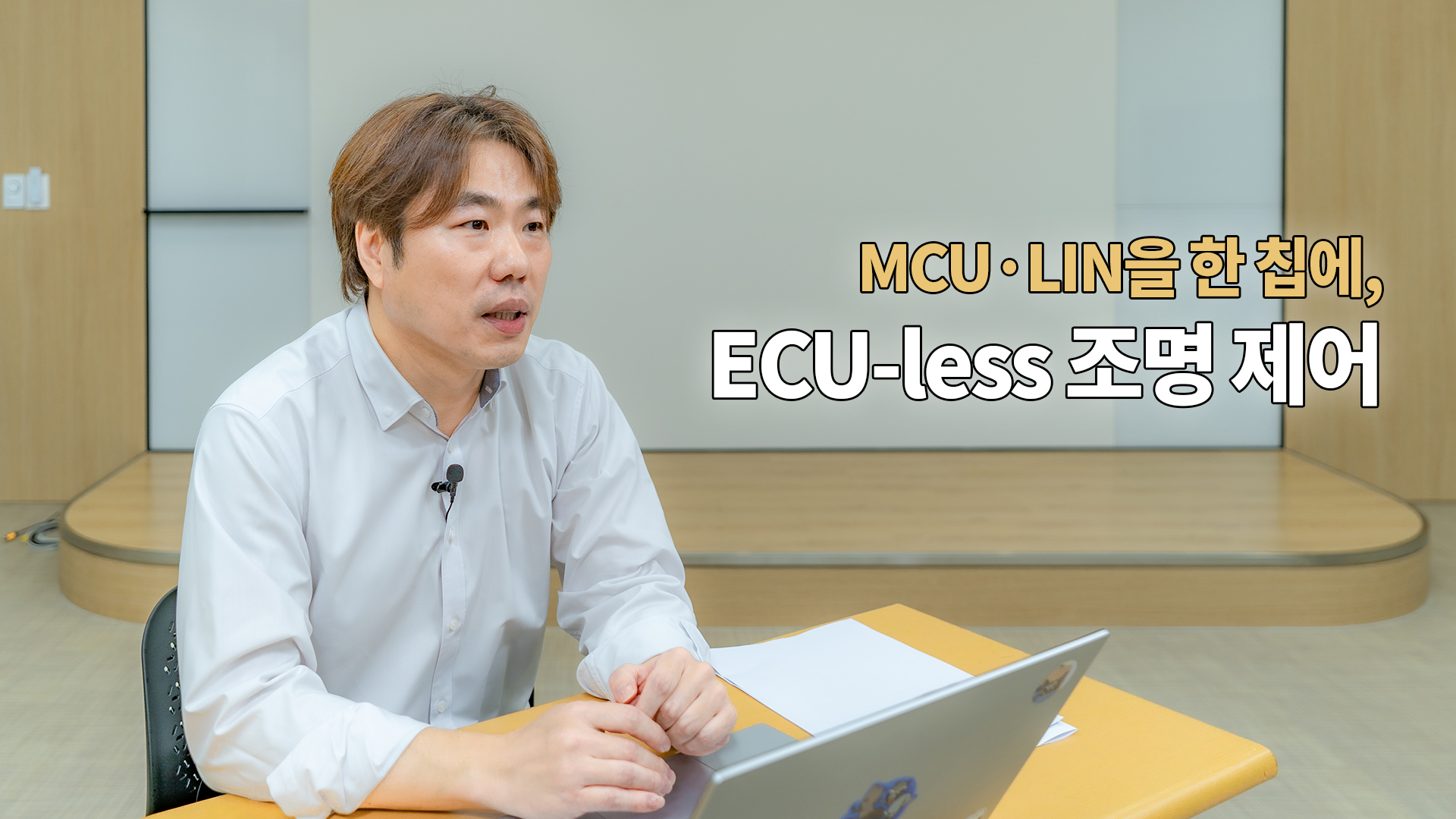
A single misaligned light means 'defect'… Vehicle interior lighting now guarded by semiconductors and software
자동차 실내조명이 '보조 조명'의 자리를 벗어나고 있다. 색상과 애니메이션으로 브랜드 아이덴티티를 드러내고 운전자 취향을 담아내는 사용자 경험(UX)의 핵심 요소로 올라서면서, LED 실내 앰비언트 시장도 빠르게 커지는 중이다. 이에 관하여 '미래 자동차를 밝히는 지능형 LED 실내 조명 솔루션' 이라는 내용으로 기술 웨비나 세션을 발표하는 최영재 다보코퍼레이션 연구위원을 앞서 만나, 시장의 온도와 설계 요구의 변화를 들었다.
2026.08.28by 명세환 기자
TI, HEV·EV 트랙션 인버터용 다축 코어리스 전류 센서 TMCS2100-Q1 공개
Texas Instruments가 HEV·EV 트랙션 인버터용 다축 코어리스 홀 효과 전류 센서 TMCS2100-Q1을 공개했다. 수평·수직 자기장을 동시에 측정하는 다축 센싱 기술로 기존 단일 축 센서 대비 최대 20배 높은 정확도를 달성하며, 버스바 무개조 설계로 기계 설계 유연성을 확보했다. 800V 아키텍처 확산에 따른 고정확도 요구 충족과 소형화를 동시에 구현한다.
2026.08.27by 배종인 기자











