


Hyundai Mobis Demonstrates World's First Next-Generation Broadcasting Standard Reception System for Vehicles in the United States
 Published2022.12.27 13:14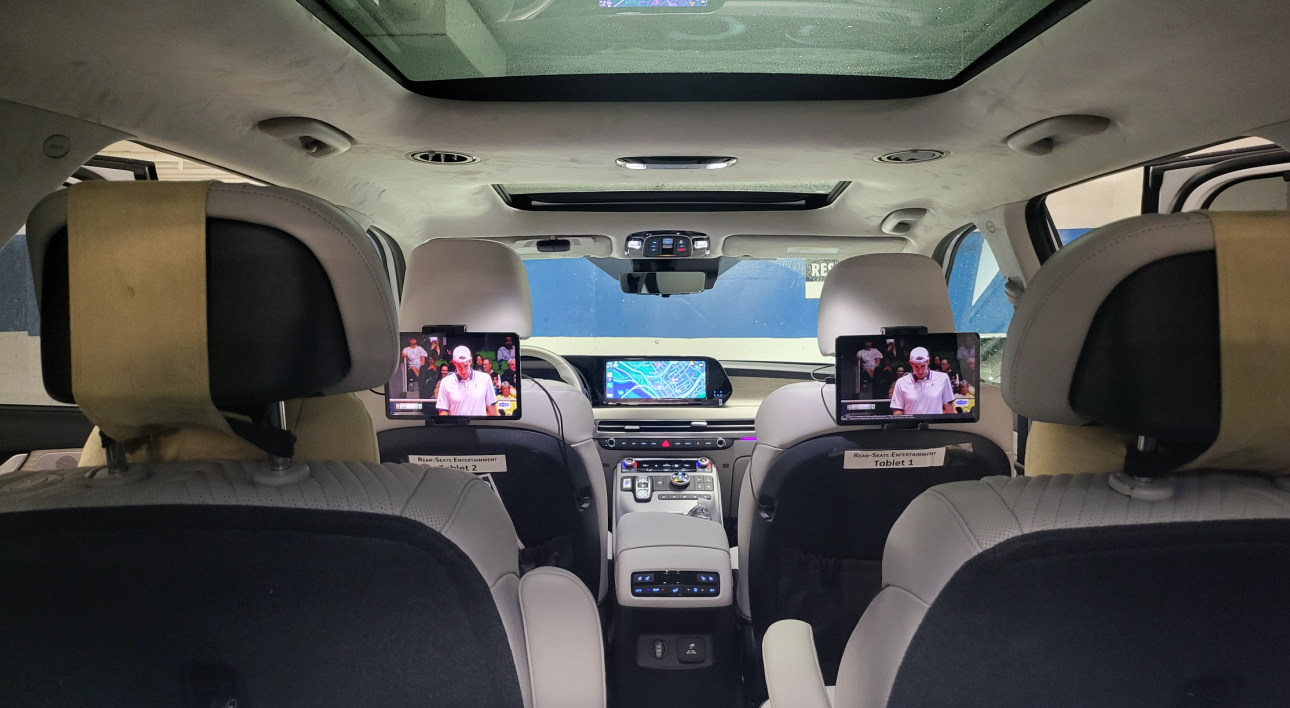
▲ ATSC3.0 System Concept Diagram (Image source: Hyundai Mobis)
Expected to meet demand for high-definition video content in vehicles while driving
Pilot project for vehicle broadcasting platform underway with Sinclair in the United States
Hyundai Mobis announced on the 26th that it will conduct a pilot project for a vehicle broadcasting platform in the North American market in partnership with U.S. media group Sinclair.
ATSC3.0 is a next-generation broadcasting standard newly established in the United States for the first time in 20 years.
It implements high-speed transmission and reception of high-definition video and data using broadcast frequencies and Internet Protocol (IP).
It has the advantage of utilizing a wider coverage range than communication frequencies at lower cost while enabling multi-channel broadcasting and bidirectional services.
In particular, with the expansion of autonomous driving, it is expected to meet the growing demand for high-definition video content in vehicles while driving.
Hyundai Mobis conducted a demonstration of the next-generation communication standard ATSC3.0 vehicle broadcasting system in Washington D.C. and Baltimore, United States starting on the 20th (local time).
The demonstration event was attended by representatives from Sinclair, MileOne, one of America's three largest auto dealers, and CAST.ERA (a joint venture between Sinclair and SK Telecom), an ATSC3.0-related solutions company.
Participants rode in vehicles equipped with Hyundai Mobis's ATSC3.0 platform and experienced demonstrations of high-definition broadcasting and location-based customized advertising while driving, and held additional business and technology cooperation meetings.
In particular, David Smith, Chairman of Sinclair, participated directly in the demonstration, showing high interest and commitment to the vehicle TV system.
Previously, in October, Hyundai Mobis, Sinclair, and CAST.ERA signed a Memorandum of Understanding (MOU) for developing a North American vehicle TV system applying ATSC3.0.
ATSC3.0 enables bidirectional transmission and reception of UHD-grade video and data both indoors and outdoors.
It is a significant advancement from the existing ATSC1.0, which only allowed one-way indoor communication in HD quality.
In Korea, it was the world's first commercialized as a terrestrial UHD broadcasting standard specification in 2016.
Hyundai Mobis and other domestic companies are already exploring multi-faceted applications including vehicle services and convergence with 5G communications.
This MOU and demonstration project signify that industry leaders from both Korea and the United States have joined forces to secure the ATSC3.0 market.
In this project, Hyundai Mobis provides the world's first automotive-grade ATSC3.0 broadcasting transceiver system that enables high-definition TV viewing while driving at high speeds.
An antenna and low-noise amplifier (LNA) are combined and mounted on the vehicle's front windshield, an ATSC3.0 broadcasting module is installed inside the vehicle, and a rear-seat monitor (RSE) is connected.
It is a solution that elevates hardware durability and software versatility to a new level for automotive applications. Sinclair and CAST.ERA handle broadcasting video format and content transmission.
To achieve this, Hyundai Mobis succeeded in pre-development of the vehicle ATSC3.0 reception system through collaboration with domestic and foreign companies.
Hyundai Mobis established detailed concepts and oversaw hardware and system development as well as operational scenario verification by applying antennas, communication modules, and chipsets.
The system completed performance verification at testbeds in Jeju and Seoul areas, where related infrastructure is being built through collaboration with CAST.ERA and KBS.
In October, reception performance was also checked in major U.S. cities including Washington D.C.
Vehicles equipped with ATSC3.0 systems are expected to be particularly popular in the mid-to-large SUV market where family car demand is high.
Applications range from real-time high-definition TV viewing to real-time emergency and disaster alerts, region-customized advertising services, navigation function improvements using precise GPS signals, and vehicle firmware OTA (Over-the-Air wireless software updates), with limitless potential.
A Hyundai Mobis official explained, "By combining with technology in the vehicle infotainment (IVI) field, one of Hyundai Mobis's core businesses, we will be able to provide even more powerful features in the future."
Meanwhile, looking beyond establishing a foothold in the North American market to targeting the global market, CAST.ERA and Hyundai Mobis will exhibit the vehicle ATSC3.0 reception system at the 'NAB Show (National Association of Broadcasters trade show)' in Las Vegas in April next year to lead IVI technology trends.

Related news

A single misaligned light means 'defect'… Vehicle interior lighting now guarded by semiconductors and software
Automotive interior lighting is moving beyond its role as 'auxiliary lighting.' As it becomes a core element of user experience (UX) that expresses brand identity through color and animation while reflecting driver preferences, the LED interior ambient lighting market is growing rapidly. In connection with this, we met in advance with Choi Young-jae, Research Director at Dabo Corporation, who will present a technical webinar session on "Intelligent LED Interior Lighting Solutions Illuminating Future Vehicles," to hear about market trends and changes in design requirements.
2026.08.28by 명세환 기자
TI Unveils Multi-Axis Coreless Current Sensor TMCS2100-Q1 for HEV/EV Traction Inverters
Texas Instruments has unveiled the TMCS2100-Q1, a multi-axis coreless Hall-effect current sensor for HEV and EV traction inverters. By simultaneously measuring horizontal and vertical magnetic fields through multi-axis sensing technology, it achieves up to 20 times higher accuracy compared to conventional single-axis sensors, while the busbar-unmodified design provides mechanical design flexibility. It simultaneously meets the high-accuracy requirements and miniaturization driven by the expansion of 800V architectures.
2026.08.27by 배종인 기자

Vector Korea Launches New Version of 'CANoe' with AI Agent and MCP
Vector Korea has released a new version of CANoe 20 SP2 equipped with an AI agent and MCP. With a single natural language prompt, it automates the entire process from CAPL test code generation to execution and error correction, completing tasks that previously took several hours to days in just minutes. The Vector-RAG technology suppresses LLM hallucination phenomena, and it is compatible with existing LLMs such as GitHub Copilot and Claude, provided free of charge on CANoe 20 SP2 and higher versions.
2026.08.27by 배종인 기자
Automotive Research Institute to Participate in '2026 Autonomous Mobility Industry Exhibition'
The Korea Automotive Research Institute will participate in the 2026 Autonomous Mobility Industry Exhibition to showcase research results in AI-based autonomous driving, high-performance computing, and system safety and security technologies. Through industry-academia-research collaboration, the institute is advancing autonomous driving technology and expanding its research scope into the space mobility sector.
2026.08.25by 배종인 기자

TUV SUD Expands Five Specialized Educational Programs Including Automotive AI Safety, CBAM, and Explosion Protection
TUV SUD will sequentially open five specialized educational programs in September through November covering automotive AI safety, Carbon Border Adjustment Mechanism (CBAM), generative AI, quality management, and international explosion protection. The automotive AI safety course based on ISO/PAS 8800, CBAM practical course, and IECEx CoPC international explosion protection certification qualification training are structured with a practical focus reflecting the latest international standards and industrial field cases.
2026.08.24by 명세환 기자











