



Universal Robots Presents 2023 Automation Trends
 Published2022.12.30 12:20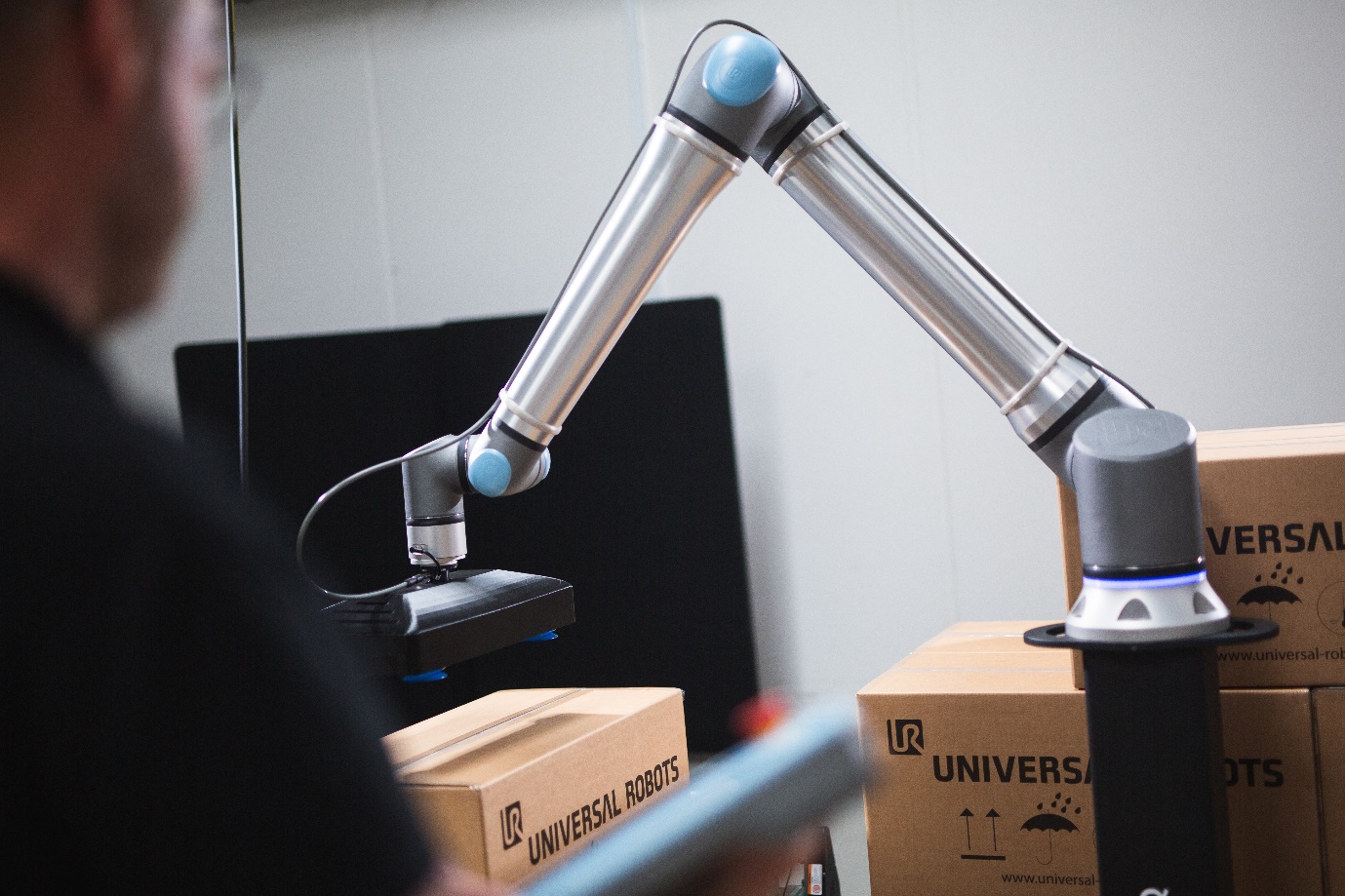
Five Outlook Perspectives Including Modular Production and Collaborative Robot Expansion
Increasing Collaborative Robot Demand...Continued Mainstreaming of Robotics
Collaborative robots are being applied in various fields such as packaging, palletizing, welding, and assembly, driving Industry 5.0. As the Yoon administration sets its sights on becoming one of the world's top three robot powerhouses, the robotics industry is emerging as a national-level future strategic industry.
Universal Robots, a leading collaborative robot company, unveiled its vision as a market leader in the collaborative robotics sector while forecasting the 2023 automation market.
Universal Robots announced key keywords and major forecasts for the 2023 automation market on the 28th.
Anders Beck, Vice President of Strategy and Innovation at Universal Robots, identified five key areas: △Turn-Key Solutions △transition to modular production △emergence of diverse collaborative robots △expansion of robot demand △customer-centric product development.
Turn-Key Solutions represent a concept that combines two or more types of advanced technologies to create synergy effects. The explanation is that automation becomes increasingly simplified when combining individual technologies such as hardware, software, applications, sensor and interface development with already-launched advanced technologies.
Additionally, modularity within production processes is increasing. Universal Robots predicts that it will convert industrial robots into collaborative robots to facilitate this.
Collaborative robots are smaller, lighter, and much easier to deploy compared to industrial robots. Furthermore, they are capable of reconfiguration, making them suitable for modularization, and offer enhanced safety.
In this regard, collaborative robots with higher payload capacity and wider working ranges are expected to transform application environments. Notably, Universal Robots' 'UR20', launched this year, features a 20kg payload capacity and a working range of 1750mm, designed to operate up to the full height of a Euro pallet. Installation is also possible in small areas.
Robot demand is expected to grow explosively, and the mainstreaming of robotics will continue.
According to the IFR World Robotics Report, annual global robot installations more than doubled between 2015 and 2021, and industrial robot installations in 2021 increased by 31% year-over-year. According to the Interact Analysis report, the collaborative robot industry is projected to grow to a market size of 2.2 billion dollars by 2026.
Accordingly, collaborative development projects where robot companies and customers work together to develop concrete solutions are expected to increase.
As the automation market becomes established, the position of customers who can communicate their specific requirements to robot companies strengthens. The explanation indicates that end-customer participation will increasingly expand in the final stages of future product development.
Lee Nae-hyung, CEO of Universal Robots, stated, "Universal Robots has always worked from the customer's perspective to transform customer lives in the way most important to them," adding, "Universal Robots will continue to make every effort next year to promote the potential and application range of collaborative robots and provide ways to easily deploy collaborative robots across various fields in real-world settings."
Comments
Related news
Universal Robots Leads Automation Solutions
Universal Robots, which commercialized the world's first collaborative robot, asserts that collaborative robots can be applied across all industrial sectors to realize automation and enhance productivity by assisting humans and creating synergistic effects.
2022.11.02by 김예지 기자

Universal Robots, Dissemination of Expertise to Meet Robot Demand
Universal Robots, the world's leading collaborative robot solution company, has moved closer to its customers by providing users with expert knowledge from professionals in preparation for the explosive demand for robots expected in the future.
2022.11.30by 배종인 기자
Universal Robots "Will Grow Domestic Collaborative Robot Market"
Global collaborative robot specialist Universal Robots held a press briefing for the domestic launch of the UR20 at BotBotBot in Seongsu-dong on the 7th, where it demonstrated the new product UR20 and presented industry prospects and future plans for collaborative robots.
2022.12.07by 김예지 기자

[Planning] Connectivity Solutions for the Industry 5.0 Era - Maximizing Human-Device Connectivity in the 5th Industrial Revolution
Recently, centered on the European Union, the concept of the Fifth Industrial Revolution (Industry 5.0) has emerged, led by the concepts of "human-centered," "sustainability," and "resilience." This is an era of collaboration between humans and machines (robots), and as interactions in a connected world become increasingly important, connectivity for smart homes, electronic devices, automobiles, and other applications is expected to become a critical factor. We examined the connectivity solutions of major semiconductor companies achieved through integration of various technologies.
2022.12.08by 김예지 기자
AI Electronic Skin First Development, "Leading Robot, Virtual Reality, and Wearable Innovation"
Future technology for wearable devices that will lead robotics and the metaverse has emerged. Research results demonstrating the detection of hand movements using conductive mesh networks at the nanometer scale, combined with artificial intelligence technology to prove operational possibilities in virtual space, are receiving attention.
2022.12.30by 명세환 기자











