


Implementation of a spin switching device that changes spin alignment according to voltage
 Published2023.08.14 11:19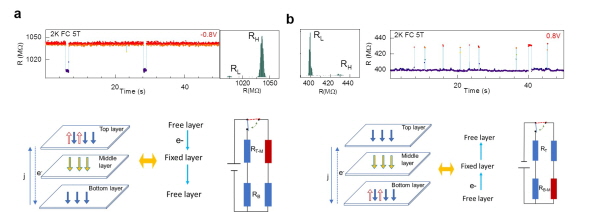
▲Random telegraph noise (RTN) signal and spin alignment that vary depending on voltage
Check for random telegraph noise signal changes depending on voltage
The emergence of a 'spin switching element' that changes spin alignment depending on voltage has opened up the possibility of applying two-dimensional magnetic semiconductor materials as key elements of room-temperature spintronics in the future.
The research team of Director Lee Young-hee of the Nanostructure Physics Research Group at the Institute for Basic Science (IBS, President Noh Do-young) (HCR Chair Professor at Sungkyunkwan University) announced on the 14th that they have jointly developed a two-dimensional ferromagnetic material that maintains magnetism at room temperature, in collaboration with the team of Professor Philip Kim of Harvard University and the team of Professor Min-gyu Joo of Sookmyung Women's University, and based on this, implemented a spin switching device that changes spin alignment depending on voltage.
Spintronics is a field of research that seeks to address fundamental challenges in existing semiconductor technology, which has reached its limits of growth, by leveraging spin, a quantum property of electrons. For over half a century, scientists have been working to develop magnetic semiconductor devices that operate using spin instead of electrons in two-dimensional materials just one atom thick.
Since the magnetism of a material is determined by the direction of spin, manipulating the alignment of spins can create magnetic materials. Conversely, synthesizing two-dimensional magnetic materials has been a challenging task. This is because when the temperature exceeds a certain temperature (Curie temperature), the spin alignment is lost and magnetism is lost.
In a previous study, the research team developed a two-dimensional magnetic semiconductor material exhibiting ferromagnetism at room temperature by injecting vanadium atoms (V), a magnetic impurity, into tungsten diselenide (WSe2), a two-dimensional semiconductor material (Advanced Science, 2020). In this study, they implemented this material into a spin-switching device capable of changing spin direction according to voltage.
The research team discovered that when vanadium was injected into a tungsten diselenide compound at a concentration of 0.1%, a spin random noise (RTN) signal that persisted regularly over time was generated.
Random telegraph noise (RTN) refers to a persistent noise caused by defects or impurities in semiconductors, similar to the sudden increase or decrease in volume when listening to music. This is the first time that spin-induced RTN signals have been observed in a magnetic semiconductor device.
Afterwards, graphene electrodes were attached above and below this two-dimensional magnetic semiconductor material to maximize the size of random telegraph noise using reverse thinking.
It was also confirmed for the first time that the random telegraph noise signal changes depending on the voltage. When a negative voltage is applied to a two-dimensional magnetic semiconductor material, the spins in different magnetic domains align in the same direction, exhibiting high magnetoresistance.
On the other hand, when a positive (+) voltage is applied, the spins in each magnetic domain align in opposite directions, exhibiting small magnetoresistance. This is implemented as a spin switching element that controls resistance by changing the direction of the spin depending on the voltage. In other words, spin can be used to turn the device on and off, and to implement a logic circuit of 0 and 1 to store information. Furthermore, we confirmed that the same effect can be achieved by changing not only voltage but also magnetic field or temperature.
Director Lee Young-hee, who led the research, said, “This is the first report to the academic world of spin random telecommunication noise in magnetic semiconductors, and the first case of utilizing this signal as a switching element,” and “It has opened up the possibility of applying two-dimensional magnetic semiconductor materials as core elements of room-temperature spintronics.”
The research results were published in the international academic journal 'Nature Electronics (IF 33.255)' on August 11.

Comments
Related news

Intel Unveils Next-Generation 'Core Ultra Series 3' and vPro Platform for Enterprise PCs
Intel has officially unveiled the "Intel Core Ultra Series 3" for next-generation enterprise PCs and the latest vPro platform, addressing a wide range of demands from enterprise notebooks to high-performance workstations.
2026.03.26by 배종인 기자
ROHM Launches ESD Protection Diode Compatible with High-Speed Interfaces of 10Gbps or Higher
Semiconductor specialist ROHM has developed the 'RESDxVx series' of ESD (electrostatic discharge) protection diodes capable of responding to next-generation high-speed data communication environments exceeding 10Gbps, simultaneously enhancing both signal quality maintenance required in high-speed interfaces and IC protection performance.
2026.03.26by 배종인 기자
ST Launches 75V Drive IC Targeting 48V Industrial Motor Driving
ST Microelectronics has unveiled the 'STSPIN9P' series of 75V motor drive ICs tailored for 48V-class industrial drive system design. The new product family is characterized by half-bridge and full-bridge configurations that enable design scalability according to motor type and output conditions. Power supply circuits, protection functions, and current sensing circuits are integrated on-chip to simplify system configuration, and the devices are designed to support applications up to 500W maximum. The company plans to provide reference designs and demo boards to support development and evaluation in industrial automation, robotics, pumps, fans, lighting, and textile machinery.
2026.03.26by 배종인 기자

Nordic supports security updates for the entire lifecycle of IoT devices at a single fixed cost
Nordic Semiconductor, a global leader in low-power wireless connectivity solutions, has unveiled a single fixed-cost licensing model that delivers FOTA (Firmware Over-the-Air) and device management capabilities throughout the device lifecycle via nRF Cloud, and introduced a new firmware update solution to prepare for the enforcement of the European Union's Cyber Resilience Act (CRA).
2026.03.26by 배종인 기자
Schneider Aims for Building Energy Savings and Operational Stability with Next-Generation HVAC Drives
Schneider Electric has unveiled its next-generation HVAC drive product line 'Altivar HVAC'. The new product line's key features center on enhanced energy savings, system operational stability, and building management system integration. The products are divided into 'ATH200' for OEM and small equipment applications, and 'ATH600' for environments requiring continuous operation and advanced control. The company plans to expand the application scope from commercial buildings to facilities where HVAC system stability is critical, such as hospitals, airports, and data centers. The announcement includes over 30% energy savings, operation from -10°C to +60°C, Modbus and BACnet support, and compatibility with low global warming potential refrigerants.
2026.03.26by 명세환 기자











