


ST's New 5MP Pixel CMOS Image Sensor Sets New Standards for Industrial Vision
 Published2025.12.12 00:00
Optimizing Security and Machine Vision with 3D Stacking and RGB-IR Technology
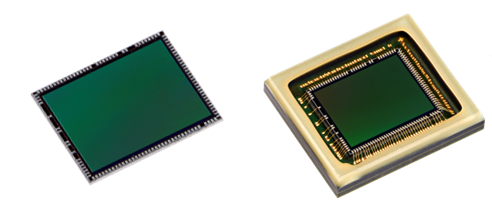
STMicroelectronics (NYSE: ST) has officially launched its latest 5-megapixel image sensor series that raises the bar for a wide range of applications, including security, robotics, and machine vision.
The series consists of the VB1943, VB5943, VD1943 and VD5943 models as part of the ST BrightSense portfolio.
The sensor is available in monochrome and RGB-IR versions and combines global and rolling shutter, advanced 3D stacked pixel architecture, and on-chip RGB-IR separation to deliver industry-leading performance and versatility.
This article takes an in-depth look at the key innovations that have made this sensor series a true game-changer.
■ Choose between global shutter and rolling shutter
○ Global Shutter
In the early stages of product design, engineers choose a CMOS image sensor. At this point, you need to decide whether to adopt a global shutter or a rolling shutter.
Because each shutter type relies on a specific pixel and readout architecture, most image sensors to date have supported either a global shutter or a rolling shutter.
As the name suggests, global shutter captures light simultaneously across the entire sensor, then reads the information sequentially.
This requires adding circuitry and in-pixel memory to temporarily store the captured data in memory before streaming it to the processor.
Global shutter is ideal for applications that require precision and consistency, as it captures the entire scene at once without being affected by motion and lighting artifacts, eliminating distortion caused by movement during exposure.
However, these advantages also come with disadvantages.
Global shutters are often slower to read, less power efficient, and less light sensitive due to the added in-pixel circuitry.
○ Rolling shutter
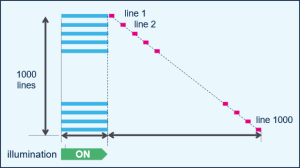
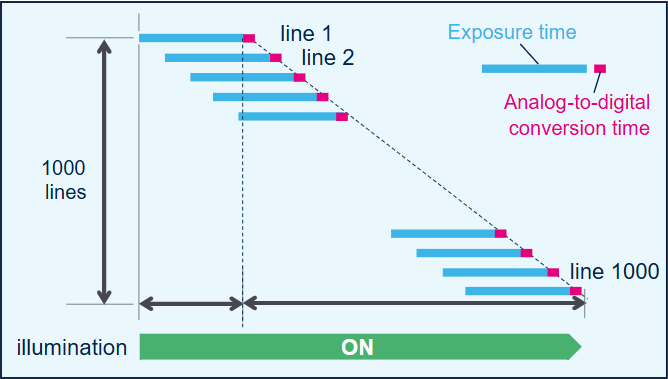
As the name suggests, rolling shutter sensors expose the image sensor sequentially, one or more rows at a time, in a rolling manner.
While exposing each row, the sensor processes the data simultaneously, gradually completing theBuild a complete frame.
Simple tasks like this eliminate the need for the additional memory and circuitry required for a global shutter, reducing power consumption and increasing pixel sensitivity.
Rolling shutter generally provides better image quality in low-light environments because more of each pixel's surface area is used to capture light.
For this reason, rolling shutter CMOS sensors are widely used in most consumer electronics today.
However, rolling shutter is prone to distortion and artifacts because it has no intermediate memory to store the entire frame simultaneously.
Additionally, the lighting must remain enabled throughout the process of sequentially exposing all rows, which can increase the overall lighting budget.
○ Combining the strengths of two technologies
By offering dual global and rolling shutter, users can enjoy the best of both technologies.
Experience superior image quality with artifact-free image capture from the global shutter and enhanced high-quality images based on on-chip HDR (High Dynamic Range) from the rolling shutter.
The operating mode can be selected via register settings, allowing distortion-free global shutter capture and HDR Rolling shutter images can transition seamlessly between frames.
Combining two shutter modes might seem like a no-brainer, but it presents a significant architectural challenge that ST has successfully overcome.
Previously, integrating global shutter functionality into rolling shutter sensors required the addition of complex lower-layer circuitry, which increased sensor size and cost and reduced pixel sensitivity.
This results in poor HDR performance and increased noise. ST has solved this challenge by leveraging advanced 3D stacking technology that vertically stacks multiple wafers onto a single chip, creating a sensor that combines the strengths of both shutters without the typical trade-offs.
■ Smarter sensors using 3D stacking
○ Top wafer
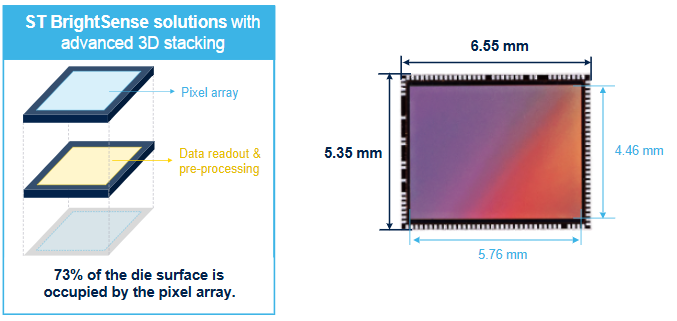
ST has designed a unique architecture based on two wafers.
The top wafer uses a 65nm process node, which includes both 2.25㎛ pixel and storage nodes.
Simply put, ST has embedded the capacitors vertically into the silicon, using Deep Trench Isolation (DTI) or Capacitive Deep Trench Isolation (CDTI) technology.
Instead of placing capacitors on the sides, which increases the size of the device, deep, narrow trenches are formed in the silicon layer to sandwich the capacitors between pixels, and full-depth deep trench insulation technology prevents crosstalk.
As a result, we were able to develop larger pixels while designing an architecture that is compatible with global shutter mode.
○ Bottom wafer
The bottom wafer uses a 40nm process node and contains both digital and analog circuits.
This method allows the pixel layer to capture more light because the logic is not interfered with.
ST is the whole device This is also why we can offer 5 megapixel resolution without increasing the size or price.
In fact, this dual-wafer method utilizes manufacturing technology developed at ST's 300mm wafer plant in Europe.
ST can therefore fabricate and combine two wafers very efficiently to offer two shutter modes while remaining competitive with similar 5-megapixel CMOS sensors that only support global shutter mode.
Additionally, 3D stacking technology allows for additional circuitry and on-chip processing to be embedded directly within the sensor, enabling smarter image sensors that deliver enhanced functionality and performance while reducing the load on the host processor.
For example, there are RGB-IR conversion and smart upscale features available on the VD1943 and VB1943 RGB-IR model products.
■ Seamless color and infrared image processing
○ From monochrome to RGB-IR
This sensor series is available in two color variants to address specific application requirements.
The VD5943 and VB5943 deliver high-quality black-and-white images, making them ideal for use cases such as inline product inspection and barcode reading that rely on machine learning algorithms and grayscale image processing.
In contrast, the VD1943 and VB1943 feature a unique pixel structure that adds a near-infrared (NIR) subpixel to the existing RGB subpixel, improving performance in both global and rolling shutter modes.
In global shutter models, near-infrared subpixels are exposed longer to capture critical information, allowing the VD1943 and VB1943 to produce near-infrared images with accuracy comparable to dedicated monochrome image sensors.
It provides a single-device solution for applications requiring both color and monochrome image processing, such as security and electronic toll collection.
However, if a company only wants to authenticate one device, choosing VD1943 will still provide access to high-quality black-and-white images that yield accurate inferences.
In rolling shutter mode, NIR subpixels play a critical role in color accuracy.
This is because red pixels are also sensitive to near-infrared wavelengths, which can distort color reproduction.
Instead of relying on external IR-blocking filters or complex processing, ST's sensor uses NIR subpixel data to separate and remove infrared components from other color channels, achieving more accurate color reproduction, improved signal-to-noise ratio, and overall improved image quality.
○ Automatic color/infrared switching
The RGB-IR versions of the ST sensor series feature on-chip RGB-IR separation, eliminating the need for an external companion chip and significantly simplifying system design.
This integration also includes built-in demosaicing capabilities, reducing software complexity and processing overhead.
The sensor supports a variety of configurable output formats, with resolutions up to 5MP RGB-NIR 4×4 pixel grouping, native 5MP RGB Bayer pattern, 1.27MP NIR subsampling, and 5MP NIR smart upscale mode.
Independent exposure control is also possible for each channel.
Smart Upscale feature enhances color It guarantees up to 5MP resolution for near-infrared image processing and provides high-fidelity data streams without performance degradation.
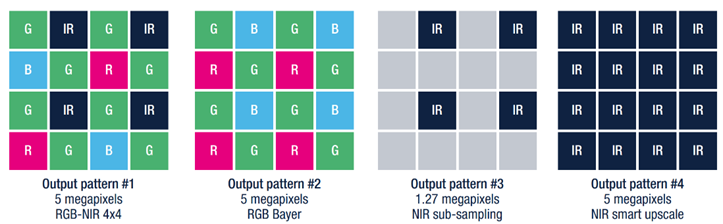
Additionally, users can easily switch between color and NIR output with a single register setting, allowing them to quickly respond to diverse application requirements.
This comprehensive on-chip integration reduces bill of materials (BOM), simplifies software development, and improves overall system flexibility and performance.

Comments
Related news

Intel Unveils Next-Generation 'Core Ultra Series 3' and vPro Platform for Enterprise PCs
Intel has officially unveiled the "Intel Core Ultra Series 3" for next-generation enterprise PCs and the latest vPro platform, addressing a wide range of demands from enterprise notebooks to high-performance workstations.
2026.03.26by 배종인 기자

ROHM Launches ESD Protection Diode Compatible with High-Speed Interfaces of 10Gbps or Higher
Semiconductor specialist ROHM has developed the 'RESDxVx series' of ESD (electrostatic discharge) protection diodes capable of responding to next-generation high-speed data communication environments exceeding 10Gbps, simultaneously enhancing both signal quality maintenance required in high-speed interfaces and IC protection performance.
2026.03.26by 배종인 기자
ST Launches 75V Drive IC Targeting 48V Industrial Motor Driving
ST Microelectronics has unveiled the 'STSPIN9P' series of 75V motor drive ICs tailored for 48V-class industrial drive system design. The new product family is characterized by half-bridge and full-bridge configurations that enable design scalability according to motor type and output conditions. Power supply circuits, protection functions, and current sensing circuits are integrated on-chip to simplify system configuration, and the devices are designed to support applications up to 500W maximum. The company plans to provide reference designs and demo boards to support development and evaluation in industrial automation, robotics, pumps, fans, lighting, and textile machinery.
2026.03.26by 배종인 기자

Nordic supports security updates for the entire lifecycle of IoT devices at a single fixed cost
Nordic Semiconductor, a global leader in low-power wireless connectivity solutions, has unveiled a single fixed-cost licensing model that delivers FOTA (Firmware Over-the-Air) and device management capabilities throughout the device lifecycle via nRF Cloud, and introduced a new firmware update solution to prepare for the enforcement of the European Union's Cyber Resilience Act (CRA).
2026.03.26by 배종인 기자

Practical Training in Low-Noise, Low-Power Circuit Design All in One Place… Training Fee Support
The "2026 Advanced Engineer Practical Masterclass" to strengthen competencies in high-sensitivity analog circuit and sensor-based system design will be held on April 16 at the e4ds Conference Center in Gasan-dong, Seoul. This program will be conducted as an offline paid hands-on training session, not online, and is targeted at engineers seeking on-site intensive learning. Texas Instruments will provide educational support for this training, allowing participation at 150,000 won, a 100,000 won discount from the original price of 250,000 won.
2026.03.26by 배종인 기자











