



Synopsys Unveils AI Design Automation Achievements with NVIDIA at GTC 2026
 Published2026.03.19 08:59
Expanding to semiconductors, automobiles, and robotics… Combining simulation, digital twin, and agent AI
Synopsys announced related achievements at NVIDIA GTC 2026, held in San Jose, USA, on March 16 (local time). This announcement aligns with the trend of Synopsys fully integrating mechanical, thermal, and fluid analysis capabilities into semiconductor design software following the acquisition of Ansys, which was completed last year.
The core of the technology lies in combining semiconductor design tools, multiphysics simulation, GPU acceleration, and agent AI into a single work environment. Synopsys has proposed a direction to reduce computationally intensive analysis times and automate complex chip design tasks using a multi-agent approach by leveraging NVIDIA's CUDA-X, Omniverse, and AI infrastructure. An L4-level agent EDA workflow was also demonstrated at the event.
Specific application examples were also presented. Applied Materials increased the speed of quantum chemistry simulations by up to 30 times, and Honda confirmed that with GPU acceleration using Ansys Fluent, computations were 34 times faster and cost savings were 38 times greater compared to 1,920 cloud CPU cores using only four GB200 GPUs. Astera Labs increased verification speed by 3.5 times by utilizing B200 GPU-based PrimeSIM on AWS.
In the field of robotics, ADI is building digital twins of tactile sensors and robot motion benchmarks using Synopsys software in the NVIDIA Omniverse and Isaac Sim environments. This is interpreted as an attempt to improve the accuracy of physical AI development by reducing the difference between results in virtual environments and real environments.
As the semiconductor industry reshapes around chiplets and high-density packaging, there is a growing need to examine not only electrical performance but also thermal, mechanical deformation, and system behavior during the design phase. This announcement can be seen as an example demonstrating that AI is expanding beyond simple design assistance to integrate simulation, verification, and virtual prototyping.

Comments
Related news
Ansys Supplies 'Thermal and Power Integrity Solution' to Samsung Foundry
Ansys Korea, a global leader in engineering simulation software (CEO Moon Seok-hwan), is closely collaborating on power and thermal management for advanced parallel (2.5D) and three-dimensional integrated circuit (3D-IC) systems, contributing to improved performance and reliability of Samsung Foundry products.
2023.10.23by 배종인 기자
Ansys' Raptor X to Use Samsung's 8nm Design
Ansys Korea (CEO Moon Seok-hwan) announced that Samsung Electronics' Foundry Division has certified 'RaptorX', Ansys's on-chip electromagnetic (EM) design solution for ultra-high-speed product analysis, manufactured using the 8nm (nanometer) LN08LPP Low Power Plus silicon process.
2023.12.07by 배종인 기자
.jpg)
CES 2024, A Festival of Mobility Powered by NVIDIA Technology
Nvidia announced on the 9th that 10 companies, including Mercedes-Benz using Drive Orin and Ansys leveraging Nvidia Omniverse, will participate in CES 2024 and showcase an impressive technology lineup.
2024.01.09by 성유창 기자

LG Innotek Reduces Development Period by 99% with Digital Twin
LG Innotek (CEO Moon Hyuk-soo) has introduced Ansys' digital twin solution and simulation software in its development process to pre-verify design through virtual simulation, reducing development time by 99%.
2024.08.08by 배종인 기자
Ansys Korea and Samsung SDS join hands in defense and defense cloud
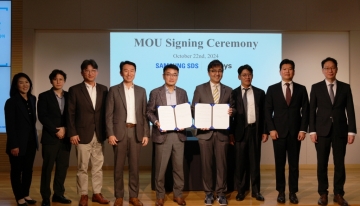
Ansys Korea (CEO Park Joo-il), a global leader in engineering simulation, and Samsung SDS (CEO Hwang Sung-woo) have joined hands in the defense and national security cloud business, with Ansys Korea providing and offering technical support for Ansys CAE solutions on the Samsung SDS cloud platform.
2024.10.23by 배종인 기자











