



MPS, “Motor Competitiveness in the Electrification Era Determined by High-Efficiency, Intelligent, and Integrated Design Centered on BLDC”
 Published2026.05.19 09:58
Motor, driver, and control algorithms emerge as key elements for system optimization.
■ Introduction
The proliferation of electrification and intelligent systems is once again highlighting the importance of motor technology. From automobiles and industrial automation to robotics, home appliances, and data center cooling systems, motors have evolved beyond simple drive components to become a key element determining system efficiency and performance. In particular, as demands for energy efficiency, miniaturization, low noise, and high reliability increase, motor selection and drive methods require much more sophisticated engineering judgment than in the past.
Amidst this trend, the two motor types still widely used—brushed DC motors and brushless DC motors (BLDC)—have distinct advantages and disadvantages depending on their respective structural characteristics and control methods. This article summarizes the operating principles and key parameters of the two motors and examines the design approaches required in the context of recent technological trends.
■ Brushed DC Motor: Simple and intuitive control
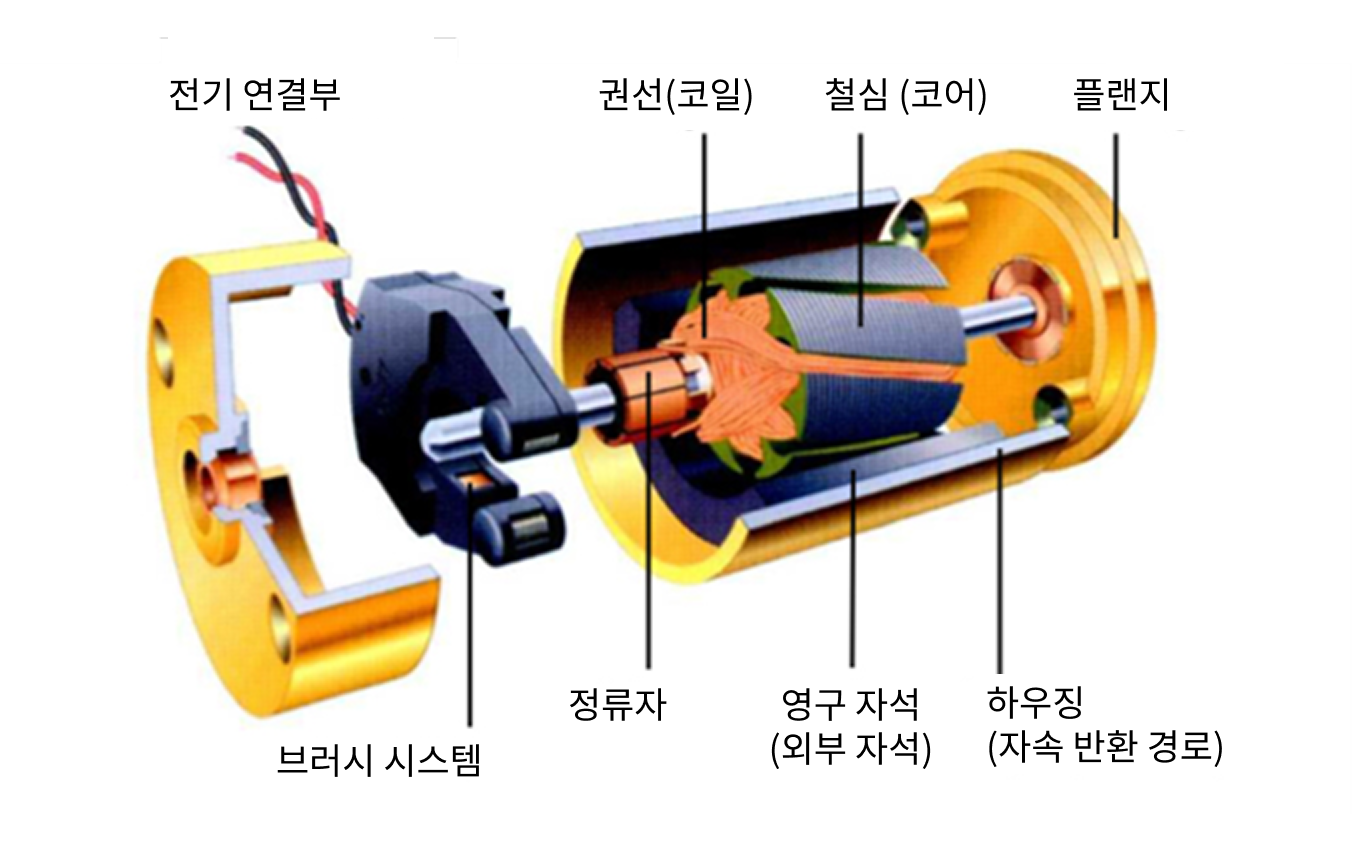 ▲Figure 1. Brush DC motor
Brushed DC motors are the most traditional type of electric motor, mechanically switching the direction of current through brushes and a commutator. Thanks to this structure, they can be driven without separate, complex control circuits and possess the intuitive characteristic that their speed is determined proportionally to the input voltage.
Speed is generally determined by the balance between the supply voltage and back-EMF, while torque is proportional to the current. This relationship enables sufficient performance to be achieved with simple closed-loop control alone, leading to the advantage of minimizing cost and design complexity.
Recently, there have been ongoing attempts to overcome the limitations of existing methods by applying integrated driver solutions that reduce power loss and enhance protection functions while maintaining the advantages of this simple structure. In particular, devices that integrate an H-bridge configuration into a small package and include overcurrent and overheating protection enable stable operation while reducing the design burden.
However, structures based on mechanical contact have clear limitations. Lifespan limitations due to brush wear, EMI issues caused by sparks, and reduced reliability during high-speed operation pose a burden in modern high-performance systems. In particular, in environments requiring low noise and high efficiency, such physical contact structures often act as design constraints.
■ BLDC Motor: Focus on High-Efficiency, High-Reliability Systems
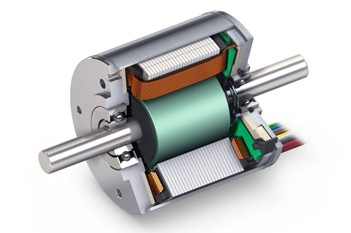
▲Figure 2. Brushless DC (BLDC) motor
BLDC (Brushless DC) motors have a structure that eliminates brushes and commutators and rotates through electronic switching. This structural change has gone beyond a simple improvement and has become a factor that changes the motor performance paradigm itself.
Electronic commutation typically estimates the rotor position using Hall sensors or sensorless algorithms and controls the current accordingly. This process enables PWM-based precise control, resulting in reduced torque ripple, improved efficiency, and precise speed control.
Recently, the rapid advancement of sensorless control technology has enabled high precision without the need for separate sensors, leading to cost reduction and improved reliability. Furthermore, advanced control techniques such as Field-Oriented Control (FOC) are expanding the scope of motors from simple driving devices into systems requiring precise control.
Along with this, the advancement of integrated driver technology that optimizes gate driving and power stages has enabled system designers to achieve high efficiency and stability without complex external circuit configurations. This serves as a significant advantage, particularly in applications with severe space constraints.
■ Changes in Motor Parameters and Design Perspectives
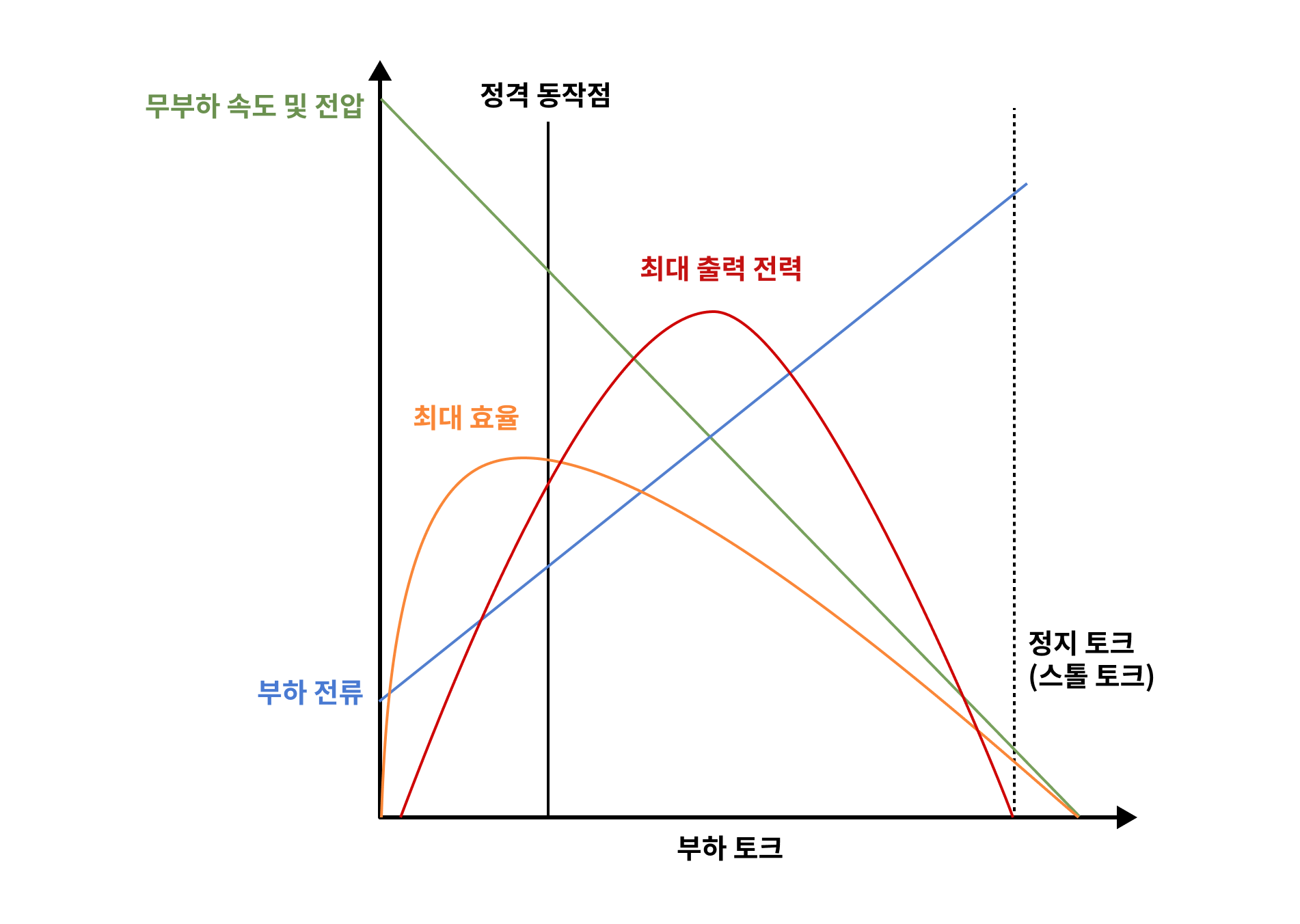
▲Figure 3. DC Motor Parameters
Key parameters important in motor design include torque constant, back EMF constant, winding resistance, inductance, and thermal characteristics. While these parameters were considered individually in the past, there has recently been a shift toward integrated optimization at the system level.
For example, power loss must be analyzed comprehensively, including not only simple internal resistance losses but also switching losses, gate drive losses, and heat dissipation structures. Particularly in high-current, high-speed switching environments, the efficiency of the power conversion stage directly affects the overall system efficiency.
In this process, the impact of driver IC on-resistance, switching characteristics, and the level of protection function integration on actual system performance is growing, and recently, compact motor driver solutions that integrate these elements in a balanced manner are considered a key factor determining design efficiency.
Furthermore, as EMI/EMC requirements become stricter, it has become difficult to meet them with simple driving circuits alone, and technologies such as current ripple minimization, soft switching, and precision gate control are becoming important.
■ Latest Technology Trends and Design Directions
The key trends in recent motor technology can be broadly summarized into three points.
First is high-efficiency power conversion. As the demand to increase power density while minimizing losses increases, highly integrated power ICs and high-speed switching technologies are being actively utilized to achieve this.
Second is the expansion of intelligent control. As digital control, algorithm-based optimization, and system-level monitoring capabilities are combined, motors are increasingly evolving into 'smart actuators'.
Third is system integration. As motor, driver, and power management functions are integrated into a single platform, design complexity is decreasing while performance is further enhanced. Particularly in the low-voltage drive domain, H-bridge-based integrated drivers are establishing themselves as a realistic alternative capable of simultaneously ensuring design efficiency and reliability.
■ Conclusion
Brushed DC motors and BLDC motors are still utilized in various industries based on their respective structural characteristics and advantages. However, in the current technological environment where electrification and high efficiency demands are intensifying, electronically controlled structures such as BLDC motors are playing an increasingly important role.
At the same time, motor performance is no longer determined by the characteristics of a single component. System-level optimization, encompassing power conversion, control algorithms, thermal design, and EMI mitigation, is essential, and a design approach that meets these complex requirements determines competitiveness.
Ultimately, next-generation motor systems are evolving beyond simple drive units into highly integrated power and control platforms, and how efficiently this is implemented will be the key to future technological competition.
 Lee Jae-cheol, Director of Technical Support, is an engineer at MPS (Monolithic Power Systems) responsible for technical support of products in the automotive electronics field, and has over 19 years of experience in related industries. MPS provides a wide range of technical services in various power semiconductor fields, including DC/DC converters, motor drivers, and LED drivers.
관련뉴스
.jpg)
MPS, “High-Current, Low-Voltage FPGA & ASIC Power Design, Multiphase Converter Solutions Rapidly Emerging”
We spoke with Thomas Hudson, MPS Senior Product Marketing Engineer, about design approaches for multiphase converters in high-current environments.
2026.02.06by 명세환 기자
.jpg)
Kim Seon-min, Director of Technical Support at MPS, “Current Sensors Rapidly Emerge as Key Elements in the Era of Solar, Wind, and ESS Expansion”
With the expansion of solar, wind, and ESS driven by carbon neutrality, the importance of current sensors in renewable energy systems is increasing. We heard from Kim Sun-min, Director of Technical Support at MPS, about the key role of current sensors in renewable energy systems.
2026.02.26by 편집부
MPS, “‘MPM3695 Family’ Meets High-Current, Low-Voltage Power Supply Design Demands”
유연한 출력 전압 구성의 새로운 접근 방법인 고전류 전력 설계를 위한 통합 전력 모듈에 대해 MPS의 정태훈 기술지원 이사가 이야기 한다.
2026.03.11by 편집부
MPS, “Complete Front-end Protection for Automotive Systems with Smart Ideal Diode Controllers”
차량 전장 프런트엔드 보호 기술의 진화와 스마트 컨트롤러의 역할에 대해 김지영 MPS 기술지원 부장이 이야기 한다.
2026.03.31by 편집부

A single misaligned light means 'defect'… Vehicle interior lighting now guarded by semiconductors and software
자동차 실내조명이 '보조 조명'의 자리를 벗어나고 있다. 색상과 애니메이션으로 브랜드 아이덴티티를 드러내고 운전자 취향을 담아내는 사용자 경험(UX)의 핵심 요소로 올라서면서, LED 실내 앰비언트 시장도 빠르게 커지는 중이다. 이에 관하여 '미래 자동차를 밝히는 지능형 LED 실내 조명 솔루션' 이라는 내용으로 기술 웨비나 세션을 발표하는 최영재 다보코퍼레이션 연구위원을 앞서 만나, 시장의 온도와 설계 요구의 변화를 들었다.
2026.08.28by 명세환 기자











