


IAR, “Even if AI can generate code quickly, the final quality of embedded development is determined by 'humans'”
 Published2026.07.21 14:32
AI-based code-based static analysis, dynamic analysis, and CI/CD automation verification are required.
■ Competitiveness is not speed, but verifiable evidence.
The advancement of generative AI is rapidly transforming software development methods. Developers can now utilize AI coding assistants to complete coding tasks that used to take hours in just tens of seconds. With AI supporting everything from function implementation and algorithm writing to test code generation, the productivity of individual developers is improving to an unprecedented level compared to the past.
However, in embedded software development where functional safety is required, such as in automobiles, medical devices, and industrial automation, the story is a bit different.
In projects that must satisfy international safety standards such as ISO 26262, IEC 61508, and IEC 62304, the biggest constraint is not the speed of writing code. The real bottleneck is the process of creating 'evidence'.
The fact that the program operates normally is not enough. Objective evidence is required regarding whether the code was written in compliance with the defined development process, satisfies relevant coding rules, and ensures complete traceability from requirements to test results.
AI speeds up code writing but does not automatically generate this evidence.
■ AI generates code, but it does not generate compliance.
Recent AI coding tools demonstrate excellent performance. They provide a significant level of results, ranging from simple function implementation to algorithm suggestions, test code generation, and code refactoring. For example, if you request that an RPM calculation function be written in C, it generates syntactically correct and logically appropriate code.
However, there is a significant problem here. While AI-generated code may be functionally sound, there is no guarantee that it satisfies compliance.
A representative example is the MISRA C rule. Even code that appears to have no issues on the surface can be deemed to have violated Implicit Type Conversion under MISRA C:2012 Rule 10.3. Such issues are reported as defects during the static analysis process, and the code is recognized as verifiable code connected to requirements only after the fix is completed.
This issue is not limited to a single specific rule. In functional safety embedded development, various international standards, such as the following, are applied simultaneously.
· MISRA C / MISRA C++
It is the most widely used safety coding convention in automotive, medical, and industrial embedded systems. It minimizes the possibility of undefined behavior by limiting the scope of C/C++ language usage. Code generated by AI must also pass MISRA rules to be applied to actual projects.
· CERT C / CERT C++
It is a standard designed to prevent vulnerable coding patterns from a security perspective. While MISRA focuses on safety, CERT aims for security. Recently, with the rise of connected embedded systems, the importance of both areas is growing together.
Common Weakness Enumeration (CWE)
It is a database that systematically classifies recurring software vulnerabilities. Since AI learns vulnerable code alongside secure code during the training process, there is a possibility that it may generate known vulnerability patterns exactly as they are. CWE serves as a standard for systematically identifying such problems.
The important point is that AI models do not check these rules on their own. Ultimately, compliance with specifications is an area that developers must verify using appropriate development tools.
■ Verification Bottlenecks That Will Not Disappear Even in the AI Era
In functional safety projects, it is common for more than 40% of total research and development costs to already be spent on verification and validation. This is not due to inefficiency. It is an essential process for establishing the extensive evidence system required by safety certification bodies.
Let's assume that AI doubles or triples the speed of code writing. What would happen if the verification process remained the same? More code would be subject to review, more static analysis results would need to be checked, and more tests would have to be performed. Eventually, the bottleneck becomes even larger.
While AI has sped up the early part of the development process (Code Authoring), the actual bottleneck exists in the later stages of development.
in other words,
· Static Analysis
· Dynamic Analysis
· Code Coverage Measurement
· Ensuring requirements traceability
· Functional Safety Approval (Sign-off)
This process determines the overall project schedule.
Therefore, increasing only the code generation speed is different from increasing the overall productivity of a functional safety project.
■ Quality is created during the development process, not at the end.
To address these issues, static analysis, dynamic analysis, and code coverage must be continuously incorporated into the development process rather than being performed at the final stage of the project. In other words, AI code generation and quality verification must take place within a single development loop.
■ Integrating Static Analysis into the Development Process
IAR’s C-STAT checks MISRA C, MISRA C++, CERT C, and CWE rules as soon as code is written. When a developer adds AI-generated code to a project, it can automatically check for rule violations prior to the review stage. The structure involves AI proposing code, developers reviewing it, and C-STAT verifying compliance with specifications. This approach significantly reduces the problems found during the code review phase.

▲[Figure 1] Static Analysis C-STAT Results
■ Dynamic analysis performed during the debugging process
Static analysis alone cannot identify all problems. Errors that occur only during execution, such as memory errors, array out-of-bounds, integer overflows, and switch statement processing errors, must be verified in the actual execution environment.
IAR's C-RUN detects these runtime errors in real time during the debugging process. Runtime verification is becoming increasingly important in the AI era because unexpected problems can occur during actual operation, even if AI-generated code is structurally correct.
.jpg)
▲[Figure 2] Dynamic Analysis C-RUN Results
■ In the AI era, the role of developers becomes even more important
The advancement of AI is not replacing developers. Rather, it is changing the role of developers.
While the key in the past was writing all the code manually, the role of determining whether the code proposed by AI is safe, aligns with the system architecture, and meets requirements has now become more important. In other words, the role of developers is expanding from code authors to quality curators.
While AI can suggest code, the developer still needs to judge whether it satisfies safety objectives, is sufficiently tested, and aligns with the overall system design. Only with such judgment can the generated code be recognized as attested code.
■ CI/CD automatically accumulates evidence
Quality checks performed on a developer's PC are just the beginning. In team-based development, every commit must be automatically verified to meet the same quality standards. In an era like today, where AI generates code in a single day that used to take a week, relying on humans to perform quality checks for every task is insufficient. Verification must be performed automatically within the CI/CD pipeline.
IAR Build Tools enables the use of the same compiler and linker as IAR Embedded Workbench in CI environments such as Jenkins, GitHub Actions, and Azure DevOps. This ensures that the development environment and the CI environment produce completely identical build results, thereby securing a reproducible build environment required by ISO 26262 and IEC 62304.
In addition, C-STAT also runs automatically in the CI environment and continuously checks MISRA, CERT, and CWE rules for every commit. Quality evidence is not prepared all at once at the end of the project, but is naturally accumulated throughout the entire development process.
■ Competitiveness in the AI Era Is Determined by Platforms
While static analysis, dynamic analysis, code coverage, and CI/CD automation are important individually, they provide the greatest value when integrated within a single platform. The IAR platform integrates these capabilities into a single development environment.
It supports Tool Qualification for major functional safety standards such as ISO 26262 (TÜV SÜD certified), IEC 61508, and IEC 62304, and C-STAT and C-RUN also operate within the same development environment. In other words, a single, consistent Evidence Chain can be established from build to analysis, verification, and certification. This is the key factor that makes the difference between simple AI productivity enhancement and functional safety compliance.
■ Conclusion
AI will continue to generate even better code in the future. However, in embedded systems requiring functional safety, objective evidence to prove quality is far more important than the code generation itself. AI writes the code, but obtaining certification is the development process and the verification tools that support it.
Competitiveness in the AI era depends not on how quickly code is generated, but on the ability to consistently produce reliable evidence of quality. At the heart of this lie development platforms and verification tool systems that support safety certification, and to simultaneously satisfy AI and functional safety, an integrated development environment capable of securing both productivity and quality is becoming more important than ever.
※ [Reference] Code Quality and Compliance - Building Stronger Code with IAR
https://www.iar.com/ko/embedded-development-tools/code-quality-and-compliance
관련뉴스

IAR Announces Latest Toolchain for Renesas RX and RL78 Architectures
임베디드 소프트웨어 개발 솔루션의 글로벌 선도 기업 IAR이 르네사스(Renesas)의 RX 및 RL78 아키텍처용 최신 버전 툴체인을 공식 발표했다고 30일 밝혔다.
2025.06.30by 배종인 기자
.jpg)
IAR Announces Commercial Support for Zephyr RTOS, A New Turning Point for Safety-Centric Embedded Development
임베디드 소프트웨어 솔루션 분야의 글로벌 선두주자인 IAR이 최근 Arm용 툴체인 9.70 버전 출시와 함께 오픈소스 실시간 운영체제인 제퍼(Zephyr RTOS)에 대한 상용 수준의 본격 지원을 발표하며 업계의 주목을 받고 있다.
2025.07.24by 명세환 기자
.jpg)
IAR Introduces Long-Term Support Service for Functional Safety… Expands Support for Embedded Platforms
IAR이 기능안전 애플리케이션을 위한 장기지원(LTS) 서비스를 도입하며 임베디드 개발 플랫폼의 지원 범위를 유지보수 단계까지 넓혔다. 회사는 장수명 제품에서 요구되는 재현 가능한 툴체인과 장기 기술지원을 묶어 제공하겠다고 밝혔다. 공식 발표일은 보도자료에 적힌 4월 15일이 아니라 2026년 3월 9일로 확인됐다.
2026.04.15by 배종인 기자
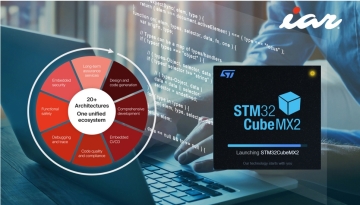
IAR-ST Collaboration Expanded… Integration of STM32C5 Support Development Environments Begins in Earnest
IAR and STMicroelectronics have disclosed their integration strategy for the next-generation MCU STM32C5 series and the new development environment 'STM32CubeMX2'. The two companies recently presented through a joint webinar an integrated development system connecting project creation, debugging, CI/CD, and long-term maintenance. This collaboration is interpreted as a case demonstrating that embedded development environments are shifting beyond simple IDE integration toward software lifecycle management-focused approaches. In particular, as functional safety requirements and long-term maintenance demands strengthen in industrial and automotive sectors, analysis indicates that the importance of securing verified toolchains is growing.
2026.05.14by 배종인 기자
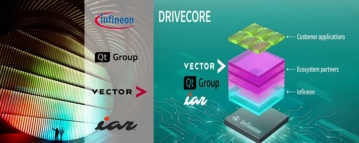
IAR, Infineon, Vector, and Qt Collaborate on Automotive Embedded Development Ecosystem
IAR 코리아가 인피니언, 벡터, Qt 그룹과 함께 자동차 임베디드 소프트웨어 개발 효율화를 위한 통합 생태계 협력 방안을 제시했다. 이번 협력은 인피니언 DRIVECORE™ 기반 개발 환경에 IAR의 임베디드 툴체인, 벡터의 AUTOSAR 미들웨어, Qt 그룹의 HMI 프레임워크를 연계하는 것이 핵심이다. 4개사는 사전 통합된 개발 환경을 통해 차량용 소프트웨어 개발 초기 단계의 환경 구축과 검증 부담을 줄이고, 프로토타입 제작부터 양산 준비까지의 기간 단축을 지원한다는 계획이다.
2026.06.16by 명세환 기자











