


[Technical Contribution] ams OSRAM, "The Completion of Premium Displays Lies in 'Spectrum Sensing'"
 Published2026.09.14 10:50
Smartphone Premium Competitiveness Determined by Display Color Accuracy and User Experience
Next-Generation BOLED Spectrum Sensor Technology Enables Natural and Consistent Color Reproduction
As the smartphone industry has become highly mature, simple numerical competition in hardware specifications has reached its limits. How high the application processor performance has become or how much larger the memory size has grown is no longer a matter of significant concern to consumers. Today, the decisive factor that allows consumers to distinguish between premium flagship smartphones and mid-to-low-end products and willingly pay higher prices is 'display quality,' which is the core of user experience. The smartphone screen is the most intuitive interface for viewing high-quality captured media, running various applications, and communicating with the digital world.
■ A New Battleground in the Smartphone Market: Display Quality and Color Accuracy
According to independent display performance evaluation organizations and market research results, modern consumers demand 'precise colors that are expressed naturally and consistently in all environments' beyond simply bright or vivid screens. Whether under intense midday sunlight, in an office with daylight-color LED lighting, or in a café with warm, low color temperature lighting, users expect display content to be expressed exactly as it is in reality without distortion. At the same time, they desire smart brightness and color tone adjustment functions that minimize eye fatigue even with extended screen use.
To implement this advanced user experience, the display must be able to accurately measure the optical environment surrounding the device in real time—specifically, the color temperature and brightness of ambient light. The key component performing this critical mission is the ambient light sensor (ALS).
This article details the technical challenges that arise as the ambient light sensor (ALS) moves to behind-OLED in the context of bezel-less design trends in flagship smartphones, and introduces ams OSRAM's next-generation spectrum color sensor technology that completely overcomes these challenges and elevates premium display performance to the next level.

■ Display White Point (CCT) and the Mechanisms of Human Vision
The human visual system possesses outstanding color adaptation capability, recognizing colors according to the surrounding lighting environment. For example, white paper is still perceived as 'white' in our brain whether it is under red sunset light or blue fluorescent light. However, a display with a fixed white point exhibits distortion, appearing relatively intensely blue or yellow when surrounding illumination changes.
For the color of a smartphone display to reach users naturally, it is essential to have technology that matches the display's reference white point (correlated color temperature, CCT) with the color temperature of ambient light in real time. When the ambient environment has a warm tone (low CCT), the screen must also appear warm, and when it has a cool tone (high CCT), the screen must be corrected to appear clear, completely eliminating the sense of incongruity and fatigue that the eye perceives.
■ Apple's 'True Tone' and the Completion of WYSIWYG Imaging
The representative technology that has established itself as the epitome of precise color control in this field is Apple's 'True Tone.' Apple has applied True Tone technology across its Retina displays, Touch Bar, Macintosh computers, iPad and iPhone series to express a natural visual environment identical to real scenes.
According to Apple, True Tone technology uses advanced multi-channel optical sensors to match the color and brightness of the display and touch bar to ambient light, thereby expressing images more naturally.
This automatic color adjustment technology is the key to achieving image acquisition and reproduction consistency (glass-to-glass) from camera capture to display output—'WYSIWYG (What You See Is What You Get)'.
1. Photo and video capture stage: The device's rear camera identifies the light source at the shooting location through a spectrum sensor and records the original data with correct auto white balance (AWB).
2. Display rendering stage: When the user views the media, the ALS sensor for the display measures the current ambient light around the viewer and corrects the display white point in real time.
When these two axes are executed perfectly, the user experiences on the display the exact color and atmosphere of the scene they actually witnessed with their own eyes at the location.
■ Market Benchmarks and Consumer Preferences
According to the latest research paper from DXOMARK, an independent display performance evaluation company, which conducted consumer panel evaluations on various devices ('Color Quality According to Ambient Light CCT on Smartphones,' 2025), "Smartphones with displays equipped with effective automatic color adjustment functions according to ambient light showed very distinct advantages in consumer preference surveys."
In fact, looking at global market research results, subtle regional differences exist, with some regions preferring intense colors and high-contrast brightness, while others prefer subdued tones similar to real scenes. A high-performance ALS-based precise white point control system provides a powerful foundation that, based on complete real-scene reproduction capability, allows manufacturers to easily apply these software styling adjustments.
■ Technical Barriers of OLED Display Behind-Panel (BOLED) Placement
As smartphone display technology has advanced, bezel-less design, which minimizes screen bezels and fills the entire front with display, has become the global standard. Accordingly, the ambient light sensor (ALS) that previously occupied the upper bezel area has relocated to below the OLED panel display (BOLED).
However, as the sensor moved beneath the inorganic glass and organic emissive layers, optical constraints and technical challenges of unimaginable magnitude began to emerge in accurately recognizing ambient light.
1) Extreme optical signal attenuation (low display transmittance)
The latest smartphone display technology has evolved from LTPS to LTPO for power efficiency and image quality improvement, and color filter-on-encapsulation (COE) technology, which removes polarizers and replaces them with polarizing color filters, has been introduced.
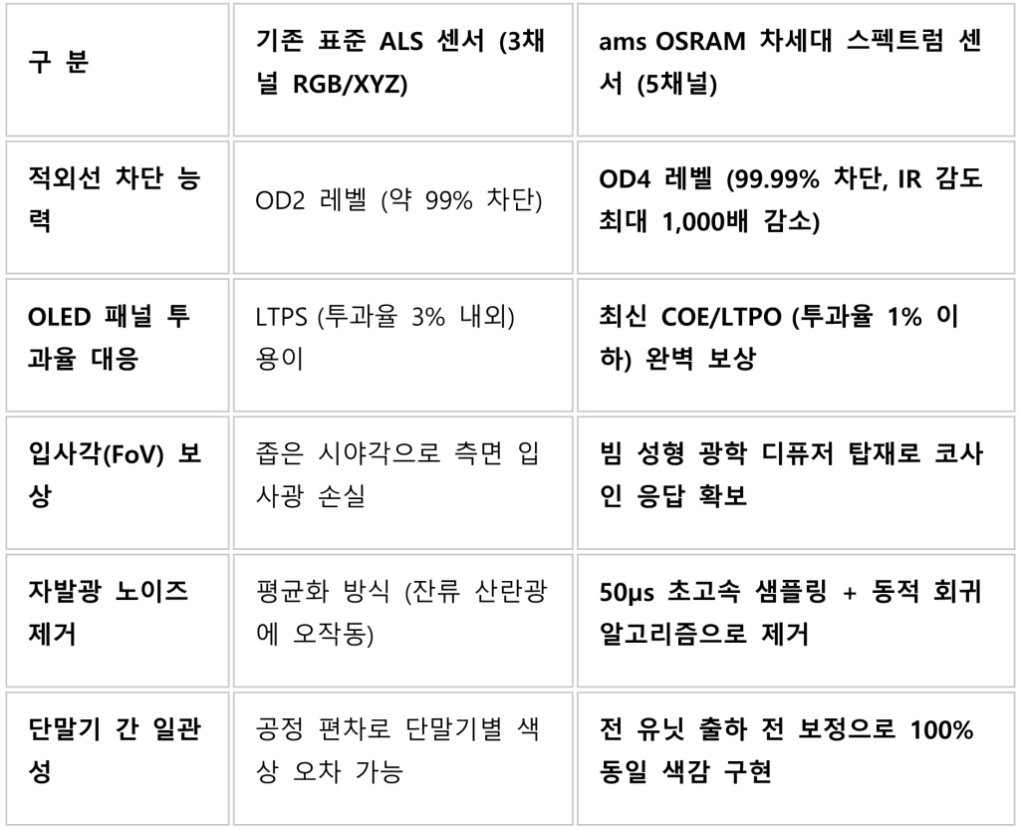
This advanced OLED structure significantly lowers visible light transmittance. While first-generation LTPS OLED transmittance was approximately 3%, the latest COE OLED panel transmittance is less than 1%. As a result, the ALS sensor mounted behind the display must analyze color temperature and brightness using only extremely weak light signals—100 to as much as 1,000 times weaker than the light actually reaching the eyes of smartphone users—creating a harsh environment.
2) OLED panel self-emission and residual back-scattered light interference (crosstalk)
Unlike human eyes that only detect the visible light wavelength region, the silicon photodiode that forms the basis of sensors is highly sensitive to near-infrared wavelengths. When infrared light emitted from intense sunlight, indoor ToF sensors, or facial recognition IR illumination enters the sensor, it causes fatal malfunction as the sensor mistakes it for visible light brightness and judges that light of much higher intensity than actual is entering.
ams OSRAM applied hybrid silver filter technology combining a special silver (Ag) coating layer on top of the existing precision interference filter. While the infrared blocking capability of existing sensors remained at OD2 level (reduction in two digits from maximum intensity), the next-generation ALS with hybrid silver filter achieved OD4 level in infrared wavelengths (reduction in four digits from maximum intensity, i.e., 99.99% blocking). Additionally, this technology dramatically reduces unwanted near-infrared sensitivity by 10 to 1,000 times compared to existing products, collecting only pure visible light spectrum values that precisely match the human visual response curve even in environments with severe infrared noise.
2) Sensing field of view compensation through beam-shaping optics
The narrow micro-hole structure of the COE OLED panel circuits causes extreme transmittance variance depending on incident angle, particularly in specific wavelengths, especially red wavelengths and near-infrared regions. Blue wavelengths below 450nm are almost absorbed by the panel, while red wavelengths vary significantly with angle.
ams OSRAM integrated advanced beam-shaping diffuser optics at the top of the sensor package. This diffuser technology refracts light entering diagonally from the sides and focuses it toward the vertical direction of the sensor. Through this, it compensates for the field-of-view constraints inherent in the display's aperture and successfully secures an effective field of view (FoV) and dynamic range (DR) close to the cosine function, which is the ideal incident angle response characteristic in the optical field.
3) Ultra-high-speed sampling and back-scattered light (crosstalk) dynamic removal algorithm
To avoid OLED panel self-emission interference, the latest smartphone systems use a synchronization technique that operates the ALS sensor only during extremely short 'blanking (off) intervals' of dozens of microseconds (㎲) that exist between display frames.
However, display pixel emissive materials have residual decay time during which light gradually decreases over hundreds of microseconds even after power is turned off. Therefore, residual back-scattered light from the display partially reaches the sensor even during the blanking interval.
Through proprietary photodiode and integrator design, ams OSRAM built a high-sensitivity front-end that accurately captures ambient light at ultra-high speed of 50㎲ (microseconds) or below. This is integrated with the following two-stage algorithm compensation technology:
o System calibration: System calibration to characterize how back-scattered light emission decreases in a specific OLED display design
o Dynamic compensation adjustment: Dynamic compensation considering the content displayed on the display prior to each blanking interval during display operation
4) Quality consistency assurance through factory calibration
All optical components and photodiodes inevitably have subtle physical and optical performance differences between products due to manufacturing process errors. If an uncalibrated sensor is applied, a quality mismatch phenomenon can occur where two identical premium smartphones of the same model are placed under identical lighting conditions, yet one screen appears yellow while the other appears blue.
ams OSRAM strictly measures all BOLED ALS products supplied in mass production before shipment and assigns unique calibration parameters to each unit. Display manufacturers utilize this calibration data to offset fine variations for each terminal, ensuring that all produced terminals maintain 100% identical high-quality color reproduction.
The hardware and functional characteristics provided by ams OSRAM's next-generation spectrum sensor in the BOLED environment can be summarized in the table below.
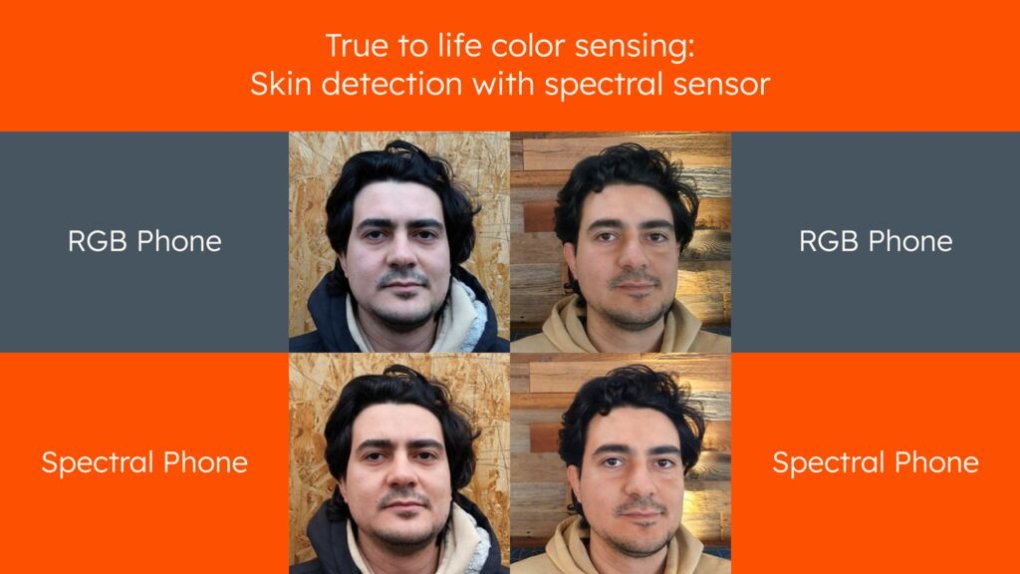
■ Spectrum Sensing Technology Determining the Success of Premium Smartphones
The behind-OLED mounting environment represents the harshest and most extreme optical conditions for ambient light sensors to date. Sub-1% minimal transmittance, back-scattered light interference from the panel itself, field-of-view limitations due to micro-holes, and measurement errors from infrared radiation were major barriers preventing automatic white point adjustment of displays.
The next-generation spectrum sensor solution presented by ams OSRAM combines complete infrared noise blocking through hybrid silver filters, field-of-view expansion utilizing beam-shaping technology, panel scattered light elimination through ultra-high-speed sensing and dynamic algorithms, and unit-to-unit quality unification through factory calibration to open a new horizon in precise display control.
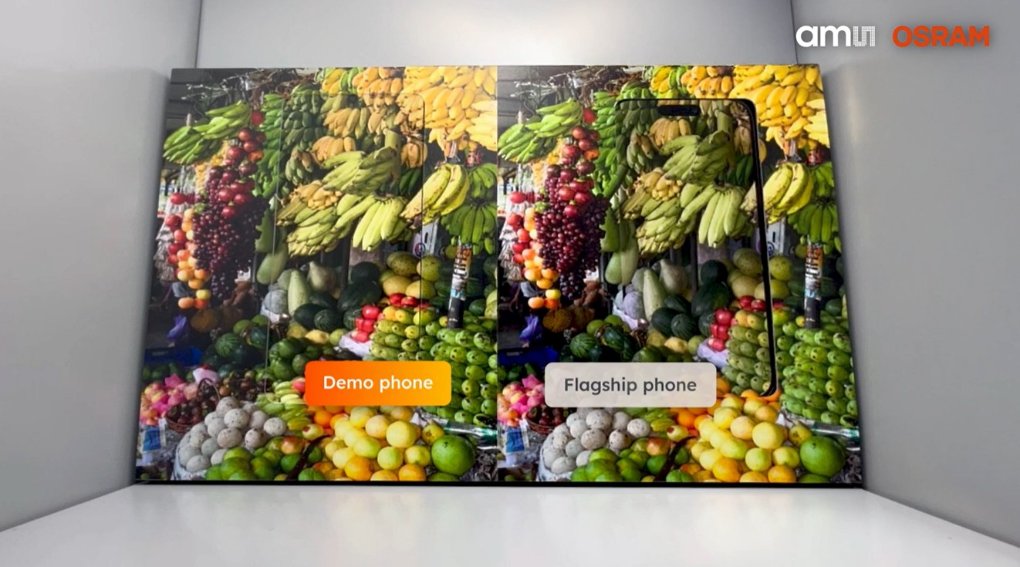
This technological advancement serves as a powerful physical foundation for leading global smartphone manufacturers including Apple's iPhone to provide users with vivid colors identical to real scenes in any environment, minimize eye fatigue, and realize perfect 'glass-to-glass' WYSIWYG color consistency extending from camera to display.
Based on decades of expertise in the optical sensing field and system integration support services, ams OSRAM will continue to innovate so that smartphone manufacturers can draw out 100% of the potential of next-generation OLED displays and achieve successful differentiation in the global premium market.
ams OSRAM's innovative spectrum sensing technology can also be confirmed in the video below.
https://www.youtube.com/watch?v=XJmHTEf036o
Comments
Related news
ams OSRAM to Celebrate 120 Years of OSRAM Brand at 'Light + Building 2026'
ams OSRAM has announced an exhibition featuring the OSRAM brand's 120th anniversary as a major focus at 'Light + Building 2026'. The exhibition will be held from March 8-13, 2026 in Frankfurt am Main, Germany, with the booth located at Hall 8.0, D40. The company cited the OSRAM trademark registration in 1906 as the benchmark for the 120th anniversary, and announced it will showcase solutions for smart buildings and infrastructure that combine lighting and sensors.
2026.03.05by 명세환 기자

ams OSRAM lighting solutions applied to new Audi Q3 headlights
ams OSRAM's high-resolution pixel-based lighting solution EVIYOS HD25 has been applied to the digital matrix LED headlights of the new Audi Q3. With this implementation, lighting functions linked to driver assistance features such as lane guidance, directional guidance, blind spot warning, lane departure indication, and icing warning have been realized in compact-class vehicles. EVIYOS HD25 is based on more than 25,000 individually controlled pixels and adjusts the light distribution pattern according to vehicle motion, sensor input, and changes in the surrounding environment.
2026.06.01by 배종인 기자
ams OSRAM Targets AI Data Center Optical Interconnects with Automotive MicroLED Technology
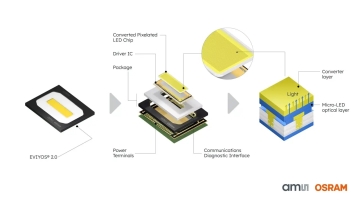
ams OSRAM is expanding its EVIYOS microLED technology, which has been applied to automotive headlamps, into the optical interconnect field for AI data centers. As generative AI proliferation drives a sharp increase in data transmission volumes and power consumption within data centers, the company has proposed a 'Slow-and-Wide' architecture leveraging hundreds to thousands of parallel microLED optical channels. The strategy aims to address the power, thermal, and EMI limitations of conventional copper-based interconnects and expand its footprint in the low-power, high-bandwidth data transmission solutions market for AI infrastructure.
2026.06.10by 명세환 기자

ams OSRAM Launches SFH 7019 Multi-chip LED Integrating Three Light Sources
ams OSRAM launched the multichip LED 'SFH 7019' on June 22, integrating three light sources—UV-A (383nm), green light (530nm), and infrared (980nm)—into a single 1.65×2.15×0.6mm package. In addition to heart rate measurement and PPG, it incorporates a light source for non-invasive assessment of advanced glycation end products (AGE) in tissue through skin autofluorescence. The dedicated photodiode SFH 2705U simultaneously detects autofluorescence and PPG signals, with individual chip control minimizing interference. The company targets this product for wearables, home care, and preventive healthcare applications for analyzing long-term physiological burden.
2026.06.22by 배종인 기자

Samsung Electronics Supplies Customized HVAC Solutions to 100 Mosques in Saudi Arabia
Samsung Electronics is supplying customized HVAC solutions to 100 mosques across eight cities in Saudi Arabia. The company will install approximately 1,000 units of the ceiling-type system air conditioner '360 Cassette', which provides uniform cooling in open high-ceiling spaces through booster fan technology. The solution features Islamic traditional pattern design and is engineered to withstand high-temperature climates exceeding 50℃. This supply demonstrates Samsung's competitive edge in customized HVAC solutions that reflect local culture and environmental conditions.
2026.07.20by 배종인 기자











