

[IFA 2026 ②]AI was the same, but strategies differed…Samsung and LG's winning moves diverged at IFA 2026
 Published2026.09.14 13:37
Samsung expands 'AI lifestyle,' LG targets Europe with 'B2B AI Home'
Beyond functional competition, energy efficiency and space utilization…two solutions targeting Europe
At IFA 2026 held in Berlin, Germany, Samsung Electronics and LG Electronics discussed the same AI but approached the market in completely different ways. While Chinese companies occupied nearly half of the exhibition space with volume and technology offensives, the two domestic companies shifted their focus from simple product competition to AI ecosystem building, energy efficiency, and space design competition. In particular, both companies presented a future where AI manages users' daily lives on their behalf, but Samsung Electronics differentiated itself with a consumer experience and content-focused strategy, while LG Electronics led with a B2B and platform-focused strategy.
The most distinctive feature of Samsung Electronics at this IFA was how it operated its exhibition space.
Market observers noted that Samsung Electronics operated outside the Messe Berlin exhibition hall in a separate space, but in reality, it operated two exhibition spaces in parallel.
Samsung Electronics set up an exclusive exhibition hall at Humboldt Carré and operated it from September 2 to 6, and held the 'Samsung Creator Hub' at Messe Berlin IFA Palais from September 4 to 8.
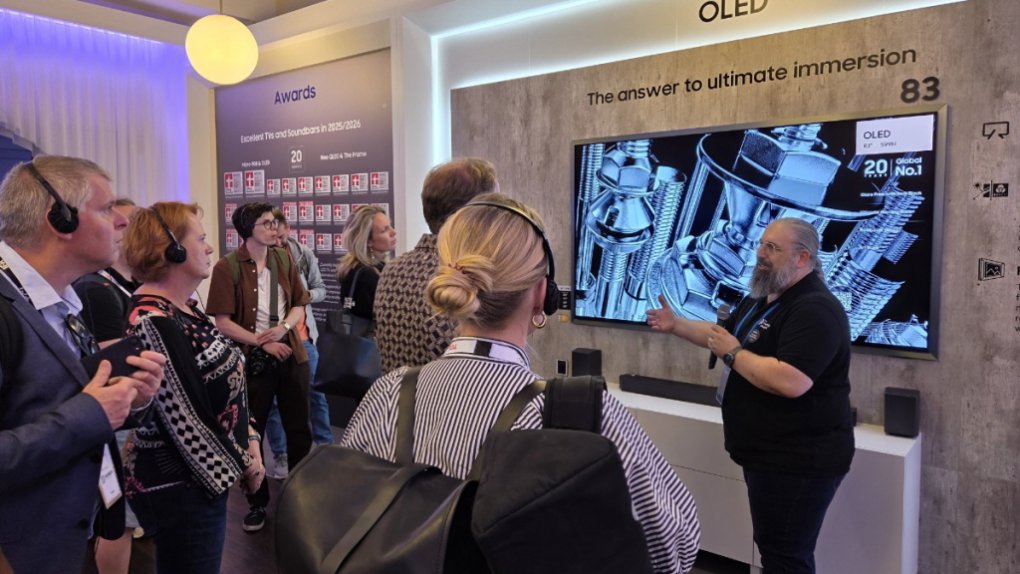
During the media days, it delivered strategic messages to distributors, journalists, and B2B customers, and during the main event, it adopted a dual strategy of presenting experiential content aimed at creators and general visitors.
The key pillar Samsung Electronics put forward was 'AI Companion.' The exhibition, composed of three areas—entertainment, home, and care—demonstrated a structure where AI connects TVs, home appliances, and mobile devices to support decision-making throughout daily life.
In particular, the fact that Samsung TV Plus's monthly active users (MAU) surpassed 100 million is a symbolic indicator showing that home appliance companies are evolving beyond hardware into media platform operators.
In terms of products, efficiency and convenience in daily life were emphasized.
The Bespoke AI washer achieved 70% additional savings compared to the A-grade energy efficiency class, the highest European standard, and the built-in dishwasher presented 20% additional savings performance.
Furthermore, the Family Hub refrigerator equipped with an 'AI Vision' camera recognizes food ingredients and serves as a smart home hub that comprehensively manages energy consumption.
The technology that particularly caught industry attention was 'AI Hybrid Cooling.'
This approach combines a thermoelectric element based on Peltier semiconductor technology with the existing compressor cooling system to optimize cooling performance depending on the situation.
This demonstrates that the expansion of AI appliances can create new component supply chain demand beyond simple software competition.
LG Electronics chose the opposite strategy.
It maintained a large-scale exhibition hall of 3,745㎡ within Messe Berlin, but configured approximately 46% of the entire space as a dedicated consultation area for business partners.
Converted to area, this amounts to approximately 1,723㎡. It focused on business expansion targeting construction companies, distributors, and commercial customers rather than general consumers.
LG reorganized AI Home into a three-stage structure of products, space, and services.
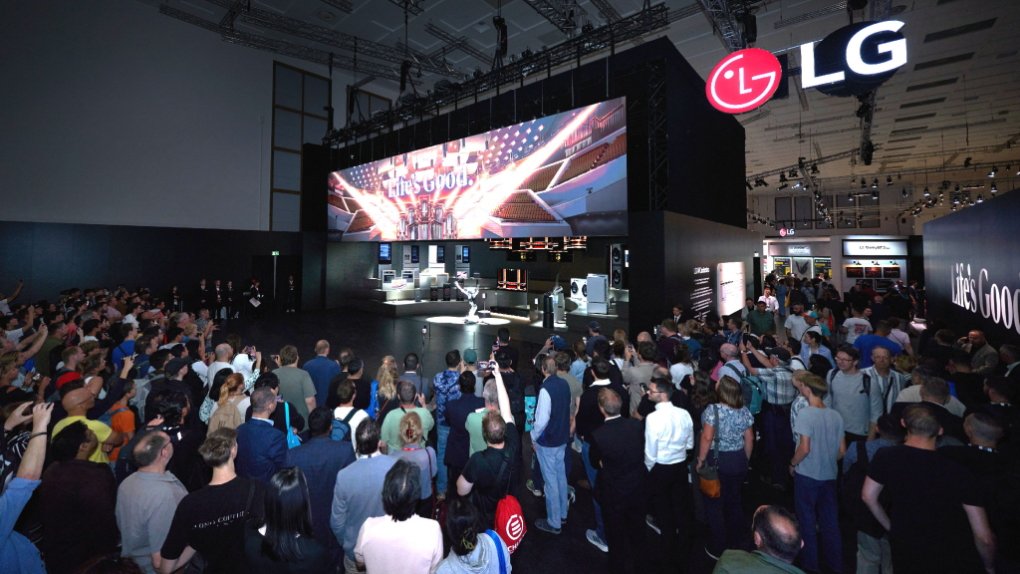
It built an ecosystem centered on AI appliances, AI Home hub 'ThinQ ON,' and AI Home platform 'ThinQ,' and unveiled for the first time at this event the autonomous AI agent 'ThinQ Claw.'
Its characteristic is that it learns users' lifestyle patterns and proactively proposes and executes necessary features.
It emphasized an AI agent-centered smart home experience, such as adjusting heating and cooling to match arrival times or recommending meal plans by analyzing schedules and eating habits.
The area LG particularly focused on was B2B expansion.
It put 'ThinQ Pro,' targeting commercial spaces, and home energy management systems (HEMS) to the forefront.
Based on the platform of Athom, acquired in 2024, the strategy is to connect over 50,000 IoT devices and comprehensively manage energy flow.
This is interpreted as a move to expand influence beyond AI appliance competition into smart building and energy management markets.
In terms of energy efficiency, LG presented more aggressive figures.
The washer achieved 70% additional savings compared to A-grade, the same as Samsung, but the dishwasher presented 30% additional savings performance and the refrigerator 35% additional savings performance.
It also revealed a strategy to respond to strengthening energy regulations in the European market by expanding the highest-tier technology, previously applied only to premium products, to general product lines.
Ultimately, what Samsung and LG demonstrated at IFA 2026 had in common was not 'AI' but 'lifestyle optimization.'
By moving away from product specification competition and focusing on energy cost reduction, space efficiency, and AI-based life automation, the direction was the same.
However, while Samsung Electronics concentrated on building a personal-centered AI ecosystem connecting mobile devices and home appliances, LG Electronics placed greater emphasis on platform and B2B market expansion, showing a difference.
In a situation where Chinese companies are expanding their presence through large-scale exhibitions and aggressive technology disclosures, Samsung and LG chose technology completion and platform competitiveness instead of scale competition.
IFA 2026 was a stage that revealed the difference in philosophy between the two companies in viewing the AI era, and a venue that demonstrated that the global home appliance industry is shifting from product-centered competition to service and ecosystem competition.
Comments
Related news
IFA 2026 to be Held on September 4, Demonstrating Its Status as a Platform for Innovation Exchange in the Electronics Industry
The IFA Berlin (Internationale Funkausstellung Berlin), the world's largest home and consumer technology trade fair, has further solidified its position as a platform for global innovation exchange by reaffirming its close collaborative relationship with Korean technology partners in Seoul. Leif Lindner, CEO of IFA Management GmbH, the organizer of IFA, held a press conference on the 2nd at the Conrad Seoul and unveiled new directions and vision ahead of the 2026 IFA event. CEO Leif Lindner stated that the 2026 IFA event will position innovation, sustainability, and global networking as core values and plans to strengthen its role as a bridge connecting Asia and Europe.
2025.12.02by 명세환 기자

Lenovo Announces Global Partnership with David Beckham
Lenovo announced on April 1st that it has established a global partnership with David Beckham. This collaboration is understood as an extension of Lenovo's strategy to expand the application of AI-based solutions in sports venues, aligned with its activities as the official technology partner of the FIFA World Cup. Both parties plan to cooperate in various fields including performance enhancement, fan experience improvement, and operational efficiency. Based on his sports field experience and perspective as a businessman, Beckham will also take on the role of demonstrating how AI technology can bring changes to work methods and decision-making for individual users as well as enterprises. Lenovo announced that Beckham is expected to participate in future global marketing campaigns.
2026.04.01by 명세환 기자

Lenovo wages all-out AI brand war featuring Beckham… Expanding consumer reach on the FIFA World Cup stage
Lenovo unveiled a global campaign "Maximum David" featuring David Beckham. Launched ahead of the 2026 FIFA World Cup opening, the campaign focuses on connecting Lenovo's AI-based device and service portfolio with the sports, creative, and business sectors. Lenovo revealed a strategy to expand AI brand awareness by combining its FIFA official technology partnership with Beckham's global influence. Analysts note that the campaign also reflects the competitive trend in the global IT industry for transformation beyond a simple PC manufacturer into an end-to-end AI company.
2026.05.18by 명세환 기자
SanDisk Unveils Large Number of New Consumer Storage Products
SanDisk held a press briefing on the 19th to introduce new product lineups for portable SSDs, announce a rebrand of its internal SSD offerings, and unveil official FIFA World Cup 2026 licensed products.
2026.05.19by 배종인 기자

IFA 2026 Expands Programs to AI Lifestyle and Smart Home
IFA Berlin announced on June 20th the strategic direction and additional programs for 'IFA 2026', reinforcing its role as a gateway for Korean brands to enter the European market. The program will be expanded to include AI-based lifestyle, next-generation smart home, digital health, and content creation, while the visitor base will be broadened to encompass distribution, retail, gaming, and logistics. During the exhibition period, the historic ICC Berlin will be specially opened for one day, and based on the Korea-EU Digital Trade Agreement, support will be provided for Korean companies' market entry into Europe and distribution partnerships.
2026.06.20by 명세환 기자