



Smart Grid Expansion Roots New Energy Industry Nationwide!
 Published2015.12.24 15:49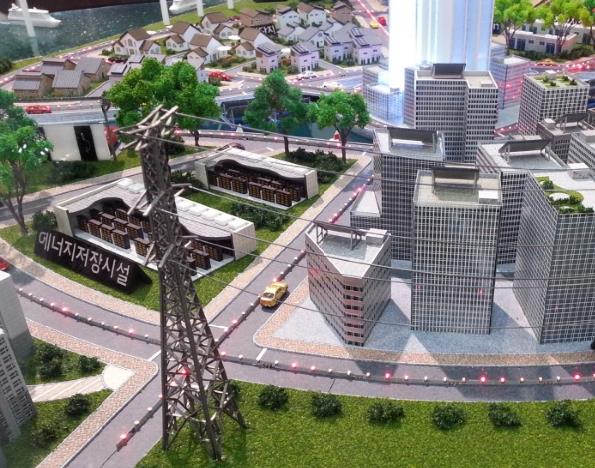
The Ministry of Trade, Industry and Energy signed a business agreement to strengthen continuous cooperation among stakeholders participating in the 'Smart Grid Expansion Project' to be launched in earnest from next year, with the attendance of 8 consortium lead organizations, 13 local governments, and related agencies.
Smart Grid, which enables the creation of diverse convergence business models through the combination of energy and ICT, is receiving significant emphasis as a core platform for the four major fields of the new energy industry (energy prosumers, low-carbon power generation, electric vehicles, and eco-friendly processes).
The new energy industry is one of the 24 key state affairs reform tasks this year. Particularly through the keynote speech at the Paris Climate Change Conference of the Parties (COP21), President Park Geun-hye presented the new energy industry strategy as a means for greenhouse gas reduction and introduced concrete policies, drawing attention as a new alternative for our industry.
With the adoption of the Paris Agreement, where all nations have obligations to reduce greenhouse gases, a massive transition of the existing energy system is accelerating and the new energy industry is expected to grow rapidly.
Accordingly, the market size related to Smart Grid, which is the foundation of the new energy industry, will continue to expand, and global competition to secure future growth momentum will intensify.
In proactive response to these changes, the Smart Grid Expansion Project to be launched in earnest from next year across 13 regions nationwide has been prepared to implement in real-world environments (residential areas, industrial complexes, commercial districts, etc.) business models capable of generating profits that have been verified through various pilot and demonstration projects including Jeju Island.
The project will deploy infrastructure in the business areas and establish Smart Grid models tailored to regional characteristics based on residents' needs to provide various power services that can maximize energy use and supply efficiency while maximizing consumer benefits. For example, analyzing power consumption patterns in houses, buildings, shops, and factories, and incorporating ICT-based energy management solutions to encourage efficient power consumption, or utilizing distributed power sources such as solar and ESS to use self-produced power together with power supplied from the existing power grid during high-price hours, with plans to reduce power consumption by 5-10%.
Government and Private Sector Joint Construction of 13 Hub Sites
Activate Energy Prosumers by 2030
First, the government and private sector will jointly establish hubs centered on 13 regions ('16-'18), expand nationwide led by the private sector ('19-'25), and plan to activate energy prosumers by '30 and secure a consumer-customized power supply system.
At this event, the Ministry of Trade, Industry and Energy, 8 consortium lead organizations, and the Korea Smart Grid Business Unit agreed to create a Smart Grid ecosystem across the nation based on the successful implementation of this project.
In addition, the local governments targeted by the project also agreed to provide administrative and financial support, including enhancing local residents' acceptance, to actively support the smooth project implementation of each consortium.
Following the business agreement, Vice Minister Moon Jae-do of the Ministry of Trade, Industry and Energy presided over a session to listen to difficulties hindering project implementation and seek solutions through various opinion gathering. During the discussion process, the Ministry of Trade, Industry and Energy, participating companies, and local governments recognized the need for regular sessions to check project implementation status and discuss development plans, and decided to establish and operate the 'Smart Grid Expansion Policy Consultation Council.'
Vice Minister Moon Jae-do emphasized the importance through opening remarks, stating "Smart Grid is the connecting link that runs through all four major fields of the new energy industry—energy prosumers, low-carbon power generation, electric vehicles, and eco-friendly processes," and said "I hope that consortium lead organizations will secure global competitiveness through bolder investment so that Smart Grid can become our new growth engine, and I request that local governments serve as a bridge between residents and companies unfamiliar with Smart Grid, playing a leading role in establishing Smart Grid in residents' daily lives."
Furthermore, the government announced that it will make an all-out effort to enable early construction of Smart Grid and flowering of the new energy industry through institutional improvements to achieve new market creation, such as opening an energy prosumer market where small-scale or excess power can be sold and expanding the application of differentiated rates by season and time period.
Going forward, detailed project plans by consortium will be finalized by January of next year, and in the first half, project briefing sessions and major infrastructure deployment targeting customers and local residents are planned.
Related news
Nvidia invests $5 billion in Intel
NVIDIA and Intel, leaders in global AI computing technology, are now forging ahead in providing cutting-edge solutions through NVLink-based architecture integration. NVIDIA and Intel have officially announced a strategic partnership and stated that they will jointly develop customized data center and personal computing products to accelerate diverse applications and workloads ranging from hyperscale to enterprise and consumer markets, thereby laying the foundation for the next generation computing era.
2025.09.22by 배종인 기자
.jpg)
Applied Materials Launches Environmental Protection Campaign to Mark World Cleanup Day
Applied Materials Korea (CEO Park Kwang-seon) is carrying out environmental cleanup activities with employees and their families around the Dongtan Sinricheon area on the occasion of World Cleanup Day, evolving into a company that engages with the local community beyond technological innovation.
2025.09.22by 명세환 기자
.jpg)
The combination of electrical and electronic technologies like AI, semiconductors, and electric vehicles with renewable energy will determine industrial competitiveness.
Professor Lim Chun-taek from Gwangju Institute of Science and Technology (GIST) stated in his keynote speech at the '2025 e4ds Tech Day' on the 9th, "Global energy investment is already shifting from fossil fuels to renewable energy, and the trend of electrification combined with electrical and electronic technologies is changing the industrial landscape."
2025.09.12by 배종인 기자
.jpg)
"Data Center Power Demand Surges: Distributed Energy is the Solution"
The power demand of data centers is surging rapidly alongside the accelerating growth of artificial intelligence (AI), cloud, and electric vehicle industries. In particular, the global power supply and demand structure centered on the United States is undertaking a massive infrastructure reorganization to adapt to this change, and Korea is no exception in this trend. As an alternative to overcome the limitations of the existing centralized power system, distributed energy systems and smart grid technologies are gaining attention.
2025.09.02by 배종인 기자
Huawei Begins Full-Scale Training of Young Korean Global ICT Leaders
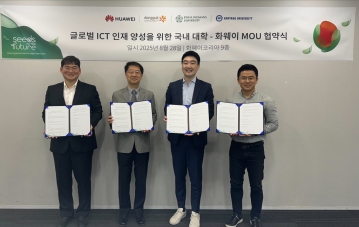
Global ICT company Huawei Korea has signed a Memorandum of Understanding (MOU) with Dongguk University, Ewha Womans University, and Hanyang University, and will jointly implement a global education program to nurture next-generation ICT leaders.
2025.08.29by 배종인 기자











