

.png)

[Interview 1] "Is the next innovation in smartphones the camera? Then pay attention to LED communication technology"
 Published2016.01.18 12:53
LED expands beyond the role of 'illumination' to art and communication fields
LED-ID: transmission and reception functions through patterns of light
What comes to mind when you think of LED? Certainly, brightly colored light. And rightfully so—across from Seoul Station, Seoul Square features a spectacular display of light each night, with the building serving as a sketchbook for moving media art made possible by numerous LED lights attached to the building's exterior wall. This is commonly called 'LED facade'.
When LED first appeared, it gained attention for its clear brightness, but failed to become commonplace due to prices more than 10 times higher than conventional incandescent and fluorescent lighting. However, LED is expected to see price reductions as shipment volumes exceed demand thanks to its long average lifespan of 22 years. In line with this, market research firm HIS predicts that LED will expand to 39% by 2023.
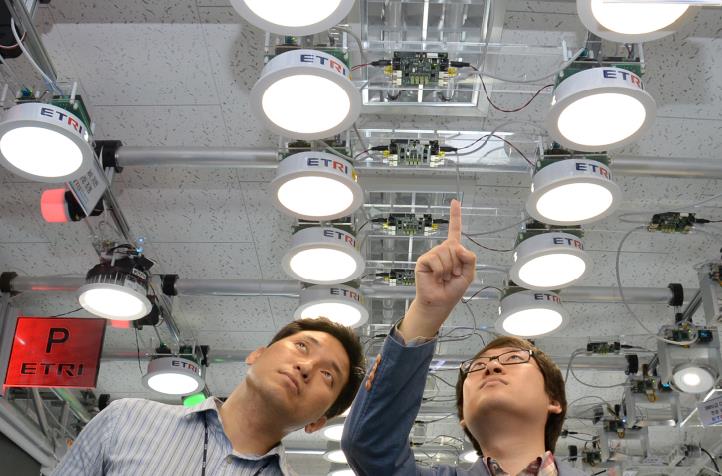
▲ETRI (Electronics and Telecommunications Research Institute) announced last May that it successfully developed visible light communication (VLC) networking technology that enables information transmission through LED light.
Now, in the IoT era, LEDs connected through communication have evolved into 'smart lighting'. The brightness and color of light can be controlled based on human presence or interior ambiance, and it is also effective in reducing energy consumption in large buildings.
Along with smart lighting, LED communication technology is advancing rapidly. In 2011, under the leadership of Samsung Electronics and ETRI, standardization of visible light communication was achieved. In particular, LED-ID is a technology that enables transmission and reception of unique information through LED display-based screens and smart cameras. We met with Professor Young-min Jang from Kookmin University (photo), who is proceeding with standardization, to hear in detail about the progress of LED communication technology. <Interview content (Part 1) will be released on the 18th, and (Part 2) on the 29th, for a total of 2 installments.>
Beginning with a Taiwan professor,
Visible light communication developed through a Japanese professor
- You call LED communication 'LED-ID'—what specifically is it?
It is a new communication technology that transmits unique identification information about an object using LED (Light Emitting Diode) light sources. By blinking visible light from LEDs at speeds imperceptible to the human eye to exchange data, it enables data communication anywhere there is LED lighting.
A Taiwan professor first published a paper on this in 1999. Visible light communication (VLC) is a technology that transmits information using the wavelength of visible light, but research was temporarily halted due to the disadvantage of shorter transmission distance compared to radio waves. Research resumed in the early 2000s by Professor Nakagawa's team at Keio University in Japan.
 - So you combined LED with visible light wireless communication (VLC)?
Yes. Afterwards, while visible light communication uses only visible light, LED communication utilizes all LED light sources including visible light, infrared, and ultraviolet. LED-ID technology can utilize light sources generated from various LEDs such as infrared and ultraviolet in addition to visible light, but generally visible light, which is perceivable by the human eye, has the highest frequency of use, so I believe display-based communication applications will increase.
- What are the advantages of LED-ID compared to existing RF-ID?
LED-ID does not require new frequency authorization unlike existing RF wireless technology. It has the advantage of no frequency interference from existing RF and the ability to use the wide spectrum of LED light, enabling high-speed multimedia data transmission.
No frequency authorization needed like existing communication,
High-speed data transmission possible through wide spectrum use of LED
- With high-speed data transmission, how much faster is it compared to existing wireless communication?
It boasts 100 times the speed of Wi-Fi. This is called Li-Fi, first proposed by Professor Harald Haas in 2011, which is a wireless network technology that transmits ultra-high-speed data using visible light. Li-Fi, based on visible light wireless communication (VLC), can transmit up to 1GB of data per second.
One of the advantages of Li-Fi is that LED bulbs usable as infrastructure are readily available in our surroundings. Wi-Fi, which transmits data using radio waves, requires radio towers and base stations to transmit radio waves. However, LEDs are everywhere around us, are they not? Furthermore, with the recent trend of replacing all fluorescent and incandescent lights with LED lights, it will not be difficult for ordinary households to use high-speed communication.
- Base stations are not needed? Could you provide a more detailed explanation of Li-Fi?
In an Italian paper, there is a concept called Atto-cell. I similarly conducted research on small-cells in 2007, which is used in studios. In this space alone, there are 16 lights, and we create 16 cells. Cells are created according to the number of lights in a space. The more cells there are, the more information can be exchanged. Various devices can accurately grasp sensed information and location information.
- Currently Wi-Fi shows security vulnerabilities, but is there any security problem with Li-Fi?
It has the advantage of being applicable to point-to-point or point-to-multipoint communication with superior physical security, indoor LBS (Location Based Service), and information broadcast. However, domestically and internationally, research is still in its early stages, and many technologies need to be developed. Nevertheless, with the growth of the LED lighting market, if IT technology is incorporated in development and standardization efforts are intensified, we can expect to create high value-added technologies through securing technological leadership in related fields in the future.
Completed VLC standardization in 2011, but commercialization delayed
Focusing on communication systems utilizing display infrastructure and smart cameras
- What is the current status of LED communication technology in Korea and the progress of standardization?

The visible light communication (VLC) system using LED lighting as a transmitter was led by Samsung Electronics and ETRI to complete IEEE 802.15.7 standards in November 2011. Subsequently, R&D and standardization proceeded, but commercialization was difficult due to the need for additional hardware modifications or use of VLC dongles (PD-photodiode) to commercialize VLC systems based on smart devices like smartphones.
To solve this, IEEE 802.15 IG-LED was operated from May 2012, and since January last year, IEEE 802.15.7a OCC (Optical Camera Communications) study group has been in progress. This standardization focused mainly on systems that use smart device cameras (image sensors) to receive signals and patterns from LED screens, LED displays, LED digital signage, or LED lighting, rather than IEEE 802.15.7 which deals with photodetectors (PD).
With final approval from IEEE 802 EC in December last year, the OWC task group (TG) officially began operations from the IEEE 802.15 interim meeting held in January 2015. This OWC TG will focus primarily on OCC technology and plans to standardize additional LED-ID and Li-Fi-based high-speed OWC technology.
- Could you provide additional explanation on OCC and cite application examples?
OCC (Optical Camera Communications) is an image processing-based communication technology that uses camera image sensors installed in smart devices to receive data for data reception. In other words, with OCC, data reception is possible simply by setting the camera to video mode and focusing on LED lighting or a display.
In addition to LED lighting, any LED-based advertisement board, screen, digital signage, or display can be utilized for OCC as long as light or patterns can be transmitted. For digital signage operators, they can provide various information with just one advertisement board and provide D2D services like display-camera or screen-camera. Additionally, LED-ID and Li-Fi technology are also planned to be included in standardization.
- OCC is still in the development phase—how do you expect it to progress in the future?
The ultimate goal is to standardize a wireless interface that supports data transmission between modulated light and image sensors. Abroad, various OCC technologies have already been proposed and active research is underway at the corporate and university level.
Japanese Casio has even developed an iPhone application that detects light waveforms using the camera's image sensor. This app works by having the receiving iPhone camera detect modulated light signals of various colors emanating from another iPhone's screen to receive data. One example is coupon information embedded in a department store sign across the street. Download the app and take a picture of the sign, and coupon information appears in real time.
OCC (Optical Camera Communications) could bring
innovation to the currently slow-growth smartphone market
- I'm curious why you are paying attention to OCC incorporating LED communication.
As often reported in the media, 'there is no innovation in smartphones.' Still, there is a forecast that the next innovation in smartphones will be the camera. Communication is now very fast and can transmit large volumes of data. Of course it's convenient and good, but people feel it's sufficient.
The issues in mobile communication are LTE and 5G, 6G, but there is short-range communication like Bluetooth, Wi-Fi, and NFC. Beyond that, there is five-senses communication in mobile devices like vision and hearing. When this connects with IoT, the core of communication will be the screen. Using OCC technology, communication will occur through cameras and screens. Haven't companies consistently focused on innovating large screens and camera functions?
- With large screens and cameras, which are fundamental features of smartphones, commercialization seems like it will happen quickly.
Until now, companies have only been interested in LTE, but when camera functions connect with communication, they will inevitably show interest as an innovative technology. When this is standardized, couldn't we advance to OWC QR codes similar to QR codes or color QR codes? That's why I understand that companies like Intel, Panasonic, and China Telecom currently show much interest.
====================================================
The remaining interview content will be uploaded on the 29th.
Related news


Infineon Provides Digital Platform for Managing Eco-friendly LED Technology
Infineon announced on October 21 that it will provide the dp digital power 2.0™ platform. dp digital power 2.0 is a digital platform for power supply that intelligently controls LED lighting systems to achieve maximum energy savings.
2015.10.22by

Solar Science Enters IoT-Based LED Smart Lighting Business
LED lighting specialist SollaScience has entered the IoT smart lighting business, recently completing the supply and installation of LED smart lighting with IoT-based wireless power-saving technology at an underground passage of a highway toll gate.
2015.12.24by
Ecolab and K-water Discuss Innovation Collaboration in Advanced Industry Water Management
Ecolab and the Korea Water Resources Corporation jointly discussed cooperation directions for maximizing water use efficiency in advanced industries such as semiconductors and data centers and establishing sustainable water circulation. The two companies agreed to gradually develop a long-term cooperation model that combines water resource infrastructure and water management technology to promote water efficiency optimization, water reuse, and carbon reduction.
2026.08.28by 명세환 기자

H.Energy Obtains Green Technology Certification…SolarOnCare Operating at 99.82% Uptime
H.Energy has obtained green technology certification from the Small and Medium Business Administration for solar power generation forecasting and I-V curve anomaly diagnosis technology. The AI-based asset management platform SolarOnCare is deployed across more than 3,000 power plants nationwide, achieving a system uptime of 99.82% and a 3.7% improvement in power generation performance. Through real-time data analysis, it protects power generation revenue by detecting and managing minor losses such as module degradation and partial shading early on.
2026.08.25by 명세환 기자











